

Giacomo Balla, Dynamic expansion + speed no. 9Around 1913, oil on paper over canvas, 107.2 x 64 cm, Rome, National Gallery of Modern and Contemporary Art © Giacomo Balla, by Siae 2025
A travel schedule entitled from 10 October to 1 February Giacomo Balla, a universe of lightWill bring all the works of the great artist together that is kept for the first time in the Museum of the capital from the Roman headquarters. A loan of more than 60 works, from the most complete public collection of Giacomo Balla’s research path, never exposed in its entirety.
At the “Leonardo da Vinci of the Twentieth Century” – As the Turin Artist Loved to Define himself – The Municipality of Parmy and the National Gallery of Modern and Contemporary Art Dedicate a Journey By Cesare Biasini With Collabi and Renata Crista Crista Gigli, which make use of the contribution of the cariparma foundation and the Emilia Romagna Region and the Collaboration of the Basis of Art.
The path dedicated to the “Painter of Light”, as Balla was defined in 1908 – if the light a constant source of inspiration, subject and at the same time the subject of a passionate study that pursues throughout his life – will also be an opportunity to present the results of recent studies around the collection to the public. The support point of the exhibition will in particular be the substantial core of works from the generous donation of the daughters, Helix and Balen by the artist, with the enlightened integration of selected paintings and designs, about the indication of the same light dances, by the great scholar Maurizio Fagiolo, with the collaboration of Elena.
Giacomo Balla, the row for the lamb, winter 1942, oil on plywood, 67.2 x 90 cm, Rome, National Gallery of Modern and Contemporary Art © Giacomo Balla, by Siae 2025
To open the route that the spectators will guide through thirteen rooms set up after a thematic and chronological order, it will be In the mirror (1901-1902), a work that makes the sculptor friend Giovanni Prini immortal with his wife, the writer Max Vanzi and Balla himself. “This is my ‘bohème’, I want it at all costs!” Giacomo Puccini is said to have declared this painting. But he dances, although flattering, he preferred that the photo was bought by the Italian state that assigned him to the National Gallery of Modern Art in Rome.
The public of Palazzo del Governatore will stand face to face with the large cycle entitled Of the living. Of the 15 works painted by the artist unveiled in 1968 by Maurizio Fagiolo dell’Arco thanks to a note of Balla, only four canvases that have the last as protagonists and marginalized the new society of the new society of the progress of the early twentieth century, with whom Balla also called the study of the research of the research of the research of the research of the research of the research of the research of the research of the research of the research of the research of the research of the research of the research of the research of the research of the research of the research of the research of the research of the ancola bridge, with the examination of the Balla. Protagon, came as a protagon. One of the most suggestive works Of surviving life to shine CrazyA woman who is immortalized by the artist on the terrace of his home studio to the Parioli on the terrace of his home studio. The upset attitude of the woman, the convulsive gestures, the gaze that wanders without a meta that express the psychological disease with disarming effectiveness, give the image a dramatic charm.
Behind the canvas The sick Instead, we read by car, the label with which Balla described the method to present the four works, as a polyptych and according to a precise follow -up that will be loyal to be presented on the occasion of the preparation in Parma.
The travel schedule of the exhibition will not neglect the relationship between the preparatory designs and the paintings of the artist, a fundamental aspect of his production, as the study for Failure From approximately 1902 (the result of his careful observation of the childish scribbles on the door of a store in Via Veneto in Rome in Rome in Rome for some time) that Enrico Crispolti was identified as a surprising precursor of the lithographs of the Paris walls of 1945 by Jean Dubuffet. Under the sketches of important masterpieces of the futuristic period, one of the two studies of Thechetto rhythms (Also known as The hands of the violinist) finished in the winter of 1912 in Düsseldorf, where Balla had gone to decorate the dining room in the house of his former student, Grethel Löwenstein.
“Now I am also about to finish a study by her husband who plays the violin, but in motion, in different positions and [incorporando] The continuous movements of the bow “ He wrote in the same year in a letter to the family.
Also as part of the stay in Düsseldorf in 1912, one of the precious iride studies (with a self -portrait) is placed, called, after the death of the artist, Iridescent interpenetrationsOne of the highest expressions of Balla’s research, the first example of a geometric abstraction daughter of the optical dynamic dissolution of light.
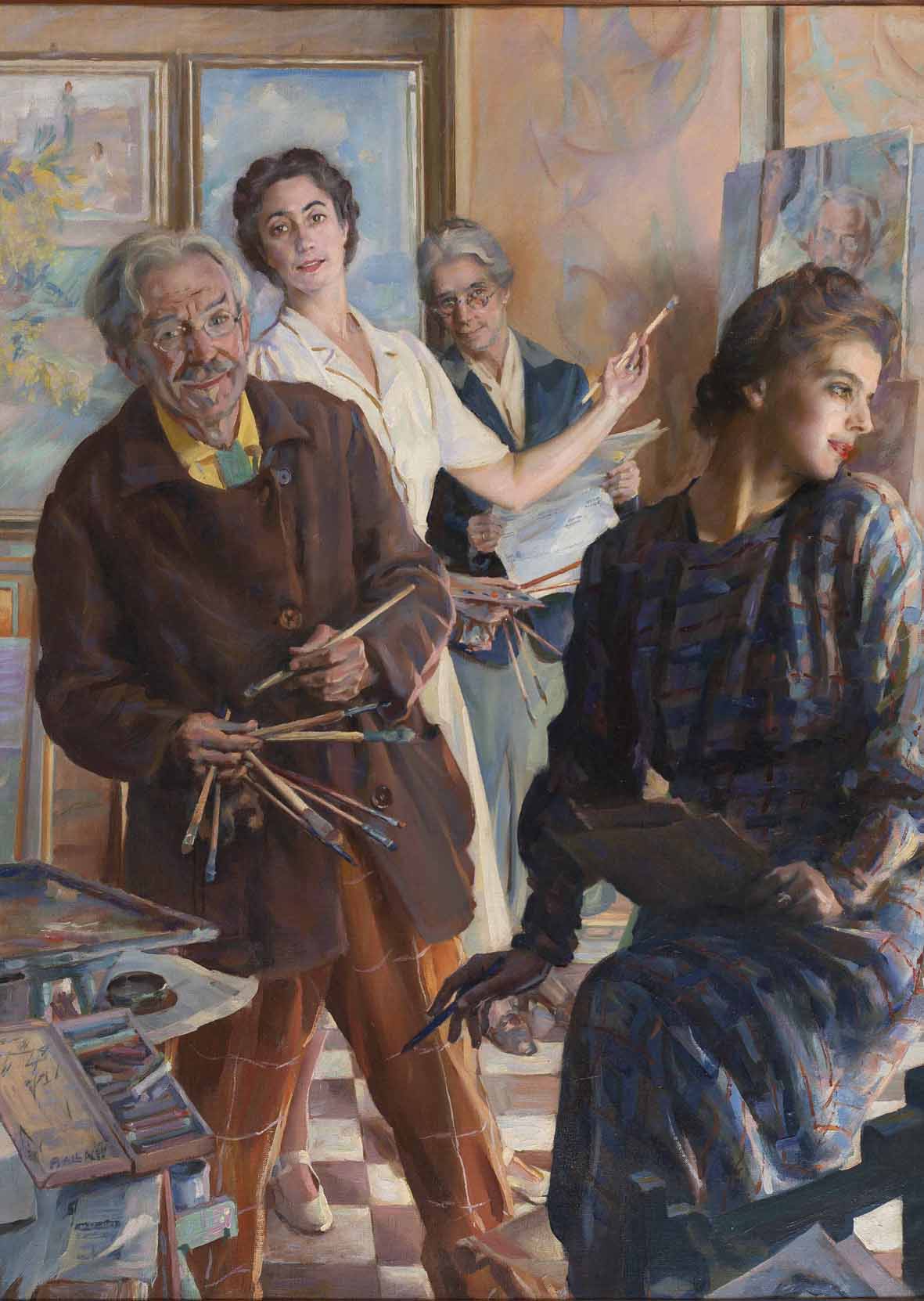
Giacomo Balla, The Painters Family, October 1945, Oil on Canvas, 100.5 x 138 cm, Rome, National Gallery of Modern and Contemporary Art © Giacomo Balla, by Siae 2025
Through the studies of Irides, to use the bean words of the bow, “Balla wants to make the substance of a volatile phenomenon such as the Regenboog, which is a symbol of light”.
Another gem that can be seen is the drawing Speed Line + Space (1913 approx.) That will be exposed to the public again after more than half a century. To the cycle of Interventionist demonstrations From 1915 is one of the impressive painting form of the call of the call “Viva L’Italia” of which it will first be shown to the public, as part of the exhibition, the result of radio analysis performed at the work of the Arsmensurae Company by Stefano Ridolfi. It is possible to identify the shape of a standing woman vertically, while the composition of 1915 has been painted horizontally. The female figure, also visible on the back of the canvas in transparency, was reduced by Elena Gigli to the preparatory studio spent in an auction in 1998 for the portrait that Balla performed to his wife Elisa in 1908, Naked lightof which today is the awareness on paper in a private collection.
The newest sections of the exhibition instead look at the newest figurative production of Balla, still little known to the general public, only recently studied in recent times (especially by Fabio Benzi), which is based on the imagination of fashion and current photography, as well as the cinematographic, as well as the fascination for that universal energy.
The exhibition presents the oil named after the back of the table The row for the Lamb (called Abacchio in Rome), Painted in the winter of 1942 The Fil Rouge is always light, vital juice of the image, from color to shape.
Enriched by photographic, biographical and historical devices from the Gigli archive, the exhibition unfolds from the phase of social and divisistic realism during the season of the futuristic radical avant -garde to land after 1930 into an unprecedented and pioneering figure.
#RomePaparma #Universe #Light #Giacomo #Balla #works #Parma #Arte.it.it