

When a social “expert” shows up on my feed and pointedly tells me that I need to do the Fate of Ophelia choreography during the full moon after every post to go viral, chances are I’m going to slap it.
(If you saw me practice that dance in my last vlog, no, you didn’t.)
However, the fact is that these hacks do not really exist in the truest sense of the word. The quality of your content determines the performance of Instagram posts.
But There are a number of things you can do to give your content a useful boost. Posting at a good time for the platform can help, as can maintaining a consistent posting frequency.
We have data to back up these points – and now I have one more to add to that list of useful boosters.
Replying to comments on your Instagram posts increases engagement. With 21%, no less.
What I find most encouraging about this data is that it validates something that shouldn’t be revolutionary, but somehow feels that way: being truly social on social media works.
Most great social media managers and creators will do this instinctively. And now we have some hard data to support the fact that this really does impact post performance.
According to data scientist Buffer, replying to comments on your Instagram posts can increase engagement by about 21% Julian Winternheimer analysis of more than 700,000 Instagram posts from almost 68,000 accounts.
Julian found that when creators respond to their comments again, their posts perform better compared to their own baseline. This finding is part of a larger study Julian conducted across six major platforms – and Instagram showed one of the strongest effects. (Threads came in at 42%, LinkedIn at 30%, and Instagram at 21%.)
Let’s take a look at how Julian analyzed Instagram data, what it means for your strategy, and how you can make comment engagement sustainable.
✨ Need help staying on top of all your Instagram comments? Buffer’s new Community feature gathers all your comments across platforms into one dashboard. Get it for free →
The analysis
To assess the impact of responding to comments on Instagram, Julian conducted a number of different analyses.
Most importantly, instead of comparing large accounts to small ones (which wouldn’t tell us much), he compared each account to its own performance over time.
Think of it this way: we’re not asking, “Do accounts that comment get more engagement than accounts that don’t?” We ask, “Does account 1 perform better when it responds than when it doesn’t?”
This method – called a fixed-effects regression model, if you want to call it technical – takes into account all the unique factors that make each account different. Audience size, niche, location, post frequency… all of that is baked into the baseline. (If you’re interested – and want more cool graphs – check out Julian’s full analyses on his blog here.)
Julian also performed a second analysis using Z-scores to double-check the results. (Basically, measuring how far above or below “normal” each post performed for that particular account.) Both methods pointed to the same conclusion, which gives us much more confidence in the finding.
Now a few important things to keep in mind:
- This is correlation, not causation. We cannot say with 100% certainty that answering causes greater engagement. It’s possible that posts that naturally perform well simply get more responses from the creator because there is more activity to respond to.
- That said, the pattern is visible across all six platforms Julian analyzed, with engagement increasing from 5% to 42%. It is difficult to attribute this consistency to chance.
- Julian’s Instagram dataset included over 700,000 posts from almost 68,000 accounts, so we’re working with a pretty robust sample size here.
Posts where creators have responded to comments they’ve seen 21% higher engagement average – even after checking whether the post had any comments at all.
Julian’s fixed effects model compared more than 700,000 Instagram posts across nearly 68,000 profiles and found a clear pattern:
“When creators respond to their comments again, their posts perform better compared to their own baseline.”
The Z-score analysis supported this. Posts with comments that were responded to often scored above an account’s typical engagement level, while posts without comments scored slightly lower. All around 63% of the profiles showed generally positive effects.
That’s almost two-thirds of accounts seeing a boost.
Source: Instagram: engagement and responses –Julian Winternheimer, Data blogOctober 2025
Why this is important specifically for Instagram
Instagram uses different algorithms in the app: one for the feed, one for stories, one for reels and one for exploring. They all work a little differently because users want different things from each part of the app.
“People tend to find their best friends in stories, use explore to discover new content and creators, and get entertained on reels,” Instagram head Adam Mosseri previously said.
But they all have something in common: they prioritize real engagement.
When you respond to comments, you do some of the things that these algorithms consider important:
Extend the conversation: More responses indicate to Instagram that your post is sparking discussion. The algorithm considers “time spent” as an important metric, and active comment threads keep people on your post longer. It is likely that your own answers will count towards this too.
Building Relationships: Instagram keeps track of interaction history between accounts. When you consistently reply to someone’s comments, the algorithm sees that connection and is more likely to show them your future posts. Consistent interactions between accounts (such as commenting on each other’s posts) tell Instagram who might want to see more of your content.
Encourage more engagement: When people see that you are actively responding, they are more likely to participate in the conversation themselves. It shows that you are actually present and care about what your audience has to say.
If you’re an active Instagrammer and create content on other platforms (🙋♀️), tracking comments is easier said than done.
Here are a few strategies that helped me:
Group your answers as you would batch your content: If you’re already setting aside time to create posts, try doing the same for engagement. I find that carving out two ten-minute windows (maybe mid-morning and before bed) keeps me on top of comments without switching contexts throughout the day.
Focus on starting conversations, not ending them: You don’t have to write paragraphs in response to every comment. Sometimes ‘Yes! Have you tried it…” or “Good question – this is what worked for me…” enough to keep the thread going.
Reply while the message is still fresh: Instagram’s algorithm looks at how quickly engagement occurs on a post. If you can respond to comments within the first few hours of posting, you’re more likely to get more engagement while still getting the post in front of more people. (This is where posting at times when you are actually available to participate becomes really strategic.)
Use tools that meet you wherever you are: Buffer’s community feature collects all your Instagram comments (plus comments from other platforms) in one dashboard. You can respond directly from there without opening Instagram and falling through the scroll hole. It’s free for up to three social accounts, and honestly, it’s saved me from spending entire afternoons on my explore page.
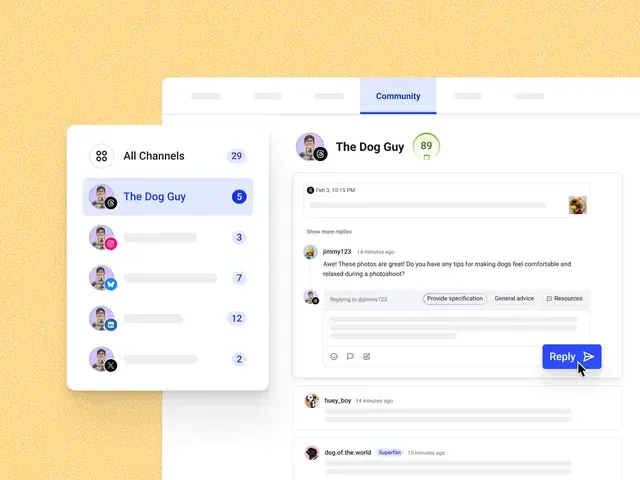
There’s also a Response Score feature that tracks the consistency of your responses over time. Think of it like a Duolingo series, but for engagement, it helps make replying a habit rather than something you only remember to do when you’re already scrolling.
The feature also includes a commentary score, which tracks your consistency and speed over time. It’s actually a habit-building tool that can help you turn engagement into a ritual rather than an afterthought.
Julian’s cross-platform analysis included nearly 2 million posts, and Instagram’s 21% engagement increase puts it right in the middle of the pack.
It’s not as dramatic as Threads’ 42% or LinkedIn’s 30%, but it’s still a meaningful boost – especially when you consider Instagram’s scale and reach.
I find this data so encouraging because it really supports the original purpose of social media: to foster real human connections between people from all over the world.
You’re not trying to crack a secret code or find a loophole in the algorithm. You only show up for the people who showed up before you. And Instagram’s various algorithms (across feed, stories, reels, and explore) all reward that kind of authentic engagement.
This is what it looks like in practice: Post your content. Respond to the people who respond. Keep the conversation going. Do it consistently. That’s it.
The 21% increase isn’t a guarantee for every account (remember, about 63% of profiles in Julian’s study saw positive effects), but the odds are in your favor if you’re willing to take the time to reconnect.
✨
More Instagram Resources
#Replying #Instagram #comments #increase #engagement