

Contents
- Viksit Bharat- G RAM G Bill 2025
- Gen Z Post Office Initiative – India Post
Viksit Bharat- G RAM G Bill 2025
(Guarantee for rozgar and Ajaevika Mission – Gramin))
Why in News?
- December 18, 2025: Ministry of Rural Development has released details via PIB Delhi.
- The government introduced the Viksit Bharat – G RAM G Bill, 2025representing:
- Statutory replacement of MGNREGA (2005)
- Alignment of rural employment with @2047 vision
- Highlights the first complete reset of legislation of India’s Rural Employment Guarantee Framework in twenty years.
Relevance
- GS II: Welfare schemes, decentralization, Centre–State relations
- GS III: Inclusive growth, rural infrastructure, employment, public finances
What is the Viksit Bharat – G RAM G Bill, 2025?
- A new legal framework for rural wage work and livelihood-related infrastructure.
- Replaces MGNREGA, 2005.
- Full name:
Developed India – Guarantee for rozgar and Ajaevika Mission (Gramin) Bill, - Objective:
- Shift from “employment as relief” → “employment as a productive investment”
- Integrate contract work with sustainable rural infrastructure and climate resilience.
Historical background: evolution of rural employment policies
Phase-wise evolution
- 1960s–1970s:
- Crash scheme for rural employment
- 1977:
- Maharashtra Employment Guarantee Act
- First legal ‘right to work’ experiment
- 80s–90s:
- NREP, RLEGP → Jawahar Rozgar Yojana
- Sampoorna Grameen Rozgar Yojana (1999)
- 2005:
- MGNREGA: National legal right to work 100 days
Inference
- G RAM G Bill is not an incremental reform, but the next structural phase in this evolution.
MGNREGA: Performance and structural limits
Important achievements
- Legal right to work (100 days)
- Women’s participation has increased:
- 48% (2013–14) → 58.15% (2025–26)
- Almost universal:
- Large-scale:
- Individual assets at the household level
Structural problems identified
- Demand-driven financing causes:
- Ground level issues:
- Ghost work, machine use
- Result gap:
- Very few households complete the full 100 days
- Weak infrastructure sustainability
- Chronic administrative understaffing:
- Only Administrative expenditure ceiling of 6%
Conclusion
- Delivery improved, but institutional architecture reached a plateau.
Why was a new legal framework needed?
Changing context of rural India
- Poverty alleviation:
- 27.1% (2011-2012) → 5.3% (2022-2023)
- Rural economy now:
- MGNREGA Draft (2005):
Policy logic
- By only wage labor → employment + productive assets + resilience
Key features of Viksit Bharat – G RAM G Bill, 2025
1. Improved employment guarantee
- 125 days wage labor per rural household (↑ from 100)
- 60 days non-work period during peak sowing/harvesting:
- Prevents labor shortages in agriculture
- Wage payment:
- Weekly, or maximum within 15 days
2. Four priority infrastructure sectors
- Water safety
- Irrigation, recharge, watershed works
- Core infrastructure in rural areas
- Roads, connectivity, public resources
- Livelihood infrastructure
- Storage, markets, means of production
- Limiting extreme weather conditions
- Flood control, drainage, soil conservation
Shift: Of temporary works → durable national assets
3. Decentralized but digitally integrated planning
- Viksit Gram Panchayat Plans
- Planning based on local needs
- Integrated with:
- National spatial databases
- Assets merged into:
- Viksit Bharat National Rural Infrastructure Stack
Financial architecture: a structural shift
From the central sector → Centrally sponsored program
- Share costs:
- 90:10 for NE and Himalayan states
- 100% for UTs without legislature
Why switch from demand-driven to normative financing?
- Demand-driven model has led to:
- Normative assignment:
- Employment guarantee retain
Financial expenses
- Total annual requirement:
₹1,51,282 crore - Central share:
₹95,692.31 crore
Administrative reinforcement
- Ceiling for administrative expenses:
- Makes possible:
- Reflects the shift of planning mentality → professional mission mode.
Governance and institutional framework
Multi-level architecture
- Central and State Gramin Rozgar Guarantee Councils
- Policy direction, accountability
- National and State Steering Committees
- Convergence, performance assessment
- Panchayati Raj Institutions
- At least 50% of the works based on costs through Gram Panchayats
- District program coordinators and program officers
- Gram sabhas
- Mandatory social audits (every 6 months)
Transparency, accountability and enforcement
- The central government is authorized to:
- Investigate irregularities
- Digital tools:
- AI-based anomaly detection
- Public accountability:
Social protection provisions
- Unemployment benefit:
- Payable afterwards 15 days if no work is delivered
- Rates and conditions:
- By prescribing rules (flexibility + rights protection)
Benefits: Impact for multiple stakeholders
For rural households
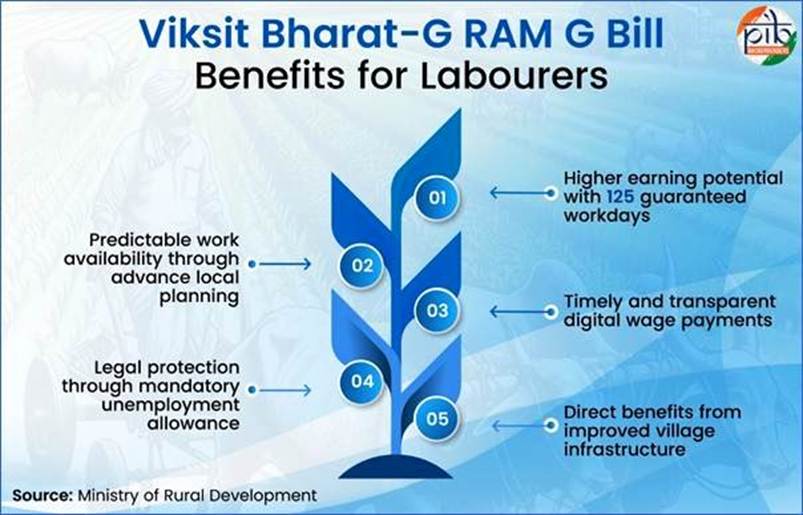
- Higher income security (125 days)
- Predictable availability of work
- Reduced emergency migration
For farmers
- Insured labor during high season
- Improved irrigation and storage
- Prevention of wage inflation
For rural economy
- Asset-led growth
- Higher village consumption
- Climate-proof infrastructure
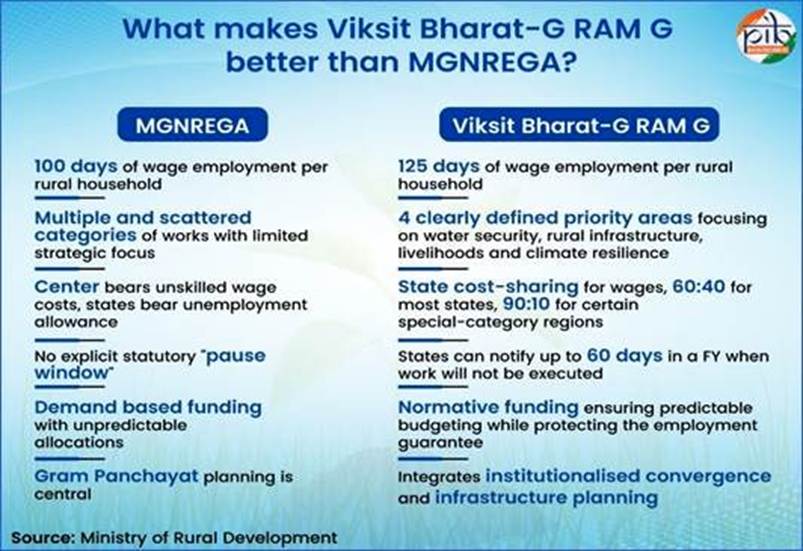
MGNREGA vs Viksit Bharat – G RAM G Bill (at a glance)
- 100 days → 125 days
- Question-oriented → Normative financing
- Temporary assets → Sustainable infrastructure
- Fragmented planning → National infrastructure stack
- Weak enforcement → Explicit central powers
Critical concerns
- Risk of dilution of the demand-driven ethos
- Higher budgetary responsibility of the state
- Capacity Shortages in Panchayats
- Over-reliance and exclusionary risks on AI/biometric data
Conclusion
- The bill marks a paradigm shift:
- From catch network opportunity → development employment
- Maintains legal warranty while:
- Strengthening the infrastructure
- Align with @2047
- Represents Second-generation social security reform:
Result-oriented, digitally controlled, fiscally predictable.
Gen Z Post Office Initiative – India Post
Why in News?
- December 2025 witnessed multiple inaugurations by Gen Z–themed post offices on Indian campusessignaling A national rollout:
- Karnataka: Acharya Institute of Technology, Bengaluru (December 18, 2025)
- Jammu and Kashmir: AIIMS Vijaypur – first AIIMS campus with Gen Z PO (December 17, 2025)
- Kerala: CMS College, Kottayam – Kerala’s first Gen Z PO (December 9, 2025)
- Andhra Pradesh: Andhra University Campus (December 9, 2025)
- PIB Delhi releases highlight this as part of India Post‘s modernization and youth strategy.
- The first Gen Z post office in India was previously inaugurated on IIT Delhimaking this one scale-up phaseno pilot.
Relevance
- GS II: Public services, citizen-oriented governance, decentralization
- GS III: Digital infrastructure, financial inclusion, institutional reforms
What is a Gen Z Post Office?
- A redesigned postal service model tailored to Generation Z (born ~1997–2012).
- Goes away from:
- Queue-based, transaction-only post offices
- Direction:
- Campus-embedded, digital, community-based service hubs
Core philosophy
Adapt public institutions to the behavior of citizens, and not citizens to institutions.
Main objectives
- Re-engage young people in formal public services
- Integrate post + bank + logistics in a single, friendly space
- Modernize the institutional image of India Post
- Build early financial literacy and confidence among students
Core functions (common on campuses)
1. Youth-oriented design and reimagining of space
- Aesthetics of a work cafe
- Comfortable seats, charging points, free WiFi
- Recreation corners with:
- Student artwork celebrates:
- Informal, non-bureaucratic atmosphere
2. Digital and technical support services
- Self-booking kiosks
- QR code based instant payments
- Cash, paperless transactions
- Simplified workflows suitable for DIY-oriented users
Policy link
- Digital India
- Ease of living
- Paperless governance
3. Modernized postal services
- Fast package booking and shipping
- Packaging facilities on campus
- MyStamp Printers:
- Personalized stamps
- Modern revival of philately
- Postal cancellations for special events
4. Financial inclusion through India Post
- Integrated access to:
- India Post Payments Bank (IPPB)
- Raising awareness among:
Why focus on Generation Z?
Behavioral reason
- Digital-native
- Cashless-first
- Preference for:
- Historically low engagement with traditional post offices
Policy insight
- Early forms of institutional involvement long-term social and financial behavior.
Management interest
1. Citizen-centered governance
- Service design based on user experience
- Shift from rule-oriented to user-oriented management
2. Institutional rebranding
- India Post repositioned as:
- Crucial for:
- Private logistics competition
3. Financial inclusion and literacy
- Early exposure to:
- Reduces future exclusion risks
4. Federal and regional balance
- Rollout about:
- Indicates scalability across Indiaand no elite urban focus.
Connection with National Visions
- Digital India
- Ease of living
- Financial inclusion
- Citizen-oriented governance
- @2047:
- Future-proof institutions
- Public services first for young people
Critical evaluation
Strengths
- Innovative institutional design
- Student co-creation
- Digital first delivery
- Potential for financial inclusion
- Replicable campus model
To assure
- Risk of:
- Cosmetic modernization without results
- Limited reach if limited to elite campuses
- Need for:
- Concerns about the digital divide for non-tech savvy users
Way forward
- Expand to:
- Universities in Tier-2 and Tier-3 cities
- Measure success through:
- Integrate with:
- Scholarships and DBT services
Conclusion
The Gen Z Post Office Initiative represents one quiet but important administrative reformswhere India Post adapts to the lifestyle, values and expectations of young citizens. By combining technology, design, sustainability and participationit shows how traditional public institutions can remain relevant in a digital, youth-driven India – fully in line with India’s vision Viksit Bharat.
#pib #summaries #December #Legacy #Ias #Academy