

As a starting self-employed person, money often feels unpredictable. One month you invoice €3,000, the next month €1,200. In the meantime, your fixed costs continue, the VAT return is coming and you wonder: will I have enough left over?
An overview of your income and expenses is not a luxury, but a necessity. It provides peace of mind, prevents stress at tax moments and helps you make better choices. In this article you will learn how you, as a starter, can get a grip on your figures, even with little data and experience. With concrete examples, a practical step-by-step plan and a simple cash flow system that works.
The problem: little experience, irregular income
Many starters think that an overview is mainly something for “later”, when your company is running more stable. But overview is crucial, especially in the initial phase.
Why starters often get stuck:
- Irregular income.
- No historical figures to fall back on.
- Uncertainty about tax amounts.
- Private and business money mixed up.
Suppose you invoice an average of €3,000 per month. That sounds good. But if you don’t know how much of this is VAT, how much you have to reserve for income tax and how much your fixed costs are, then € 3,000 is not a profit. It’s turnover. And turnover is not the same as what you keep.
Turnover is the total amount that you invoice. Profit is what remains after you subtract costs. That difference is where many starters go wrong.
Income and expenses: what minimum do you need to keep track of?
Overview starts simple. You don’t have to create complicated reports. As a starter you need to know at least this:
- Your monthly turnover (excluding VAT).
- Your fixed business costs.
- Your variable costs.
- What you should put aside for taxes.
- What you need privately to live on.
Let’s take a concrete example.
Situation:
- Turnover per month: € 3,000 (excl. VAT)
- Fixed costs: €600 (software, insurance, telephone, accountant)
- Variable costs: €200
Your total costs are then €800 per month.
Your profit before tax is then: € 3,000 – € 800 = € 2,200.
But that doesn’t mean you can spend $2,200.
Don’t forget taxes: booking is not an option
As a self-employed person, you pay income tax on your profits. You also pay an income-related contribution to the Healthcare Insurance Act (Zvw). The exact percentages differ per year and situation, but as a starter you should roughly take into account a 30% to 40% reservation on your profit, depending on your total income and deductions.
Many starters make the biggest mistake here: they look at their bank balance and think this is “their money”. Until the tax bill comes.
In our example:
Profit: €2,200
Suppose you have to reserve 35% for taxes.
€2,200 x 35% = €770 reserve.
What is left then?
€2,200 – €770 = €1,430 net available (for private recording and buffer).
This is why overview is so important. Without calculation, € 3,000 turnover seems large. With insight you see that you actually have approximately € 1,400 left over.
Do you want to calculate exactly how much you need to reserve? Then use the Cash flow template from The Happy Financial. This allows you to see per month what comes in, what goes out and how much you can safely withdraw.
Cash flow: the difference between profit and money in your account
Cash flow literally means cash flow: the money that actually goes in and out of your account. You can make a profit, but still get into trouble if customers pay late.
Example:
- You send invoices for €3,000 in January.
- Your customer will not pay until March.
- Your fixed costs will continue in January and February.
Then you have turnover on paper, but no money to pay your bills.
As a starter you often don’t have a buffer yet. That is why cash flow planning is not a luxury, but a basic skill.
Practical system for overview (even if you’re just starting out)
Here’s a simple system you can implement today.
Step 1: Work with separate accounts
- 1 business account for income.
- 1 savings account before tax.
- Possibly 1 invoice for VAT.
Every time money comes in, you distribute it immediately. For example:
- 35% to tax bill.
- Set aside 21% VAT.
- The rest remains in your business account.
Step 2: Work with a fixed “private salary”
Even if you exchange profits, you can pay yourself a fixed amount every month. For example €1,200. In good months you build up a buffer, in bad months you use that buffer.
Step 3: Plan ahead (at least 3 months)
Don’t just look at this month, but estimate the next three months. What invoices do you expect? What costs are coming?
This is where the Cashflow template really comes in handy. You enter expected income and expenses per month and immediately see whether you will fall short. This way you can make timely adjustments.
Common mistakes made by starters
- Spend everything that comes in.
- Make no distinction between VAT and profit.
- Don’t build up a buffer.
- Pay private expenses from the business account.
- No insight into fixed costs
The latter is especially risky. If you don’t know that you have, for example, €600 in fixed costs per month, you cannot determine a realistic minimum turnover target.
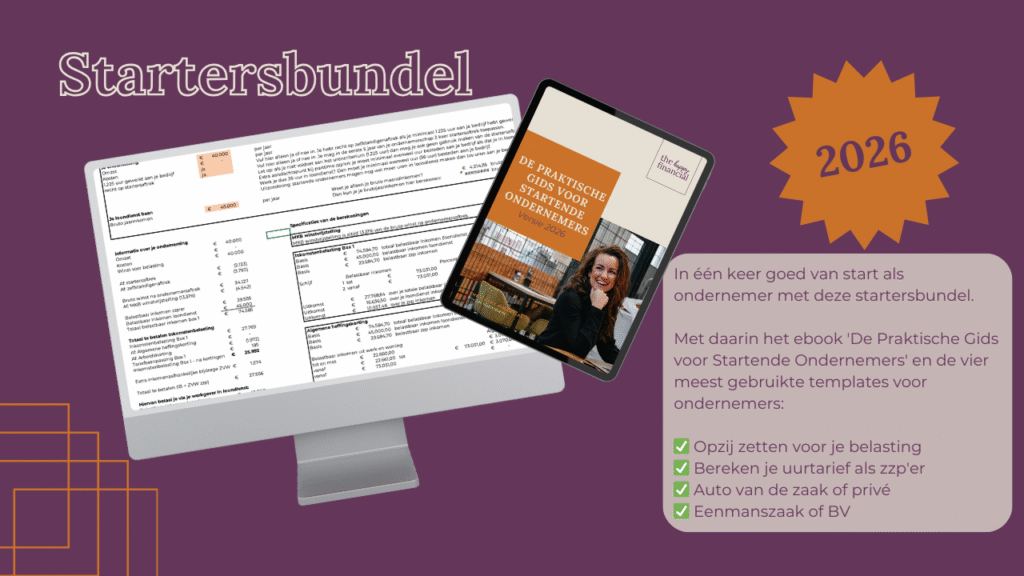
Do you want to know what hourly rate is needed to cover your costs and make a profit? Then the combination of an overview and the Hourly Rate template from the Starter Bundle is a logical next step.
Step-by-step plan: this is how you create an overview within 30 days
Week 1
Map all your fixed and variable costs. Write everything down.
Week 2
Analyze your average monthly turnover (or make a realistic estimate if you’re just starting out).
Week 3
Determine how much you need to set aside for taxes and set up a separate savings account.
Week 4
Prepare a cash flow statement for the next 3 months.
After 30 days you will have more insight than most starters after a year of business.
Summary checklist
- Do I know my average monthly turnover?
- Do I know my fixed monthly costs?
- Do I make structural reserves for taxes?
- Do I have a buffer for at least 2–3 months?
- Do I work with a cash flow statement?
Can’t you answer “yes” to everything? Then this is the time to create structure.
From chaos to control
An overview of your income and expenses is not about perfection. It’s about predictability. Especially as a starter, you have little data. That doesn’t mean you can’t plan anything. You work with assumptions, make adjustments and learn every month.
Do you want to put this into one clear system? Then download the Cashflow template from The Happy Financial. Every month you see what comes in, what goes out and how much you can safely withdraw. Combine this with the Starter Bundle if you want to get your financial basis right in one go (note: the cash flow template is not included in the Starter Bundle, but you can order it separately).
Overview gives peace of mind. And peace gives space for entrepreneurship.
#Overview #income #expenses #selfemployed #control #Happy #Financial