

A bitcoin

BTC price
the exchange rate has undergone a significant correction in the recent period. The price is down about 30 percent from $90,500 and also appears to be below the $63,000 level, a low not seen since November 2024. The market mood has noticeably deteriorated, but at the same time more and more people in the options market are betting that the exchange rate will approach $90,000 again by the end of March.
What does the options market show?
On the platform of the leading crypto derivatives exchange Deribit, the premium for a call option (buy option) with a strike price of $90,000 expiring on March 27 was approximately $522 on Thursday. THE Based on the Block-Scholes model this means there is about a 6 percent chance that bitcoin will reach $90,000 again by expiration.
In contrast, the premium for a $50,000 put option (sell option) with the same term was about $1,380, reflecting a roughly 20 percent chance of a deeper decline to $50,000.
Based on the data, the market is currently pricing in further weakness or prolonged uncertainty, rather than a quick, V-shaped recovery. At the same time, it is also notable that there is still demand for call options at strike prices around $90,000, indicating that some investors view the current correction as a favorable longer-term entry opportunity.
Macroeconomic background and deterioration of mood
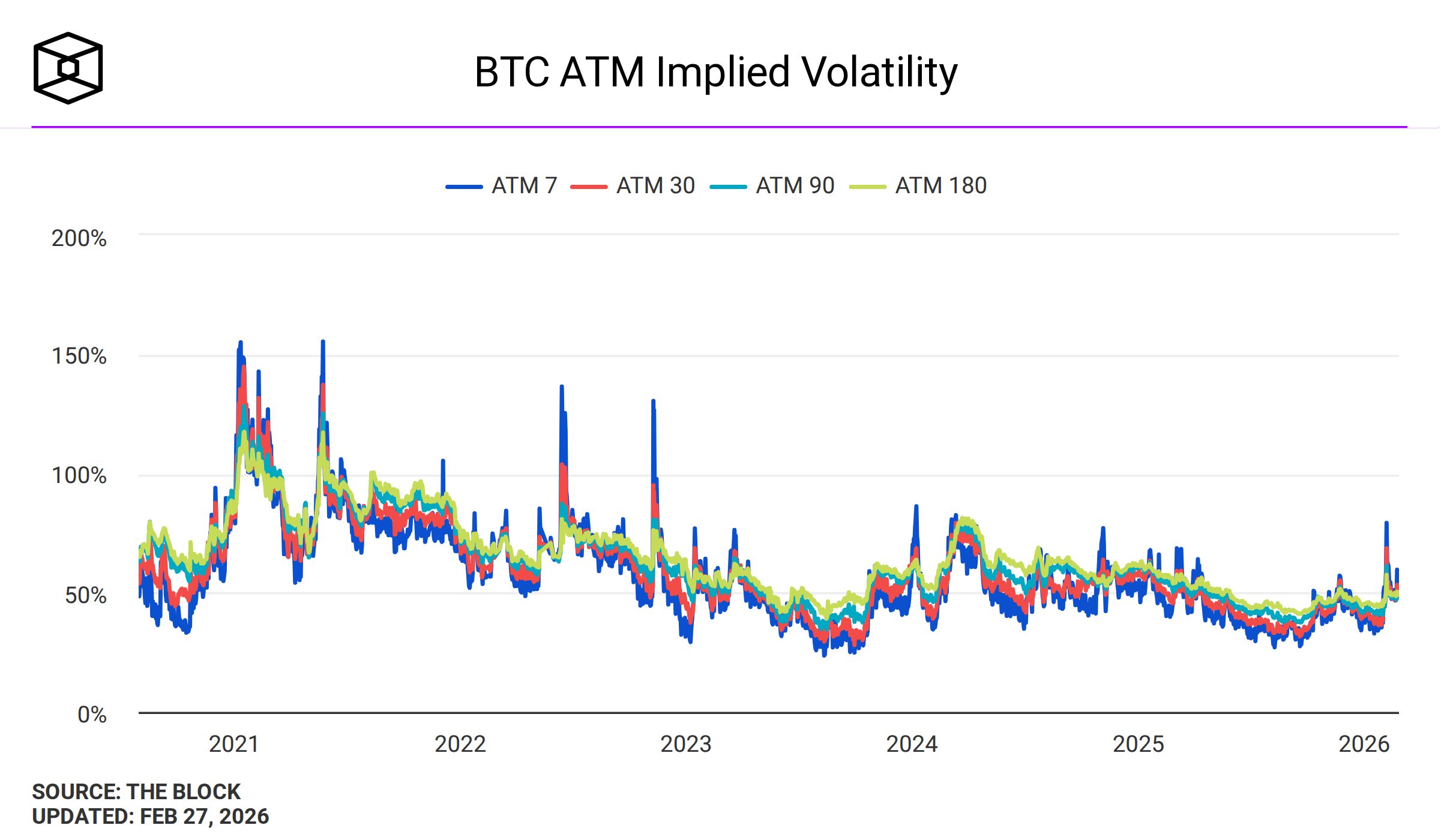
Bitcoin Implied Volatility Curve: Short-Term Inversion (1 Week ATM IV ~60%) Indicates Persistent Uncertainty Despite Recovery. Source: Het Blok
There are not only crypto-specific reasons behind the exchange rate drop. The drop to $62,000-$63,000 was partly associated with weaker US employment data and resulting recession concerns. Risk aversion among investors has increased, which tends to put pressure on volatile assets.
The uncertainty is also increased by the question marks surrounding the technology sector. Artificial intelligence developments are extremely capital intensive, with supply chain bottlenecks and energy demand creating additional challenges. According to a recent report, a leading technology player’s capital expenditure could reach $180 billion by 2026, up from $91.5 billion in 2025. This shows how much money is flowing into AI infrastructure, while some investors worry that returns on investment will be slower than expected. In such an environment, riskier assets, including cryptocurrencies, may become more vulnerable.
Institutional problems and risks of companies
Another uncertainty factor affecting the market is the future development of quantum computing. In mid-January, the head of equity strategy at a major international brokerage firm removed bitcoin entirely from its model portfolio, citing the fact that future quantum computers that are sufficiently advanced could theoretically be able to decrypt private keys. While this is currently more of a theoretical risk, the decision clearly signals the caution of institutional players.
Exchange companies that have a significant amount of bitcoins on their balance sheets are also under pressure. The enterprise value of the best-known such company, MicroStrategy, recently fell to $53.3 billion, while the cost of bitcoin shares was around $54.2 billion. In the case of Japan’s Metaplanet, its market capitalization is $2.95 billion, while the total cost of bitcoin purchases is $3.78 billion. Investors fear that a prolonged bear market could lead to forced selling of these players.
Broader market correction
The current downturn is not unique to the crypto sector. Several stocks with a market value of several billion dollars suffered weekly declines of 20 to 30 percent. There were also significant swings in the precious metals market, with silver, for example, weakening 36 percent in one week after reaching an all-time high of $121.70 on January 29. All this suggests that there has been a broader wave of risk reduction in global markets.
Current prices
Signaling in the options market is complex. In the short term, based on the priced-in probabilities, they see a greater chance of a new decline, to $50,000, than of the price rising again to almost $90,000 at the end of March. At the same time, the interest in higher strike prices shows that there are investors who value the current weakness as a longer-term accumulation opportunity.
It is important to emphasize that option pricing is not a specific prediction, but an overview of current market expectations and the risk-reward ratio. The estimated 6 percent chance does not mean that Bitcoin absolutely cannot reach $90,000, just that based on current information the market sees this as less likely than further weakness or sideways movement.
Considerations for Investors
In the current environment characterized by increased volatility, conscious risk management and appropriate position sizing are particularly important. Taking advantage of the derivatives markets can result in quick profits, but also quick losses. Options trading can therefore be especially recommended for those who are aware of the workings of pricing models, time depreciation and hedging strategies.
Over the longer term, bitcoin’s core narratives of limited supply, its role as a digital store of value, and its ability to hedge against inflation have not changed substantially. However, in the short term, the exchange rate is strongly influenced by macroeconomic data, expectations around the AI sector and the development of institutional risk appetite. Current options market signals remind us that Bitcoin’s price remains unpredictable in the short term, whether up or down.
#Option #Traders #Bitcoin #Bounce