

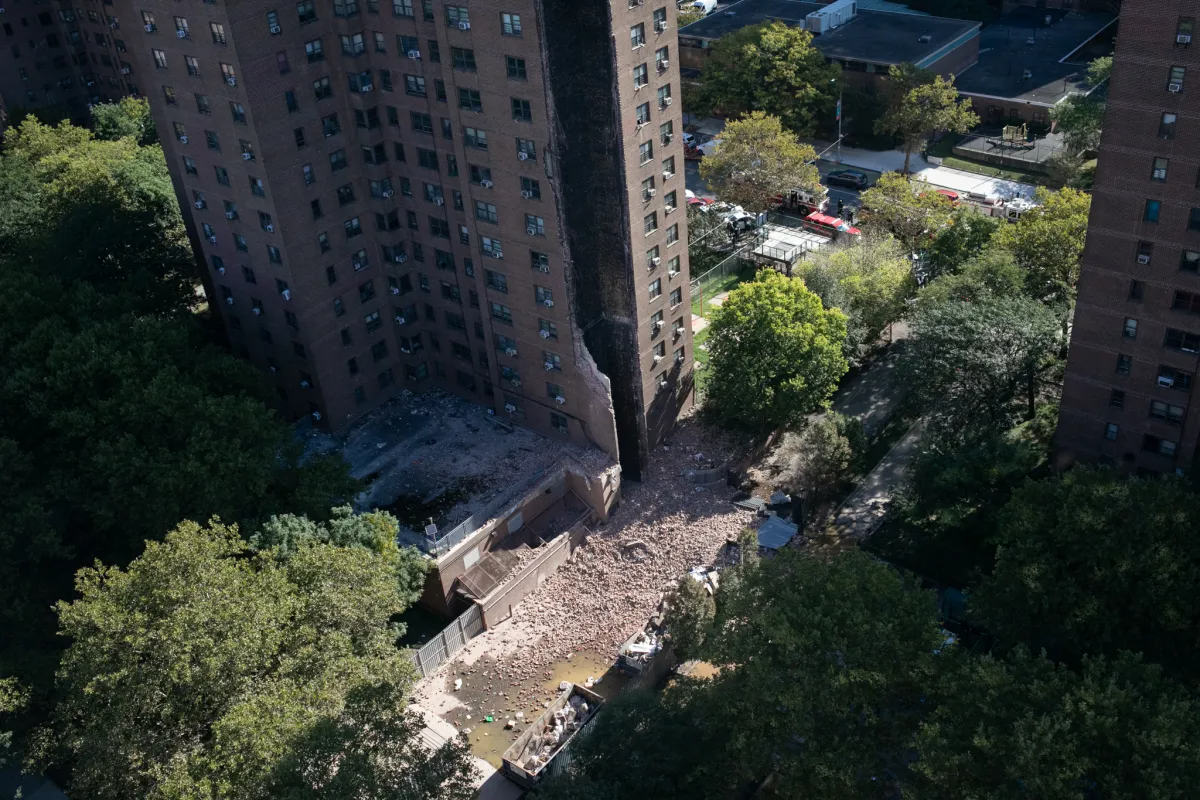
Residents of a NYCHA building in the South Bronx were evacuated on October 1, 2025, after part of their building collapsed. Photo by Ben Fractenberg/THE CITY
This article was originally published on November 4 at 5pm EST by THE CITY
Nearly a decade ago, hundreds of NYCHA boilers were completely out of compliance with the city’s anti-pollution rules. Only a small percentage had received the required inspection from the Department of Environmental Protection (DEP). About 70 percent operated without mandatory operating certificates.
That’s why NYCHA and DEP signed a Memorandum of Understanding (MOU) requiring the authority to get all of its boilers operational with up-to-date certificates by July 2021.
It never happened.
On October 1, one of those non-compliant boilers exploded at Mitchel Houses in The Bronx, causing a 20-story chimney to collapse and tens of thousands of bricks to fall to the ground next to a basketball court and near a playground. Miraculously, no one was injured.
Investigators believe there was an explosion caused by gas accumulates in an offline boiler, travels up the chimney, and then ignites when a NYCHA employee flips the switch to turn on the boiler. Tenants in the apartment line next to the smokestack were evacuated and temporarily housed in hotels, and the building’s gas was turned off for weeks. The ultimate cause is still under investigation.
But NYCHA officials admitted that the DEP’s “certificate to operate” for that boiler and seven others in the building at 205 Alexander Avenue had expired in 2009. On the day of the disaster, they had not been inspected by the DEP in 17 years.
An analysis by THE CITY of DEP and NYCHA data found that the Alexander Avenue boiler that exploded was one of at least 50 boilers spread across the city in 14 NYCHA buildings with expired registrations or certificates. When asked about this, NYCHA officials admitted that despite the MOU with DEP, at least 180 of the 1,027 boilers it now services have yet to fully comply with a proper operating certificate or registration with DEP.
NYCHA emphasizes that in addition to DEP inspections, all of its boilers are also subject to regular safety inspections by the Department of Buildings, and that DOB inspectors found “no major safety concerns” during a June investigation into the Mitchel Houses boiler that exploded four months later. But the lack of DEP inspections over the years meant one fewer set of eyes were on these massive and potentially volatile appliances that provide heat and hot water to 3,400 tenants in eleven buildings in Mitchel.
DEP officials said their inspectors do not check gas line connections or safety equipment designed to prevent accidents like the one on Oct. 1. This is done by DOB. But they do test the combustion efficiency of the boiler by turning it on, checking that smoke levels are within an acceptable range and assessing the draft pressure of the boiler to confirm that the boiler has been properly vented, DEP officials said.
Boilers like those from Mitchel Houses must be inspected by DEP every three years to keep their certificates current. But the government has struggled for years to keep up with basic maintenance of its 175,000 apartments. At one point it no longer complied with the city’s Clean Air Tracking System (CATS).

In 2016, more than 70 percent of boilers were no longer compliant, prompting discussions with the DEP to reach an agreement on how to get back into compliance with the city code.
Exactly 19 years ago last Wednesday, NYCHA and DEP signed the agreement requiring the authority to comply. The original MOU did not include a specific timeline, but in July 2019 it was amended to require NYCHA to have all of its boilers registered or current certified by July 2021.
That amendment coincided with a separate agreement with the U.S. Department of Housing and Urban Development (HUD), in which NYCHA submitted to oversight by a federal regulator. The monitor then began conducting an independent review of all of NYCHA’s efforts to clean up toxic mold, eliminate hazardous lead paint, repair permanently broken elevators, and eradicate persistent pest populations in its developments.
One of the solutions required by HUD involved NYCHA’s aging boilers, most of which had been in operation for decades without replacement. As part of that deal, NYCHA would have to replace 297 boilers across the system by the end of 2026. NYCHA managed to install 133 replacements late last year, but still has 159 to go. To meet its promise to replace the rest on time, it must replace seven each month, according to the NYCHA monitor’s April report.
NYCHA spokesman Michael Horgan said that under the HUD agreement, the authority has “made tangible improvements to the homes and buildings of NYCHA residents” and “marked transformative growth in the areas of accountability, governance and compliance.” He declined to answer questions about the Mitchel Houses incident, noting that “a multi-agency investigation into the Mitchel Houses incident is ongoing.”
Under pressure to achieve multiple goals, NYCHA management has missed the deadline to have all its boilers pass clean air inspections. Horgan said the authority is now “working with DEP to re-examine the schedule that will bring the remaining locations into compliance.” That includes Alexanderlaan 205.
An examination of DEP records by THE CITY revealed that dozens of boiler operating certificates had expired years ago, meaning they had not been inspected by DEP in years.
For example, the boilers at 205 Alexander Avenue were last inspected by DEP in 2006 and approved for an operating certificate that expired in 2009. At the time, NYCHA had to reapply for a new inspection and an updated CTO, but NYCHA did no such thing. DEP took no action in response.
Recognizing NYCHA’s ongoing struggle to cope with its steadily deteriorating portfolio, DEP had embraced a no-violation protocol regarding NYCHA boilers. The 2016 Memo of Understanding continued that protocol, with DEP agreeing “that it will not issue violations to NYCHA regarding expired boiler registrations or CTO on account of the boilers without prior notice to NYCHA and an opportunity for NYCHA to demonstrate to the reasonable satisfaction of the DEP Commissioner that it is making a concerted effort and consistent progress toward achieving full compliance in accordance with this MOU.”
Since then, DEP has not issued any violations against NYCHA boilers, despite the fact that dozens of boilers have been out of compliance for years. In response to THE CITY’s inquiry, DEP spokesperson Robert Wolejsza noted that the MOU deadline occurred during the Covid pandemic and stated that the agency “will continue to work with NYCHA to review requirements for buildings/boilers that are currently out of compliance.”

As a result, Mitchel Houses’ boilers remained in violation of city rules on clean air inspections for years — a fact that was only discovered when THE CITY learned of their existence after the Oct. 1 gas explosion.
The same state of non-compliance applies to dozens of NYCHA boilers across the city – in some cases for decades. For example, boiler operation certificates at the Gowanus Houses in Boerum Hill expired in 1986.
Most boiler certificates for use have expired in recent years.
Although the boilers at Morissania Houses in the Bronx near Yankee Stadium expired in April 2021, NYCHA is only now in the process of obtaining an updated certificate of occupancy.
Certificates for the use of boilers in the Parkside Houses next to the Bronx Botanical Garden ended in July 2021 and are still non-compliant. NYCHA said a “complicated repair is underway at this location, which must be completed before appropriate DEP registration can be filed.”
In some cases the boilers were in such a condition that they had to be switched off.

At Lincoln Houses in East Harlem, the operating certificate for the five boilers there expired nearly five years ago, in January 2021. The entire boiler plant was then taken offline for replacement, forcing NYCHA to deploy temporary mobile boilers to heat the development. NYCHA said a new certificate to operate in Lincoln will be obtained “upon the commissioning of the new plant.”
A similar circumstance is about to occur at the Sumner Houses in Bed Stuy, where at present there is no registration or “certificate to operate” for the boiler there. That plant will be taken offline next month and replaced by mobile boilers.

Related stories
Email tips@brownstoner.com with further comments, questions or tips. Follow Brownstoner further X And Instagramand like us further Facebook.
#NYCHA #boiler #exploded #dozens #expired #permits