Not all sunglasses protect you from eye damage. Here’s how to spot the difference

Not all sunglasses protect you from eye damage. Here’s how to spot the difference

3 minutes, 54 seconds Read

Now that summer is really here, you might be ready for a new pair of sunglasses.
While the style, color, price, and level of comfort they provide are all important considerations when selecting your sunglasses, there is one feature that experts say should be the top priority for everyone.

Dr. Ambhruni Padhye, an optometrist and clinical services development consultant at Specsavers, told SBS News: “The most important factor is to make sure you get enough UV protection.”

How can UV rays damage your eyes?

Short-term problems may include excessive blinking, swelling, difficulty looking at bright lights, and photokeratitis, which is similar to sunburn of the eye.

Anita Dessaix, chair of the Cancer Council Australia Public Health Committee, told SBS News: “Over time, UV exposure can potentially cause serious or permanent eye damage, including cataracts and cancer of the conjunctiva. [membrane covering the white of the ey]skin cancer of the eyelids and around the eyes, solar keratotherapy [cloudiness of the cornea]and pterygium [an overgrowth of the conjunctiva onto the cornea].”

How do you know if your sunglasses provide good UV protection?

All sunglasses sold in Australia must be tested and labeled to a mandatory standard.
They are divided into five categories – from 0 to 4 – based on the level of protection they provide against sun glare and UV.

The lens category number should be printed on the label or sticker attached to the glasses, and is often printed on the inside of the frame.

Some or all of these symbols may be printed on the inside of your sunglasses frame. Source: SBS news / Amy Hall

When purchasing sunglasses online, check the product description for the lens category number.

Dessaix said the Cancer Council recommends wearing tight-fitting, wraparound sunglasses with a lens category of 2, 3 or 4 because these “absorb 95 percent of UV radiation.”

The category of sunglasses that best suits your needs may vary depending on when you want to wear them, Padhye said.
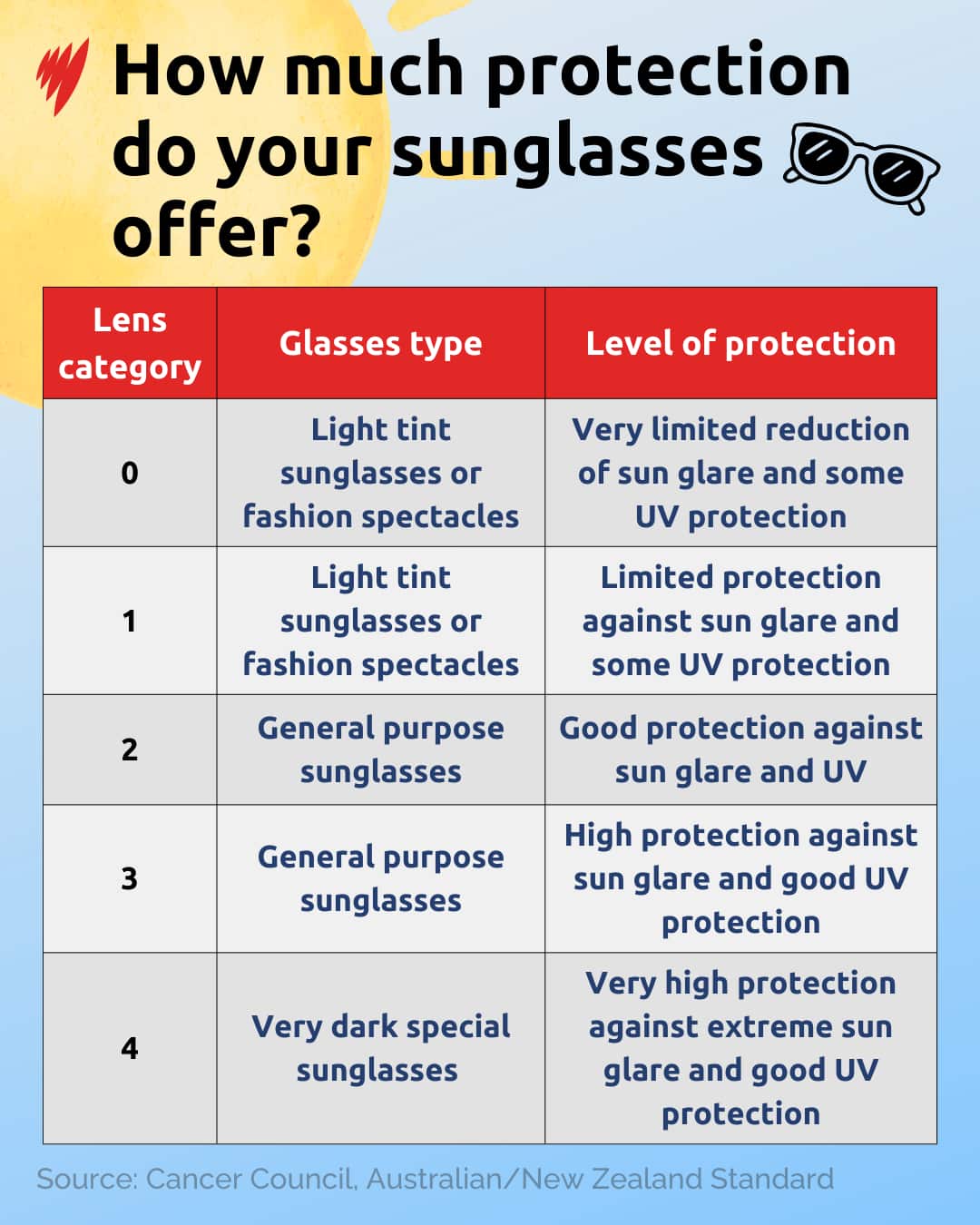
A table showing the different lens categories for sunglasses and the level of protection they provide wearers against UV rays and sun glare.

Each lens category offers different levels of eye protection against sun glare and UV rays. Source: SBS news

“Category 2 has a medium shade and is recommended for daily sun with good UV protection,” says Padhye.

“Category 3 is more of a darker shade, which is ideal for brighter outdoor conditions with strong glare.”
Although Category 4 sunglasses are ideal for high-glare conditions such as snow or water, they should never be worn while driving.
Glasses with a lens category 0 or 1 are generally considered fashion glasses and not sunglasses, and offer little to no UV protection.

Padhye recommends consulting an eye care professional if you are unsure whether the sunglasses you want to purchase or that you already own provide adequate protection against UV rays or solar rays.

Other ways to protect your eyes from UV damage

Wearing sunglasses isn’t the only way to protect your eyes from UV damage.

Wearing a wide-brimmed hat can add an extra layer of protection, keeping the sun off your eyes and face, Padhye said.
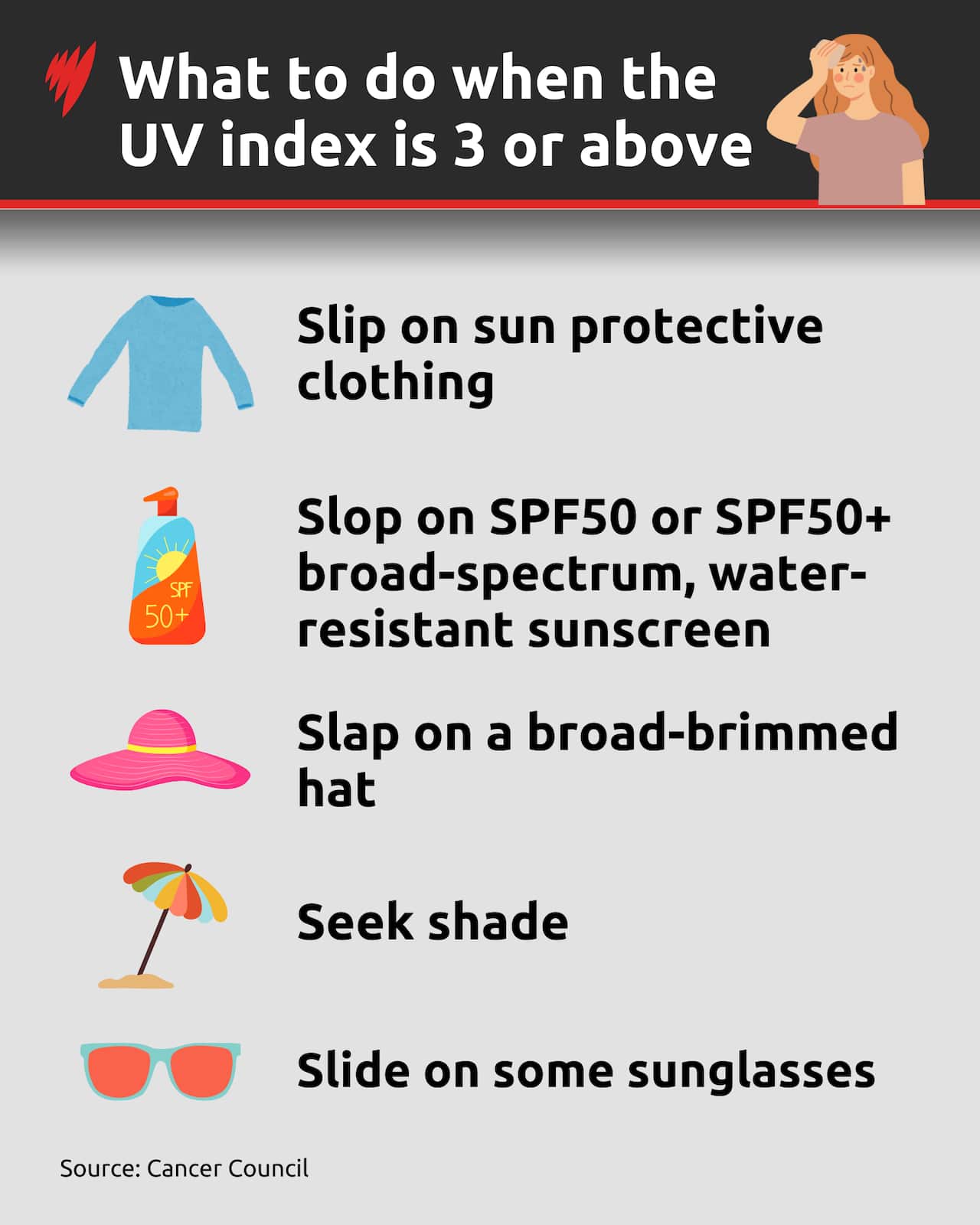
An infographic showing what to do if the UV index is 3 or higher.

Wearing sunglasses is just one part of a sun-safe routine. Source: SBS news

“Also use sunscreen – be careful as the skin around the eyes is delicate,” Padhye said.

Symptoms of sunburn in the eyes

If your eyes are sore after being in the sun, you may have photokeratitis.
“This is because the cells in your cornea become damaged,” Padhye said.

“The eye can also be quite red. Sometimes you can see blurred vision, and this can be temporary, but it can also cause a lot of watery and watery eyes and almost a gritty, irritated feeling.”

How to treat sunburn on eyes

If you suspect you have photokeratitis, Padhye said you should stay indoors to minimize further exposure to UV radiation.
“If you wear contact lenses, I recommend that you remove them to prevent further eye irritation,” she said.
“You should also avoid itching. It can of course be difficult not to rub your eyes, but this will certainly worsen the complaints.”

Just like the sunburn you might get on your face or body, photokeratitis can be treated at home.

“Some common treatments that can be applied for photokeratitis include using lubricating drops, pain relievers, and placing a cold, damp cloth over your closed eyes to soothe and cool the eyes,” Padhye said.
But if you want to make sure you get the most appropriate treatment, she recommends seeing an optometrist.
“We have all the technology to diagnose and treat, and if we feel further testing is needed, we can always refer to an ophthalmologist.”
Disclaimer: This article is for general information only and should not be used as a substitute for professional medical advice. Readers are advised to consult a qualified healthcare provider for guidance specific to their situation.

#sunglasses #protect #eye #damage #Heres #spot #difference

Similar Posts

Leave a Reply

Your email address will not be published. Required fields are marked *