

In recent years, the theme of women has returned to the center of international artistic debate, not only as an operation of historical recovery, but also as a terrain for cultural redefinition. In a few weeks in Flanders Museum of Fine Arts Ghent will inaugurate”Unforgettable. Women artists from Antwerp to Amsterdam, 1660-1750“, a major exhibition dedicated to forty women artists active in the Netherlands in the seventeenth century: a project already housed at the National Museum of Women in the Arts in Washington, DC and ready to come to Europe. An exhibition that questions the consolidated idea of a golden age dominated exclusively by male figures, and instead restores the image of a constellation of female presences capable of influencing the artistic, social and symbolic economy of their time.In Milan, almost parallel, Anselm Kiefer has chosen to devote himself to this Alchemist a monumental cycle of works, which transforms the Hall of the Caryatids of the Royal Palace into a female pantheon. His figures – wise and visionary women, often marginalized or persecuted – emerge from the footage as symbols of knowledge, destruction and rebirth. Here the woman is not a muse or allegory, but an active force of transformation.
It is in this climate of renewed attention that Carlo Vercelli inaugurated in Milan last December “Path in figure” (Milan, Palazzo Pirelli, December 2 – 23, 2025), an exhibition entirely dedicated to the female figure. A work that was not born in the wake of a trend, but as the result of multi-year research. “Putting women at the center today – the artist observes – means questioning one of the most important forces of change”. In her painting, the female body becomes a place of relationship, a space to listen, a daily presence that can activate a reflection to project itself beyond the present. The woman is not just an object of representation, but an indicator of the profound transformation of the role of the artist in contemporary society. ‘Art history – she argues – has long been dominated by men, because women have been systematically devalued. Yet we know how much impact they had on modern painting, often providing decisive clues that were not heeded.’ The reference goes to figures like Artemisia Gentileschiable to redefine the strength and dignity of the female body, among others Tamara de Lempicka, through which, through the study of volume and form, visions are anticipated that are still current. In this genealogy, Vercelli sees the need for rediscovery: woman as the key to a new relational reality, which can provide new coordinates for the interpretation of the present. «I would no longer talk about male or female artists – he underlines – the artist is this way because of circumstances. But looking for an opportunity for change in the feminine is an added value, for those who watch and for those who create».
In a historical phase marked by profound social transformations, the role of women is also destined to be redefined. Not just in art. In the American cultural and political debate, some readings have been proposed by think tanks such as the Heritage Foundation they placed a configuration of the feminine role back at center stage, strongly anchored in traditional social and family models. A perspective that, although born in a specific context, opens up broader questions: whether and how these visions can also influence the European debate, and especially to what extent they come into tension with artistic practices that, like Vercelli’s, read the female figure as a space of relationship and change.
It is within this interweaving of historical rereadings, contemporary tensions and future perspectives that Carlo Vercelli’s work is situated. And from here the dialogue with the artist begins.
For Carlo Vercelli, women are never a subject to exhibit nor an image to consume. Rather, he is “a figure of intermediary, a point of passage through which inner states, social tensions and open questions about the present emerge. My female figure thus becomes a relational instrument: it not only tells about itself, but activates a direct dialogue with the viewer. She is not a torn woman, nor a victim, nor a vulnerable icon. It is a daily, concrete presence, captured in a fragment of lived time: an attitude, a look, a silent waiting.”
Carlo Vercelli, Sheoil on canvas, 60 x 60 cm, 2025
What are your references?
«Mine is a path that starts from the informal, but which in recent years has translated into a more conscious figuration. The human figure has become the central element of my work, while the landscape and surroundings have lost more and more importance. In this passage I feel close to artists who have worked on the figure, such as Giacomettibecause of his ability to focus on the essential, or Baconfor the intensity of the relationship between body and space. I also look at the Italian tradition of the twentieth century, a Morlotti and Capogrossifor the use of the sign as an expressive instrument.»
Technology also seems to play a decisive role in this evolution.
«I use a very diluted oil with turpentine essence, almost a watercolor oil. This technique allows me to obtain nuances, transparencies and drawing paths that a traditional oil would not allow. It is a painting that retains a strong material component, but at the same time is light and able to restore intimate sensations.»
The exhibition “Metaphysics/Metaphysics“which starts from the protagonists of the historical group born in Ferrara in 1917 – Giorgio de Chirico, Alberto Savinio, Carlo Carrà, Filippo de Pisis, Giorgio Morandi. Do you see similarities with today? In what way do you think traditional Italian art can contribute?
‘Every time we talk about metaphysics, it is inevitable to take a step back. Behind De Chirico there is not only the twentieth century, but the entire Italian fifteenth and sixteenth centuries. His research stems from a deep respect for the canons of the Renaissance, which are, however, crossed by something new: a completely Italian surrealism, different from the French, linked to time, to memory, to the sensation of the past. It is a material painting, never ephemeral, made of sturdy, dense figures. Also in this sense Morandiif we want, can be read as metaphysical: matter is always central.
When I was at the Academy – he continues – we were asked to look at the Italian artists of the twentieth century associated with metaphysics, because they represented a way of understanding space as a lived place, full of suggestions. I believe that today it is not a matter of revisiting a single theme, but of re-traversing our culture without forgetting what has come in from outside. American culture, fromAction painting at the Pop arthad a profound impact and shifted attention to gesture and directness. Metaphysics, on the other hand, entails a more philosophical value linked to thinking. Even the Italian tradition of the twentieth century – out Sironi further – cannot be pushed aside. Today, it should be valorized to return to a new, non-static figurative. A figurative that enters into dialogue with authors such as Gauguin, Soutine, Baconwho worked on reality through color and drawing and had a profound influence on European and Italian culture of the second half of the twentieth century.
Exhibitions such as that of Kiefershow, for example, how Informal, Dada and Cubism radically transformed the concept of painting. That is why I believe that today it is necessary to keep the past and the present together: look to the roots to understand who we are, but work on today. It always comes to mind Paul Gauguin, Where do we come from? Who are we? Where are we going? It is a question that still concerns us all. The present is the playing field, the only place from which we can try to imagine the future.”
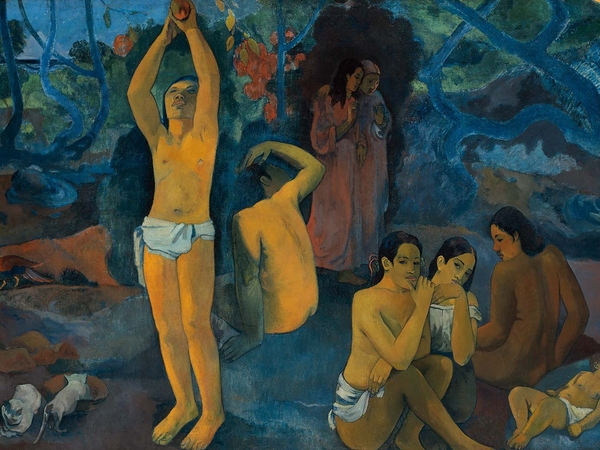
Paul Gauguin, Where do we come from? What are we? Where are we going? 1897-1898, olio su tela, Museum of Fine Arts, Boston
In recent decades, the cultural basin of art seems to have changed profoundly. Is it still possible today for an artist to make his voice heard?
«We live in a very large market, but paradoxically little able to recognize the true artist. Many get stuck between the promise and a dead end. The ability to do, which is the core of artistic work, is difficult to achieve today because it must be intercepted by cultural basins capable of supporting free and autonomous research. And this is not easy today.
In the 1960s and 1970s, galleries had a different function: they were not primarily focused on profit, but on building a cultural discourse. Groups of artists were formed and routes guided. Today, this role has largely been lost. There is an economic subjectivity. This is clearly visible at fairs: next to historicized or already listed artists, the absolute unknown often appears, which is more functional for a commercial strategy than for a real cultural project. In this context, we also end up creating characters out of thin air, imported from other cultural contexts. I think, for example, of the massive invasion of Chinese art on the European market: it is not a matter of rejection of the foreigner, but of the way these artists are constructed and presented, often in a clumsy, forced way, without authentic depth.
In all this, the acceptance of the artist – even if only culturally, and not necessarily economically – becomes fundamental. Without that recognition, one remains in a state of isolation. And the only thing that can help you move forward is to believe deeply in your work.”
In such a complex scenario, what path does an artist have before him today?
«I believe that the only possible path is to work on a precise artistic path. Without chasing absurd techniques or empty originality. Technology contributes, but does not create talent. What counts is coherence, humility and fidelity to a quest. I started when I was thirteen and even though I couldn’t see far at the time, I have always followed this line.
Nowadays there is a tendency to demand originality at all costs, to create objects that aspire to amaze but lack structure and depth. Art, on the other hand, should be a point from which we can start again. A place capable of creating a completely different situation than the current one, dominated by a culture of the object without meaning.
But it’s not easy. There are times when abandonment is always just around the corner. But in recent years I have come to understand that some human values remain fundamental. As Van Gogh said: existing and doing existence is already something. Doing, continuing to do is what can give meaning to the present and perhaps leave a trace in the future.”
In a system that often privileges the object over thought and the market over vision, Vercelli’s position sounds like an acceptance of responsibility. Art today is not called to create consensus, but to create awareness. To rebuild relationships, memory and depth. Not to amaze, but to endure.
#muse #presence #Woman #Carlo #Vercellis #painting #memory #change #Arte.it