

An injured victim of Chinese aggression is carried to an air force helicopter in NEFA (North-East Frontier Agency) for evacuation to a hospital. | Photo credit: THE HINDU PHOTO ARCHIVE
Drawing from declassified CIA documents, diplomatic archives at the Prime Minister’s Museum & Library (PMML), the Foreign Relations of the United States (FRUS) and documents from the Cold War International History Project, the groundbreaking research challenges long-held narratives about the conflict. The findings – “Unraveling the Geopolitical Dimensions of the 1962 Sino-Indian Conflict: How the US Shaped the China-India Divide” – appeared in the April issue of the Journal of Public Affairs (Wiley).
Author Dr. Lakshman from Jindal School of International Affairs shared business line that Washington’s goal at the time was to intensify tensions between India and China and block any political rapprochement. The study states that Tibet was the main reason for launching the offensive against India in 1962. This step was taken after the US deliberately turned Tibet into a political and psychological lever to influence India’s foreign policy, break Asian solidarity and draw the region into a confrontation in line with US Cold War objectives.
Fallout due to non-alignment
In the early 1950s, the US pinned its hopes on India for a strategic alliance in Asia. But when New Delhi chose not to join, Washington turned to indirect methods of cultivating influence, with Tibet quickly becoming one of the key pressure points.
The CIA takes action
The research shows that the 1956 Tibetan uprising provided the opening that Washington had long sought. Declassified documents show that the CIA began covertly supporting Tibetan resistance groups and viewed the unrest as a strategic opportunity.
Tensions increased after 1959, when the Dalai Lama fled to India. CIA activity increased sharply, with funds, supplies and reconnaissance missions, some launched from Pakistan, then a close US military ally, targeting Tibetan guerrillas. Pakistani cooperation, the paper argues, allowed American influence to penetrate the Himalayan border and contributed to Chinese perceptions of a rising anti-Beijing disposition.
Shaping public narratives
According to the study, these covert actions were never intended to support Tibet’s political cause. Instead, their aim was to widen the divide between India and China and block any possibility of bilateral accommodation. Public narratives were taking shape at the same time: the CIA assessments recognized that India and China might have been able to settle their border issue peacefully. However, the public debate created enormous pressure, limiting New Delhi’s diplomatic maneuverability.
The memoirs of former US Ambassador John Kenneth Galbraith confirm the extent of CIA influence. Galbraith described intelligence operations that shaped media narratives, funded political groups, and influenced debates in India. Dr. Lakshman characterizes this as early ‘cognitive warfare’, the use of ideas and perceptions as strategic weapons.
Regional arms race
By the early 1960s, India’s position had become increasingly vulnerable. US military aid to Pakistan led by SEATO and CENTO fueled an arms race in the subcontinent, while India’s dependence on Western financial aid limited India’s diplomatic autonomy. The contradiction was stark: Washington armed Pakistan while also providing financial support to India.
When the 1962 war broke out, China interpreted India’s actions through the lens of years of covert American activities in Tibet, tacitly viewing India as aligned with a Western effort to weaken Beijing’s hold on Tibet. As the conflict unfolded, the United States moved quickly to position itself as India’s savior, providing military and diplomatic support that brought New Delhi closer to the Western bloc.
War of perceptions
The study concludes that the 1962 conflict was fought both in the realm of perception and on the battlefield. A declassified policy brief from the JFK Presidential Library cited in the study said the United States should “limit speech… so as not to give the Chinese a pretext to allege any American involvement.” Nevertheless, the author argues, US covert operations have achieved “much more than they wanted,” pushing India and China toward a clash and widening the rift between China and the Soviet Union.
Nehru’s forced turn
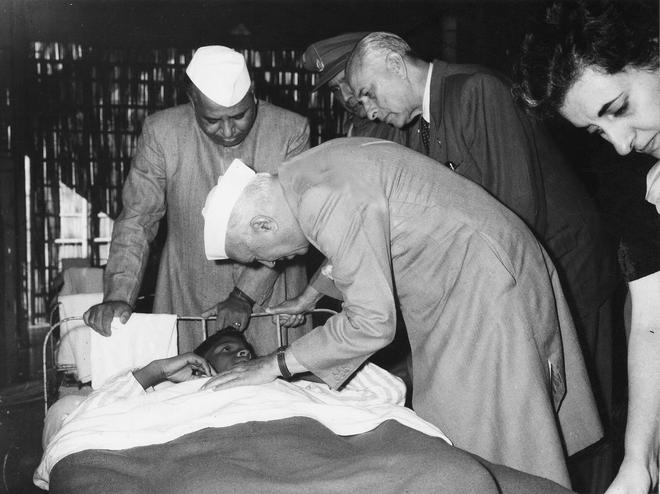
Prime Minister Nehru offers a word of comfort to an injured jawan at Tezpur Hospital (NEFA) in August 1963. China had invaded India in NEFA region in October 1962. | Photo credit: THE HINDU PHOTO ARCHIVE
Ultimately, the conflict forced Prime Minister Nehru to request military assistance from the United States, a significant departure from India’s long-standing non-aligned position, and an outcome that Washington quietly welcomed.
More like this

Published on November 19, 2025
#research #covert #strategy #border #dispute #driving #force #war #India #China