

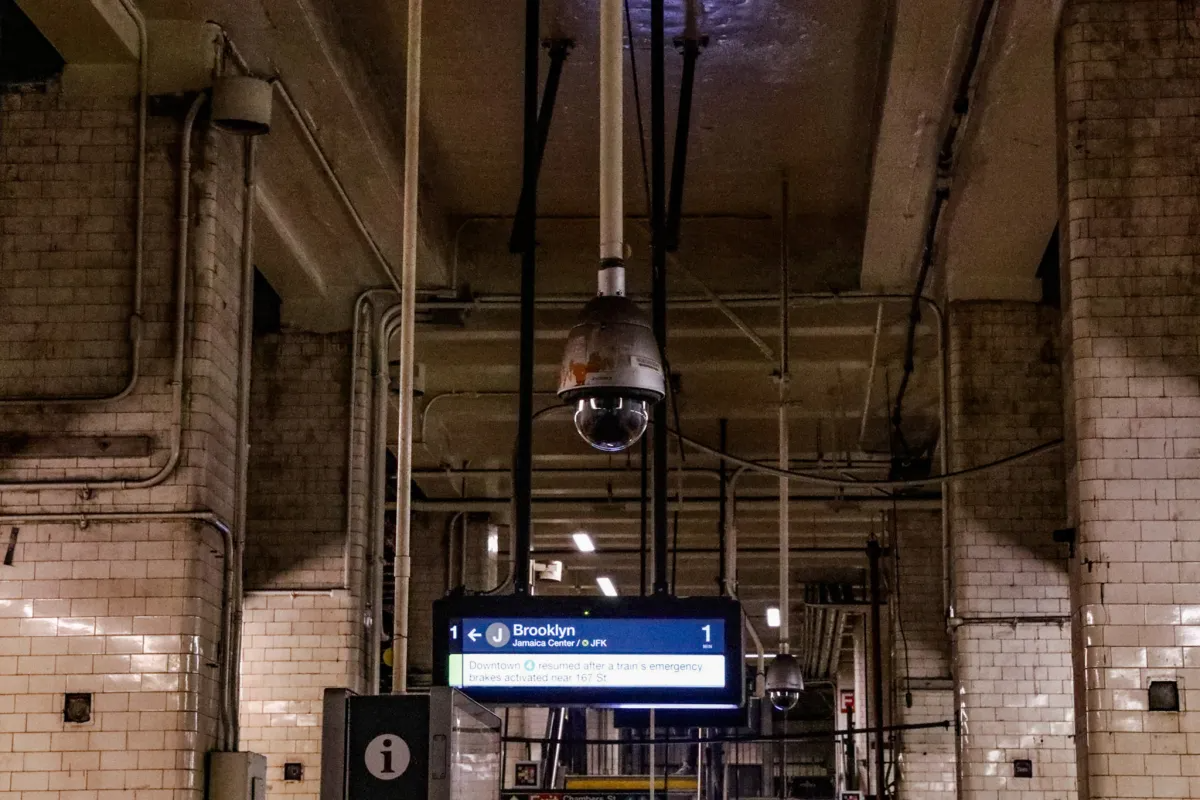
The MTA had surveillance cameras at the Chambers Street station, January 6, 2026. Photo by Alex Krales/THE CITY
This article was originally published on January 8, 5pm EST by THE CITY
The MTA has begun exploring whether artificial intelligence could be used within the transit system to detect weapons, monitor unattended items or even anticipate subway storms.
An unspecified number of technology vendors and systems integrators responded before the December 30 deadline request for information from the transportation authority early last month, officials said.
“There is interest across the board,” Michael Kemper, MTA chief safety officer, told THE CITY. “It comes not only from the MTA, but also from the business world, the AI business world, working with us.”
The request details the first steps in the MTA’s shift to enable using AI to perform complex public safety work, such as analysis real-time video feeds of metros and buses and predicting potentially unsafe behavior via cameras in public transport.
“This is not only the norm, it is also the expectation: AI is here, AI is the future,” Kemper said. “If we don’t investigate, investigate and investigate again, that would be malpractice on our part.”
But technology watchdogs warn that the AI boom comes with privacy risks and tracking capabilities that could go beyond what the MTA says it needs in video analytics.
Jerome Greco, supervising attorney for The Legal Aid Society’s Digital Forensics Unit, said the technology’s ability to identify potentially “unusual” or “unsafe” behavior in a transit environment poses many potential problems, including “very negative” interactions with police.
“This use of AI is not like Netflix telling you which movie to watch next,” Greco said. “The consequences if things go wrong can be quite significant and I don’t think the MTA should be so nonchalant about that.”
William Owen, communications director for the Surveillance Technology Oversight Project, compared transit officials’ efforts to the weapon detector pilot program which then-Mayor Eric Adams and the NYPD implemented in the subway in 2024 one month trial with more than 3,000 searches across 20 stations, the AI-powered scanners returned 12 knives, no weapons and more than 100 false positives.
“It actually turned out to be just a metal detector that found a lot of umbrellas and other items instead of actual weapons,” Owen said.
Kemper said the MTA understands the issues raised over the transit system’s use of AI video analytics, which he described as a “tool” to improve human decision-making.
“People have concerns about it and questions about it – our job is to be transparent and answer those questions,” he said. “But we must move forward and explore these technologies to keep our riders safe.”

Notably, the request makes no mention at all of the use of controversial facial recognition technology. used by the NYPD in an incident in April 2024, critics urged researchers to review it. A 2021 Amnesty International survey found that the NYPD could feed images from more than 15,000 cameras in Brooklyn, The Bronx and Manhattan into facial recognition software.
The MTA says its AI research focuses on tapping into current technology for the sake of public safety.
Technology providers’ response to the MTA’s request is the latest step for the nation’s largest public transit system in its effort to adapt the fast-growing technology for safety purposes. There are more than 15,000 cameras throughout the transit system and on the more than 6,000 cars in the metro fleet.
Artificial intelligence is already being put to the test elsewhere in the city’s transport network.
The authority last year retrofitted the axles of some cars along the A Line with Google Pixel smartphones that combine with advanced artificial intelligence capabilities to detect and analyze potential track defects. The MTA is also testing new AI-enabled rate gates on selected stations.
The safety-focused initiative focuses on utilizing the existing network of cameras whose streaming video feeds were not functioning at a Sunset Park station during a Recording in the April 2022 metro.
A Report December 2022 about the outage the MTA inspector general mentioned that the video stream at the Brooklyn station and two other stops had gone down four days prior to the shooting.
In its request for information, the MTA acknowledged some issues related to the use of eyes in transit.
“With more than 15,000 cameras across approximately 472 metro stations, current monitoring practices remain manual, reactive and labor-intensive,” the report notes.
The document adds that the MTA aims to evolve that monitoring design into a “proactive, intelligence-based ecosystem, capable of behavioral signaling, risk assessment and incident response.”
While the initiative would be based on advanced video analytics and AI technologies, insights from certified subject matter experts in behavioral science and psychology who have “a deep understanding of human behavior in transit environments” would guide the effort, the MTA said.
There is no timetable for the project, whose next step will involve assessing submissions from interested parties to determine what is possible to ultimately activate it within a 24-hour public transport system that transports almost 4 million metro passengers every day.
The MTA’s chief safety officer said its potential value is “tremendous” to motorcyclists.
“We look forward to moving forward once we find something we feel comfortable with,” Kemper said.
Legal Aid’s Greco countered that the MTA should be cautious when it comes to predictive technology for “unusual” or “unsafe” behavior on the subway system.
“How will that work and who gets to make that decision and what are the consequences of that decision?” he said. “If it determines that there is unsafe behavior — based on who knows what it will use to determine that — what happens?
“Are we now essentially policing people because they are queer?”

Related stories
Email tips@brownstoner.com with further comments, questions or tips. Follow Brownstoner further X And Instagramand like us further Facebook.
#MTA #exploring #monitor #thousands #cameras