

This audio is generated automatically. Please let us know if you have any feedback.
Meta has shared an update on its efforts to adapt to Australia’s new teen social media ban, which puts the onus on social platforms to keep all teens under the age of 16 off their platforms or face significant financial penalties.
The new law went into effect on December 10, and so far Meta says it has revoked access to nearly 550,000 accounts it believes belong to underage users.
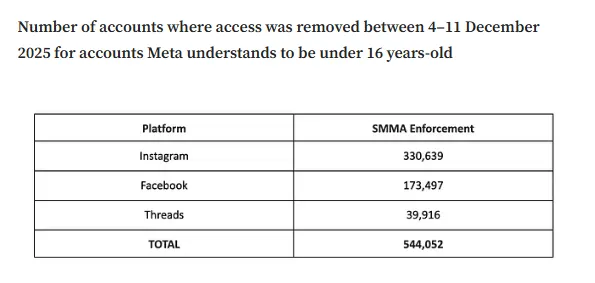
That’s a lot of profiles that have seemingly lost access to Facebook, Instagram, and Threads, although Facebook and Threads are probably less of a concern for most teen users.
However, Instagram is an important connector, with many young people logging onto IG for connection and entertainment. For context, Snapchat reported that it was nearby 440,000 users under 16 years old before the law came into effect.
The consequences could be significant, but as a parent of two teenagers affected by this change, I can say that very few young users appear to be overly concerned and do not appear to have significantly changed their usage habits since December 10th.
That’s because they can use VPNs and other connection options to get around the rules, while many use Instagram in a logged-out form, which still allows them to scroll through Reels, with some algorithmic sophistication. It’s a little more limited, but despite these reported numbers, there’s minimal behavior change that I’ve seen or heard.
Australia’s Social Media Law, the first significant age-based restriction on social media access in a Western country, aims to better protect children from harmful exposure online by ensuring young teens are not exposed to adult content or negatively affected by social platform algorithms.
But again, as I’ve noted before, it’s a flawed approach that can easily be undermined, while the law’s assumptions also don’t match the research, nor the potential for adverse risks by pushing teens to other, less safe places on the internet.
One of the main shortcomings, at least from a legal perspective, is that Australian authorities have not mandated any means of checking users’ ages to keep young teens out of their apps. Instead, Australian law places the onus on the platforms themselves to ‘take reasonable steps’ restrict teens under 16 from accessing their apps.
“Reasonable steps” is a pretty vague qualifier, especially when you’re threatening $50 million in fines for violations, and when it comes to a legal argument, it’s going to be difficult for a court to definitively rule on “reasonable steps,” especially when you consider what, say, Elon Musk might consider “reasonable” relative to anyone else.
On this front, Meta says it wants to implement AgeKeys by OpenAgethat allows users to do this set up a verified age key, which is then stored on their device, allowing them to share “verified age signals” with participating platforms in a privacy-protecting way.
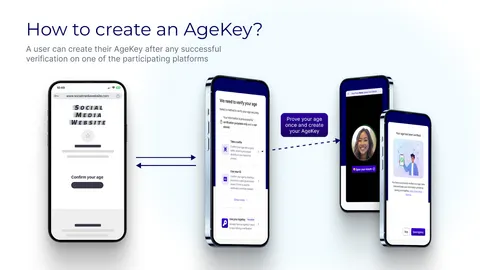
“Users can verify their AgeKey in multiple ways, such as with a government-issued ID, financial information, face estimation or national digital wallets. Meta will begin integrating this tool into its apps in Australia and other markets in 2026.”
That will then create another barrier to entry, although the real value of this is largely based on wider adoption, and making it as easy as possible for young users to use AgeKeys to prove their age.
That’s why Meta keeps going pushing for age verification and parental approval legislation at the app store level.
“To ensure that all teens are protected online, we believe legislation should require app stores to verify their age and obtain parental consent before allowing their teens under 16 to download an app. This is the only way to ensure consistent, industry-wide protection for young people, regardless of which apps they use, and to avoid the crazy effect of catching up with new apps that teens will migrate to to avoid the social media ban law.”
On this point, I agree that the app stores have much broader oversight, through the download bottleneck, that can help ensure better enforcement of the rules.
But it seems that this is a more difficult case to solve, or that politicians are eager to take a public stand against social media companies, which are seen as the bad guys among voters.
In any case, Meta is working to implement better age verification systems, but these will remain sensitive, which is important to note as more regions consider similar restrictions.
#Meta #deleted #teen #accounts #Australia