

Maria Barosso, Demolition of the houses in Via Cremona for the excavations in the Forum of Caesar, 1932, pencil and watercolor on paper, Rome, Museum of Rome |
Photo: Alfredo Valeriani
An exhibition entitled Maria Barosso, artist and archaeologist in transforming Romepromoted by Roma Capitale, Ministry of Culture – Capitoline Superintendence of Cultural Heritage and produced in collaboration with the Sapienza University of Rome, presents 137 works, including about a hundred prints, drawings, watercolors and paintings created by the artist.
The project, curated by Angela Maria D’Amelio, Maurizio Ficari, Manuela Gianandrea, Ilaria Miarelli Mariani, Domenico Palombi, with the collaboration of Andrea Grazian and Eleonora Tosti, includes works from the deposits of the Capitoline Superintendency, and in particular from the Museum of Rome in Palazzo Braschi. There is no shortage of paintings from private collections and other prestigious institutions, including the Historical Archives of the National Roman Museum in Palazzo Altemps, the Archaeological Park of the Colosseum, the Vicariate of Rome and the Camillo Caetani Foundation.
Maria Barosso, Road improvements at the end of via Cavour and facade of Santa Maria in Macello Martyrum, 1932, pencil and watercolor on paper Rome, Museum of Rome | Photo: Alfredo Valeriani
The works on display are an invitation to follow the personal and professional phases of the Turin painter and archaeologist. The sections correspond to the places of Rome in transformation depicted in Barosso’s works, in dialogue with photographs, documents and historical artefacts.
His works are not only a refined artistic testimony, but also represent a precious archive that recovers the complexity of an era when, in order to open new streets and monumental squares, entire neighborhoods, churches and buildings were sacrificed.
Through the tables of Barosso, the visitor takes part in crucial episodes in the life of Rome, from the excavation of the Velia, the hill that connected the Palatine and the Esquiline, to the surprising emergence, among the rubble of Largo Argentina, of the four republican temples and the Curia of Pompey, to the demolition of medieval houses and churches along the new Via del Mare. Thanks to the exhibition route, we come across the Compitum Acilium, which is being exhibited for the first time. It is a small sanctuary dedicated to the Lares, discovered in May 1932 during the excavation of the Velia. Destroyed by the rush of works, the monument survives today thanks to Barosso’s drawings and watercolors, which transform a lost artifact into a living memory.
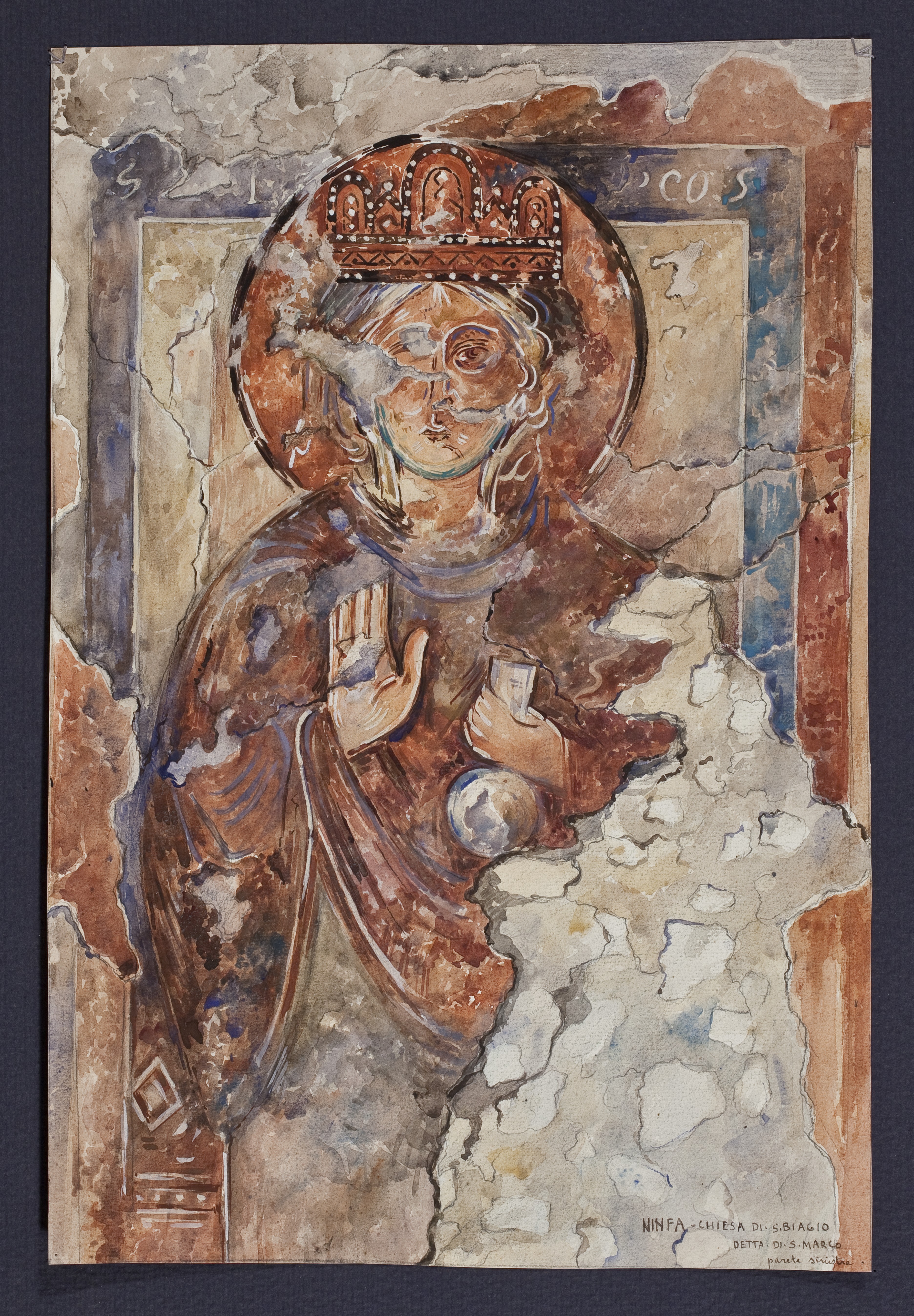
Maria Barosso, Church of San Biagio a Ninfa, reproduction of a fresco with the figure of a saint, 1923, watercolor on cardboard Rome, Museum of Rome
The route ends with a group of paintings by Mario Mafai, Eva Quagliotto and Tina Tommasini, who, in the manner of Maria Barosso, were able to convey the tensions of a city balanced between the past and modernity.
We see that the changes in urban planning that, in just a few years, have irreversibly changed the centuries-old image of Rome, are an opportunity for reflection on the historical and cultural transformation of the capital and its consequences.
#Maria #Barossos #Rome #Central #Montemartini #Rome #Arte.it