

Lessons from past technological developments
Debt nuances
I just read the following sentence: “Graphic Processing Unit (GPU)-rich clouds are now raising multi-billion dollar debt with GPUs as collateral.”
It got me thinking…
Figure 1. General Purpose Technology (GPT) booms and busts, Gartner’s hype cycle
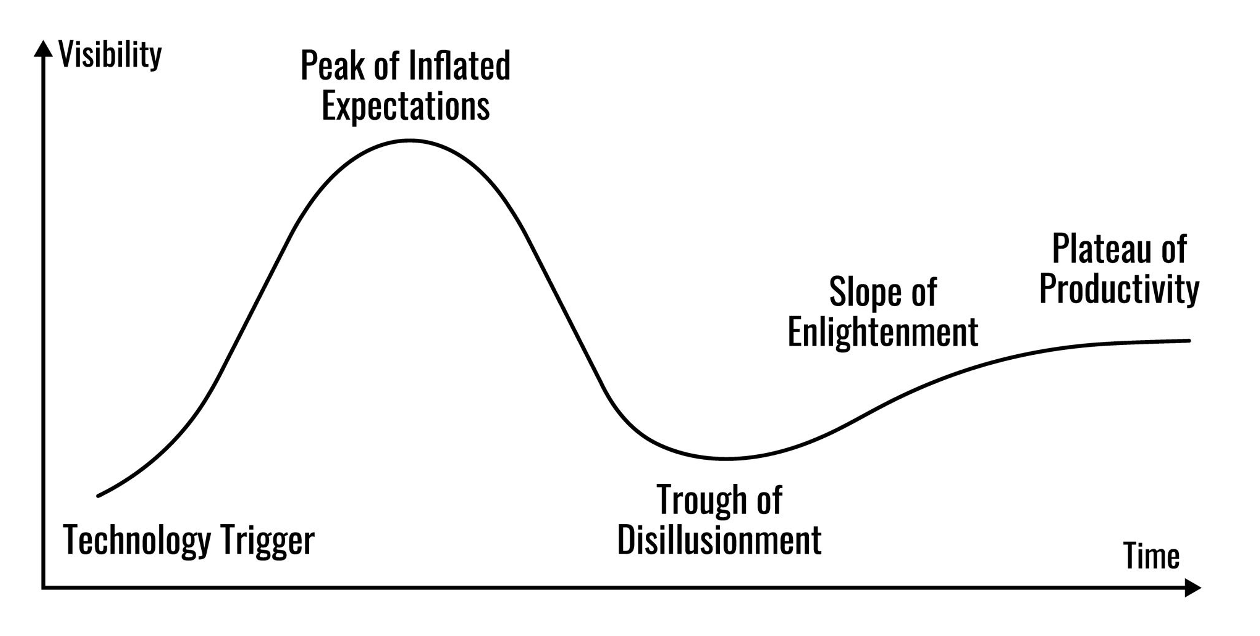
Source: Gartner
During the railroad boom of the 19th century, American railroad companies issued bonds for everything: their equipment, their track, their federal government land grants, and even their future profits. Today, that debt is being increased with GPUs as collateral – something that should make us sit up and take notice.
Much more recently, Bloomberg and PitchBook have variously reported that CoreWeave’s total GPU-backed debt has surpassed $10 billion, that Fluidstack (now part of CoreWeave) has received approval for more than $10 billion in financing using its Nvidia GPUs as collateral, that Lambda has secured a $500 million loan backed by its existing Nvidia chips, and that Crusoe (formerly Crusoe Energy) has taken on hundreds of millions in GPU-backed debt, including a $200 million deal in late 2023 and another $225 million this year.
The railroad bubbles and failures of 1873 and 1893 each demonstrated unsustainable growth and speculative lending that weakened the financial system and were major factors in the subsequent economic depressions, in part because the railroads were built on mountains of debt.
The current construction of artificial intelligence (AI) and data centers has so far been financed by the free cash flows and cash balances of the major US technology companies, as well as private capital from private equity firms such as Apollo and Blackstone.
But changes are coming. In October, Bank of America Global Research noted; “Loans to finance AI data center spending have skyrocketed in September and so far in October.”
Figure 2. AI takes on more debt
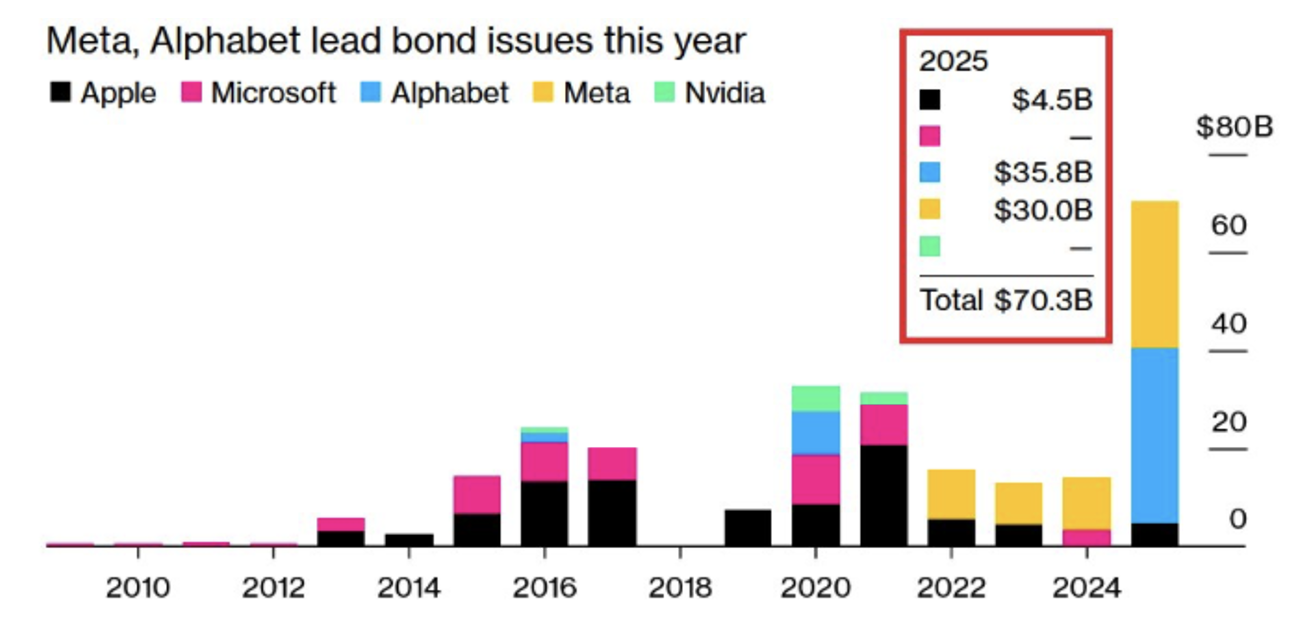
Source: Bloomberg
Doug O’Laughlin, in his Invented knowledge newsletter, wrote: “The implications are profound,” adding: “What had been a disciplined, cash-flow-funded race could now devolve into a debt-fueled arms race.” In subsequent interviews, O’Laughlin has said that this “debt bomb” should make people afraid that AI could be a bubble.
And the increase in debt burden illustrated in Figure 2 does not take into account the shift in AI spending from the balance sheets of the major hyperscalers.
Some are teaming up with private equity firms to form joint ventures called Special Purpose Vehicles (or SPVs) to finance data centers and chips, keeping expenses and debt off the books. In June, Meta raised about $29 billion from private credit companies for new AI data centers organized through such SPVs.
The Pied Piper: CoreWeave
I should note that Meta’s deal is not unique. AI cloud provider, computer vendor and non-consumer-facing company CoreWeave has been called the ticking time bomb of AI. Even though the company’s customers include Microsoft, OpenAI and Meta, and its third-quarter revenues doubled to $1.4 billion from the same period last year, The Verge’s Elizabeth Lopatto reported last month: “CoreWeave is saddled with massive debt and, barring the absolute best-case scenario of rapid AI adoption, has no clear path to profitability.”
CoreWeave IPO (initial public offering) in March at a share price of US$40. In June, shares peaked at US$187. Today the shares are trading at US$90.66. You could say that the bubble has already burst, but before you do… as I write this (10e December 2025), CoreWeave just increased a 2031 private convertible bond offering from $2 billion to $2.25 billion, with a 1.75 percent interest rate payable semiannually and a conversion price of $107.80 per share, which represents a 19 percent premium to CoreWeave’s current price, suggesting there may not be a bubble at all.
Lopatto also noted: “CoreWeave simply isn’t possible without Nvidia. The company said it owned more than 250,000 Nvidia chips, the infrastructure needed to run AI models, in documents CoreWeave filed for its initial public offering (IPO). It also said it only owned Nvidia chips. Additionally, Nvidia is a major investor in CoreWeave, owning it for about $4 billion in August of shares. Nvidia facilitated the March IPO, according to CNBC: “when there was subdued demand for CoreWeave’s stock, Nvidia stepped in and bought shares. In addition, Nvidia has committed to purchasing excess capacity that CoreWeave customers are not using.”
And that makes the debt load even more impressive.
Debt facilitated by backscratching?
Meanwhile, Nvidia and OpenAI have signed a partnership agreement to deploy approximately 10 GW of Nvidia systems, with Nvidia planning to invest up to $100 billion as deployment progresses. Elsewhere, Microsoft’s OpenAI tie-in includes a very large Azure commit/usage, so OpenAI’s Azure consumption contributes to Microsoft’s reported revenue.
And in case you’re wondering: no: “These investments are not circular; they are complementary.” That’s what Lia Davis, CoreWeave’s head of global communications, said, adding: “This is about an entire ecosystem all rowing in the same direction to accelerate the AI economy. There is nothing circular about it. Rather, these partnerships are about accelerating innovation and adoption. We are jointly defining the next generation operating system for civilization.”
Investors have gotten this line before.
The American railroads were also ‘central’ to advancing civilization at the time, reducing a journey across America that had taken twelve weeks in 1800 to just three days in 1930. But the railways were so ‘central’ in the second half of the 19th century that they regularly caused bubbles and failures.
AI has been described as a species ‘eating the economy’. Seventy-five percent of the S&P 500’s returns since ChatGPT’s launch can be attributed to AI-related stocks, while data center construction spending is overshadowing other construction projects and also causing electricity prices to rise across the country.
Richard White wrote in his epic history of the American railroads – the ‘transcontinentals’: Railways“They created modernity…” But they also left behind “a legacy of bankruptcies, two depressions, environmental damage, financial crises and social unrest.”
It would be unusual if this time it were different
It may be worth remembering the words of journalist Derek Thompson, who wrote in his November 4 newsletter: AI could be the railway of the 21st century. Brace yourself‘Memories are short, and caution and natural risk aversion are no match for the dream of becoming rich thanks to a revolutionary technology that ‘everyone knows’ will change the world.
The global railway mania of the 19th century bankrupted thousands of investors, wiped out hundreds of companies, but left countries with a railway network that enabled a century of industrial dominance. Likewise, the fiber optic/internet/broadband boom of 1999 evaporated $5 trillion in market value by early 2000, but it also laid the wiring that began the internet age. Similar stores can be informed about the electricity bubble, aviation, radio broadcasting and automobiles.
About three-quarters of General-Purpose-Technology (GPT) growth shares a similar pattern of colossal overinvestment, financial carnage through creative destruction, then lower prices and decades of productivity gains on the remaining infrastructure.
At the heart of the current AI boom are General Purpose Technologies (GPTs) – on the scale of electricity or the internet – and the infrastructure being built will support decades of economic activity. And unlike the Dot.Com bubble, the investment isn’t billions in speculative debt lent to “pre-revenue” companies with no path to profitability. This time, the investments (so far) mainly come from companies with strong balance sheets. But beyond that core, the classic signs of any bubble are visible.
It would be unusual, given the high enthusiasm or hype, high asset prices, overbuilding, uncertainty about future demand, and even the many elements consistent with past bubbles, if this boom did not also conform to the pattern illustrated in Figure 1. It would indeed be a first.
But if so many people think we are in a bubble, can we really be in a bubble? I would respond by pointing out that bubbles are not black swans.
Table 1. Bulls vs. Bears
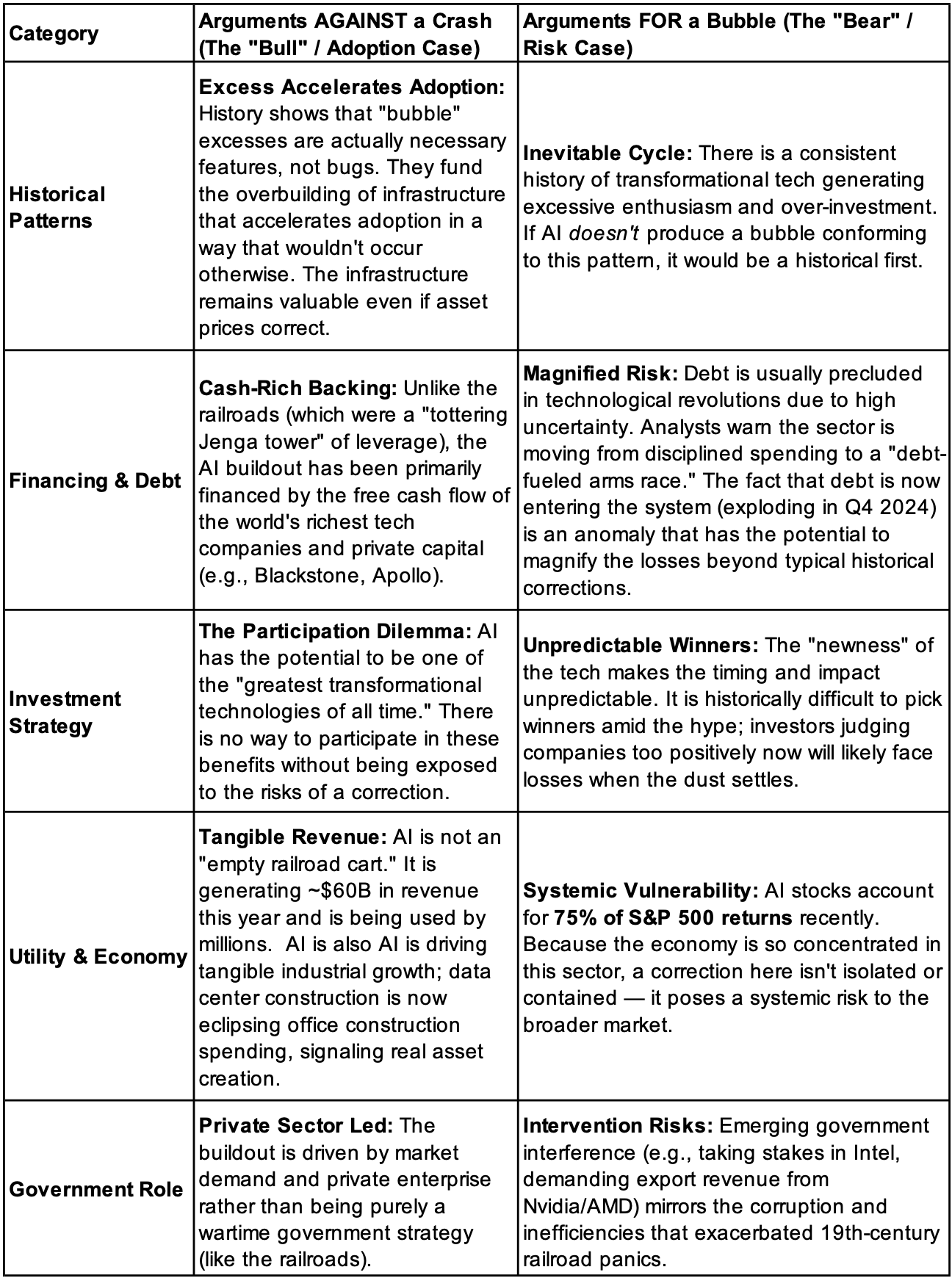
Whichever side of the debate you sit on, Table 1 is my attempt to summarize some of the arguments for the bulls and bears.

He is also the author of the best-selling investing guide to the stock market, Value.able – how to value and buy the best stocks for less than they are worth.
Roger regularly appears on television and radio, and in the press, including ABC radio and TV, The Australian and Ausbiz. View upcoming media appearances.
This post was contributed by a representative of Montgomery Investment Management Pty Limited (AFSL No. 354564). The main purpose of this message is to provide factual information and not advice about financial products. Furthermore, the information provided is not intended as a recommendation or opinion about any financial product. However, any comments and statements of opinion should contain general advice only, prepared without taking into account your personal objectives, financial circumstances or needs. Therefore, before acting on any information provided, you should always consider its suitability in the light of your personal objectives, financial circumstances and needs and, if necessary, seek independent advice from a financial advisor before making any decision. Personal advice is expressly excluded in this message.
#Lessons #technological #developments