

Japan’s financial regulator is planning legislation that would require crypto exchanges to maintain liability reserves to protect customers from hacks or security breaches.
A rreport on The Nikkei said the Financial Services Agency (FSA) plans to introduce legislation to Parliament in 2026.
The legislation would require crypto exchanges to meet requirements similar to those for securities firms, which currently maintain reserves ranging from $12.7 million to $225 million depending on trading volume.
Until now, crypto exchanges have been able to avoid reserve requirements by storing some of customers’ assets in cold storage, which are wallets that are not connected to the internet.
The new framework will create formal procedures for returning assets to customers in the event that a crypto exchange goes bankrupt. It includes allowing court-appointed administrators to handle customer refunds.
To ease the financial burden, the FSA is considering allowing exchange platforms to take out insurance rather than maintain full cash reserves.
Japan has been rocked by a series of crypto hacks
The planned mandate follows a series of security breaches targeting Japanese crypto exchanges.
Perhaps the most notable hack, from which Japan is still recovering, was the collapse of the now-defunct Mt. platform. Gox. Hackers had removed 850,000 BTC from the platform in 2014, causing the exchange to go bankrupt. Some refunds didn’t start until a decade later, and refunds now run through October 2026.
BREAKING: Mount Gox has postponed BTC refunds until next year.
Less selling pressure on the market.
This is very bullish. pic.twitter.com/3vWJrgFIEy
— Ash Crypto (@AshCrypto) October 27, 2025
In early 2018, Coincheck suffered one of the largest crypto exchange hacks of the time after approximately $530 million worth of NEM tokens were stolen. Shortly after the incident, the FSA raided Coincheck’s Tokyo office.
In September of the same year, the Zaif platform was hacked for approximately $62 million. Japan’s FSA subsequently issued a business improvement order, which did not provide sufficient explanation as to how the hack occurred. The regulator also highlighted the platform’s shortcomings in risk management.
More recently, DMM Bitcoin lost 4,502 BTC worth approximately $305 million in May last year. In this incident, North Korean hackers had compromised an employee of Ginco, the wallet software provider that DMM had contracted for transaction management.
Just last month, an estimated $21 million worth of Bitcoin and other cryptos were stolen from addresses linked to SBI Crypto, a mining pool owned by SBI Group. Blockchain investigations had identified money laundering activities through the transaction mixer Tornado Cash and potential North Korean connections.
Earlier this month, Japan’s FSA said started weighing a rule that would require any company providing crypto management systems, such as the software used by DMM Bitcoin before the breach, to submit prior notice to regulators.
Asia ranks second in terms of Bitcoin thefts, Japan has one of the highest numbers of victims
On-chain analytics firm Chainalysis said in a semi-annual report that Asia ranked second in Bitcoin thefts and had a record number of digital heists.
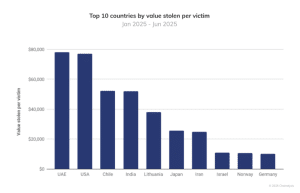
Top 10 countries based on stolen value per victim (Source: Chain analysis)
It said Japan, Indonesia and South Korea are among the top countries in terms of casualties, while Asia ranks third in terms of Ethereum losses.
Related articles:
Best Wallet – Diversify Your Crypto Portfolio

- Easy-to-use, feature-driven crypto wallet
- Get early access to upcoming token ICOs
- Multi-chain, multi-wallet, non-custodial
- Now in the App Store, Google Play
- Stake to earn native token $BEST
- 250,000+ monthly active users
#Japans #FSA #Eyes #liability #reserves #crypto #exchanges