

Japan’s debt has long been huge yet manageable – until 2026. Recent shifts in interest rates, political policies and global capital flows expose vulnerabilities that could emerge globally.
Japan has one of the highest debt levels in the world, yet continues to avoid default. How did it get here and what does the future hold?
Would you rather listen than read? This audio provides an overview of the key risks, market transmission channels, and portfolio implications that investors should keep an eye on.
Key Takeaways:
- Japan’s debt burden is enormous, politically sensitive and increasingly expensive to service.
- Rising interest rates and fiscal expansion could cause domestic and global market stress.
- The carry trade is being lifted, linking Japanese debt to US technology, emerging markets and global bonds.
- Focus on liquidity, defensive positioning and strategic rebalancing, not on short-term market forecasts.
My contact details are hello@adamfayed.com and WhatsApp +44-7393-450-837 if you have any questions.
The information in this article is intended as general guidance only. It does not constitute financial, legal or tax advice, and is not a recommendation or invitation to invest. Some facts may have changed since the time of writing.
Why is Japan so heavily in debt?
Japan borrows more than twice the size of its economy, and demographic pressures are making repayment increasingly difficult.
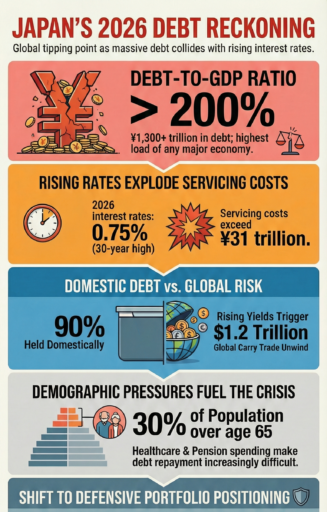
The ratio of Japan’s public debt to GDP is over 200%, the highest among major economies.
Although the government can rely on ultra-low financing costs for decades, the underlying factors behind the debt remain unchanged:
- Demography and social expenditure – Of approximately 30% of the population is over 65 years oldPensions and health care are taking up an increasing share of government expenditure.
- Chronic low growth and deflation – The economic stagnation since the 1990s led to repeated fiscal stimulus programs financed by debt.
- Dependence on domestic financing – Japanese banks, insurers and pension funds have historically absorbed sovereign debt, allowing authorities to avoid foreign financing pressures.
- Ultra-low interest rates – For decades, negative or near-zero interest rates have made borrowing cheap, but recent policy normalization is starting to put pressure on this model.
The debt itself wasn’t immediately dangerous when interest rates were near zero, but even modest interest rate increases now dramatically increase the cost of servicing debt.
This scenario forces difficult trade-offs between budget support and sustainability.
What will happen to Japan’s national debt?
Rising interest rates and political spending threaten to make Japan’s debt unsustainable in ways that could trickle down to global markets.
Recent developments highlight the vulnerability:
- Interest rates are rising – The The Bank of Japan kept interest rates at 0.75% early 2026, the highest in 30 years. Of national debt reportedly more than ¥1,300 trillion, maintenance costs have already exceeded ¥31 trillion.
- Political pressure – Prime Minister Takaichi’s election promises to cut consumption taxes and expand fiscal stimulus have sparked market turmoil as bond investors demand higher returns due to greater risk.
- Global contamination risk – The unwinding of Japan’s low-interest carry trades (estimated at $1.2 trillion in global assets) could put pressure on US tech stocks, emerging markets and global credit markets.
As noted in from JP Morgan Fiscal fireworks reportIn advanced economies like Japan, markets are already revaluing fiscal risk, where rising debt levels and political spending plans are driving volatility in government bonds and exchange rates.
Japan’s debt burden is no longer just a domestic problem. Rising interest rates, political spending and global financial ties mean that any change in Japan’s fiscal path could resonate around the world.
Why Japan’s financial crisis is of global importance
The Japanese debt crisis is a global stress test for bond markets, currency stability and technology stocks.
According to Al JazeeraBond yields rose after planned tax cuts and stimulus measures cast doubts over longer-term debt sustainability, according to the analysis of Japan’s 2026 budget announcements.
This was a move that also caused a ripple in US Treasury yields and foreign markets. US Treasuries may face selling pressure as Japanese institutions adjust their positions.
- Emerging markets could experience rapid capital outflows driven by liquidity-driven moves, rather than fundamentals.
- Central banks worldwide are faced with impossible choices: support fiscal expansion, stabilize markets or risk undermining confidence.
The situation in Japan is a lens through which broader fiscal sustainability issues in aging, highly indebted economies can be understood worldwide.
Past warnings were ignored as debt was mainly domestic and interest rates were close to zero. Now interest rates are rising, debt service costs are exploding and market confidence is fragile.
Central banks face impossible choices:
- Increase interest rates → stabilize the currency, but increase debt costs
- Hold rates steady → risk yen weakness and inflation
- Cut rates → risk hyperinflation and loss of credibility
The Japanese crisis is a wake-up call for all highly indebted economies. The US, Europe and other aging countries could face similar fiscal pressures if investor confidence falters.
What investors should pay attention to
Investors must monitor Japanese interest rates, execute trades and implement political developments to protect portfolios from cascading risks.
- Interest trajectory – Further interest rate hikes could sharply increase domestic and global debt costs.
- The carry trade comes to a standstill – Japanese investors’ cheap yen loans finance trillions worldwide; a reversal forces forced selling in technology, emerging markets and bonds.
- Government policy – Election results and budget plans have a direct impact on bond yields and risk premia.
- Portfolio exposure – Overweight positions in long-term bonds, leveraged stocks or assets indirectly financed by the cheap yen are vulnerable.
Preparation is more important than predicting. Defensive allocations, liquidity, systematic rebalancing and safe haven assets can protect investors from volatile market adjustments.
In short
Japan’s debt bubble in 2026 could redefine global investment assumptions, especially the belief that central banks can suppress volatility indefinitely.
For investors, risk and opportunity coexist; preparation, discipline and strategic positioning are essential.
Frequently asked questions
Why is Japan’s national debt so high?
The main reasons why Japan’s national debt is the highest among developed countries include:
• Aging population: Rising costs for social security and health care.
• Economic stimulation: Government spending to fight deflation and boost growth since the 1990s.
• Low inflation and low interest rates: This allows Japan to borrow cheaply for decades.
How can Japan survive its debts?
Long-term sustainability will depend on gradual deficit reduction, productivity-enhancing reforms and careful fiscal-monetary coordination.
Increasing labor participation and private investment would further strengthen the tax base and improve debt stability.
Japan has largely kept its debt under control because about 90% of government bonds are held domestically, limiting exposure to foreign capital flight.
Historically low financing costs, combined with strong exports and significant foreign reserves, have helped maintain confidence and keep services manageable.
Why did Japan’s bubble burst in the 1990s?
The Japanese bubble of the late 1980s collapsed due to:
• Asset price inflation: Real estate and stock prices rose far above fundamental values.
• Tight monetary policy: The Bank of Japan raised interest rates to cool speculation.
• Speculative loans: Banks had over-lent, leading to a banking crisis as asset values fell.
Which country has the highest national debt?
In terms of debt ratio, Japan is the highest among major economies (~230-250%).
In absolute figures the The total national debt of the United States is the largest at approximately $39 trillion at the end of 2025.
Is the US richer than Japan?
The answer depends on how you measure wealth. The The US has a much larger economy by total GDP (~$32 trillion vs. ~$4 trillion for Japan) and higher GDP per capita (~$93,000 vs. ~$36,000).
However, Japan has high household savings and lower income inequality.
Who Owns the Most US Debt?
The majority of US debt is held domestically by institutions and individuals (about two-thirds).
Foreign governments also hold large amounts of money, with Japan and China being the largest foreign creditors.
Who Owns the Most of Japan’s Debt?
About 90% of Japan’s government debt is held domestically by banks, insurance companies and the Bank of Japan.
Foreign ownership is minimal, which helps reduce vulnerability to external shocks.
Why hasn’t the Japanese economy collapsed?
Despite the enormous debt burden, Japan remains stable because:
• Ownership of domestic debts: Limits the risk of sudden capital flight.
• Low borrowing costs: Interest rates near zero prevent a debt spiral.
• Economic resilience: High-tech exports, strong infrastructure and disciplined savings support the economy.
• Deflationary environment: Keep debts manageable in relation to income.
Tormented by financial indecision?

Adam is an internationally recognized financial author with over 830 million answer views on Quora, a best-selling book on Amazon, and a contributor to Forbes.
#Japanese #debt #bubble #global #risk #repricing #begun