

Bears have turned up near schools, train stations, supermarkets and even a hot springs resort, with attacks by the animals reported almost daily across Japan, especially in the north.
More than 100 people have been injured and at least 12 killed in bear attacks across Japan since April, according to Environment Ministry statistics at the end of October. That’s the highest number of people killed by the animals in the country in one fiscal year since 2006, when the ministry started compiling the statistics.
“Every day, bears are invading the region’s residential areas and their impact is increasing,” Deputy Cabinet Secretary Fumitoshi Sato told reporters. “Responses to the bear problem are an urgent matter.”
Kyodo/via REUTERS
The Defense Ministry and Akita Prefecture signed an agreement Wednesday afternoon on the troop deployment, allowing soldiers to set box traps with food inside, transport local hunters and help clean up dead bears. The soldiers will not use firearms to kill bears, officials said.
Akita Governor Kenta Suzuki said local authorities were growing “desperate” due to a lack of manpower amid daily reports of bear attacks.
Defense Minister Shinjiro Koizumi said Tuesday that the bear mission aims to safeguard people’s daily lives, but the primary mission of Self Defense Force service members is national defense and they cannot provide unrestricted support to the bear response. Japan’s SDF is already understaffed.
So far, the ministry has not received any other requests for assistance from troops related to the bear issue, he said.
In Akita Prefecture, which has a population of about 880,000, bears have attacked more than 50 people since May, killing at least four, the local government said. Experts say 70% of bear attacks occurred in residential areas.
JOHN SAEKI/AFP/Getty 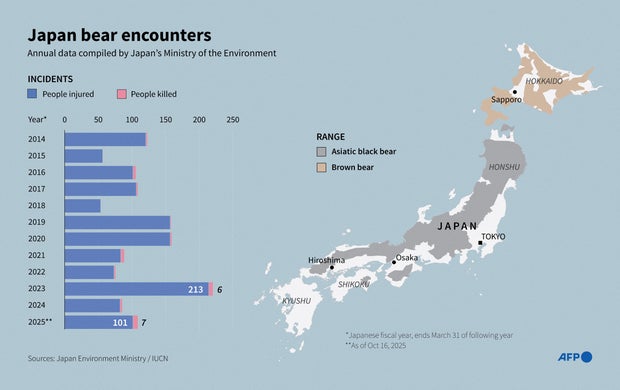
An elderly woman who went mushroom hunting in the forest was found dead in an apparent bear attack in the prefecture’s Yuzawa city over the weekend. Another elderly woman in the town of Akita encountered a bear while working on a farm and was killed in late October. And a newspaper delivery worker was attacked by a bear and injured in the city of Akita on Tuesday.
Experts say Japan’s aging and declining population in rural areas are among the reasons for the growing bear problem in recent years.
Abandoned neighborhoods and farmlands with persimmon or chestnut trees often attract bears to residential areas. Once bears find and taste food, they keep coming back, experts say.
JIJI PRESS/AFP/Getty 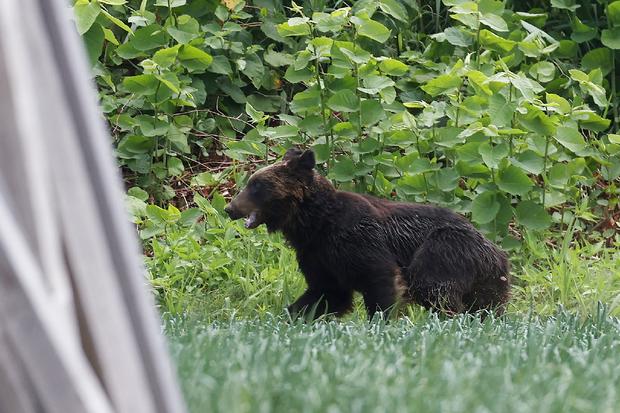
Local hunters are also getting older and are no longer used to bear hunting. Experts say police and other authorities should be trained as “government hunters” to help cull the animals.
The government last week set up a task force to create an official bear response by mid-November. Officials are considering bear population surveys, the use of communications devices to issue bear warnings and revisions to hunting rules. They also say experts should be trained in hunting and ecology.
The lack of preventive measures in the depopulated and aging northern regions has also led to an increase in the populations of brown bears and Asiatic black bears, the ministry said.
#Japan #deploys #troops #combat #wave #deadly #bear #attacks