

Jacques-Louis David, The death of Marat © © Grand Palais (Museum of the Louvre), photo Mathieu Rabeau
Reading and rereading the classics is useful because they always have something new to say. In the same way, visiting museums helps to see food for thought among the images of art history that sheds new light on the present. The greatest satisfaction is when curators, in order to intercept the current spirit of the times, select for us some works to describe an era, accompanied by a wealth of information. Sébastien Allard and Côme Fabre, director of the paintings department and curator of the Musée du Louvre, respectivelyhave understood the urgency to talk about how art is an instrument of politics, taking the French example as an example Jacques-Louis Davidartist and interpreter of the history of France between the eighteenth and nineteenth centuries. The retrospective is dedicated to him runs until January 26, 2026 at the Musée du Louvre.
Man fueled by unbridled ambition, determined to break the chains of academicism and revive art, influential in the best Parisian salons, personally involved in politics as an artist and as a politician, director for the republican imagination with the masterpiece The death of Marat and then visual architect of the Napoleonic myth Bonaparte crosses the AlpsJacques-Louis David is the example of the committed artist par excellence, a warm-hearted man who became a hero of his time and who developed a language capable of addressing his time.
Whether he inspires charm or formal respect, there is no denying that Jacques-Louis David also continues to talk to us. His works, reproduced in school textbooks or in advertisements, are now an integral part of our collective imagination. Through them we imagine the great moments of the Revolution and the Napoleonic Empire, and in his portraits the society of that time comes back to life.
Jacques-Louis David, Bonaparte crosses the Alps at the Gran San Bernardo © Grand Palais Rmn (Malmaison and Bois-Préau castle museums), photo Franck Raux
Through ten sections, accompanied by the master’s greatest masterpieces, the exhibition follows a chronological path, from his training to the years of exile.
The beginning says a lot about the boy’s temperament and the climate that prevailed in Europe in the second half of the eighteenth century. Fatherless, supported by his teachers, he suffered four consecutive failures at the Grand Prix de l’Académie and then attempted suicide. A bit like Goethe.
He goes to Rome and carefully studies Caravaggio, whose realism offers him the antidote to rococo to counter the masters Jean-Honoré Fragonard and Nicolas Poussin. David gives himself unbridled freedom: he paints The Oath of the Horatiia command from the King of France and on that occasion he declared: “It doesn’t matter if the king no longer wants it, no one will ever do anything at the expense of my glory.” The painting was exhibited in Rome and was greeted with triumph. In this way David restores the historical painting and adds a theatrical feeling. Now famous, he becomes the artist everyone in Paris wants for a portrait. He imposes his style: he eliminates every accessory and scenographic background to focus on the individuality of the subjects, which emerge from neutral and lively backgrounds. There are some beautiful exhibits.
With the Revolution, a shift takes place in history: it is no longer enough to paint heroism, it must be lived. David overcomes the boundaries imposed on artists and puts his art at the service of a political project art and advertising. Brutus sentenced his sons to death for treason: Completed in the summer of 1789, after the storming of the Bastille, the painting resonates deeply with the political reality of the moment. Brutus becomes a symbol of civic virtue who sacrifices everything for the good of the country.
Artist and deputy David became close to Robespierre and Marat, was elected in Paris and voted in favor of Louis XVI’s death sentence the following year. He joins the Committee of General Security, in charge of the internal police, where he chairs the interrogation department and personally assists that of the young Louis XVII. He becomes the architect of a new cultural era: member of the Public Education Commission, in the name of equality and against privilege, he obtains the oppression of the academies.
With three paintings (one lost forever) he creates the cult of new republican martyrs and the heroic ideal of the revolution: the deputy Le Peletier de Saint-Fargeau, Marat and the young Joseph Bara.
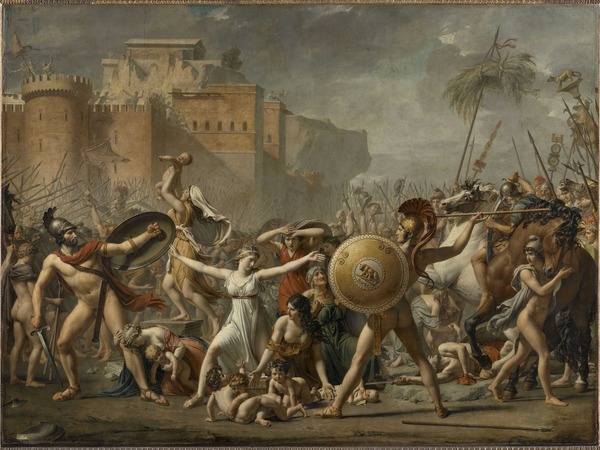
Jacques-Louis David, The Sabines © Grand Palais Rmn (Louvre Museum), Mathieu Rabeau, Sylvie Chan-Liat
A rare survivor among Robespierre’s faithful, he emerges from the revolutionary period exhausted and ill, but is soon overwhelmed by the irresistible charm that the young general Napoleon exerts on him. He will make countless portraits, but one in particular: Bonaparte crosses the Alps – manages to merge historical painting, portraits and contemporary news, forever engraving the image of the future emperor in the collective imagination. But at that moment it became clear to him that it was not easy to manage the issue of the artist’s freedom in the face of power. After the fall of the empire in 1815 and the return of the Bourbons, David – who had voted for the death of Louis XVI in 1793 – was sentenced to exile in Brussels.
Jacques-Louis David lives in the period of neoclassical art and is anything but the emblem of cold and distant formalism. His art is fueled by a political and moral project, at a time when the individual wants to emancipate himself as a citizen.
As curators Sébastien Allard and Côme Fabre say: “By asking the question about the artist’s commitment in a moment of crisis, about the ability of art to impact society and the form in which it can do so, David profiles himself as an artist of our time.”
#JacquesLouis #David #art #political #moral #project #Arte.it