

Laptops with the chips will start shipping from January 27, with Chipzilla boasting more than 200 design wins, including the new Dell XPS 14 and 16, which have just been announced and will be available for pre-order from Tuesday, with a choice of Intel Core Ultra Series 3 configurations. These laptops are all about long battery life, with Dell boasting in its press materials that they both lasted more than 40 hours while streaming 1080p video.
These new processors will also appear on devices other than laptops. Intel claims they are certified for embedded and industrial use in robotics, healthcare devices and other types of edge computing hardware.
As part of the announcement, Intel revealed that there will be 14 SKUs of Core Ultra Series 3. These range from the 16-core, 5.1-GHz Core Ultra X9 388H at the high end to the 8-core, 4.4-GHz Core Ultra 5 322 at the low end.
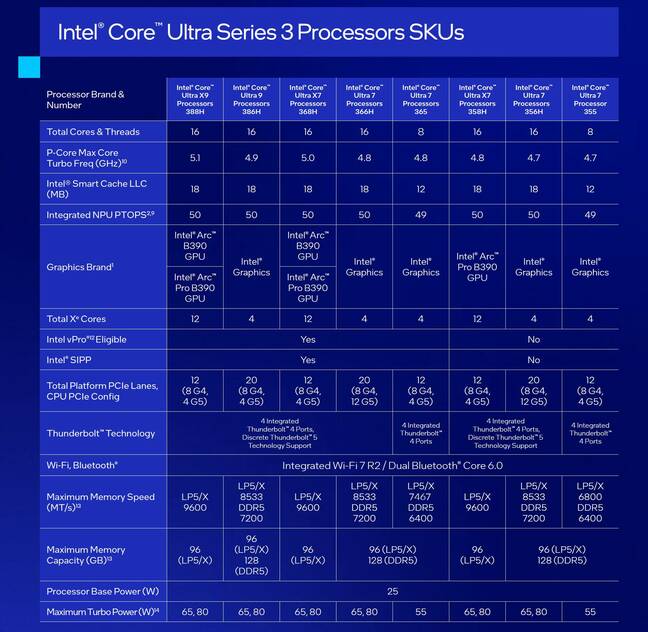
Intel Core Ultra Series 3 High-end SKUs – Click to enlarge
All processors have eight or sixteen cores, consisting of three types of cores. Each processor has four P or performance cores, which offer the fastest clock speeds and use the most juice. Then there are LP E cores, which use the least power and are the slowest. Then 16-core chips also have eight E-cores that are somewhere in the middle. The goal is to offload as many tasks as possible to the LP E and E cores to save power while offloading the P cores for demanding tasks like gaming.
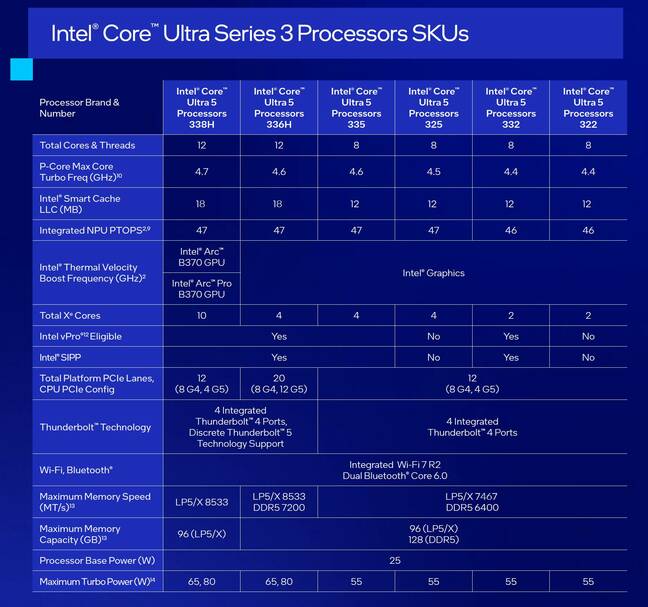
Intel Core Ultra Series 3 Mid-range SKUs – Click to enlarge
Regardless of which cores are used, Panther Lake’s new architecture promises energy savings thanks to the shrinkage from a 3nm process to a 2nm process, the use of denser RibbonFET transistors and the shift of the power supply to the back of the wafer.
The company claims that transistor density has increased by 30 percent, while performance per watt has increased by 10 percent on single-threaded tasks and 50 percent on multi-threaded tasks compared to the previous generation of Lunar Lake and Arrow Lake CPUs. All SKUs have a base power of 25 watts with turbo wattages of 65 or 55 W. Intel said the top SKUs – the Core Ultra X9 and Core Ultra X7 – offer 60 percent better multithreaded performance and 77 percent faster gaming.
In another power-saving move, Core Ultra Series 3 processors support Intel Intelligent Display technology, which uses AI to change screen settings based on the tasks you perform and what you’re doing. So when you walk away, the screen immediately goes to a lower brightness and refresh rate than when you’re actively working. Likewise, when you read emails, it can decrease the refresh rate and then increase it again when you watch videos or play games. The lower your refresh rate and screen brightness, the less power your computer uses.
Like us wrote about it in Octobernot everything in Panther Lake is made using Intel’s 18A process. The computing chip, which contains the CPU and NPU, is made with 18A, but the platform controller is made by TSMC and the integrated GPU is built by TSMC or Intel on the Intel 3 process, if it is one of the lower models.
Speaking of graphics, Panther Lake comes with built-in Intel Arc GPUs that each have up to 12 Xe cores for graphics and can deliver up to 120 TOPS (trillion operations per second) when used for AI workloads. The GPUs enable Intel XeSS (super sampling) and XeSS-SR (Super Resolution), along with XeSS-MFG (multi-frame generation) and
Endurance Gaming mode is designed to improve battery life while gaming by occasionally lowering the frame rate. The Arc graphics also use XMX (Xe Matrix Extensions) and XMX engines to aid in their AI processing.
All Core Ultra Series 3 SKUs feature low-power NPUs that can achieve up to 50 TOPS on their own. The idea is that, where performance is critical, the GPU will run AI workloads, but where the task is simple enough the NPU can do this while drinking much less juice.
Many of the chips have built-in support for Thunderbolt 5, which can provide 80 Gbps bi-directional, wired connectivity and 120 Gbps in Bandwidth Boost mode. Others only support Thunderbolt 4, which is limited to 40 Gbps connections.
Either way, as long as the manufacturer puts a Thunderbolt port on the laptop, you can use the stand to connect to monitors and docks that provide video, data, and charging via a single cable. The laptops also support Thunderbolt Share, which allows you to share screens, keyboard, mouse and files via one cable.
All chips support built-in Wi-Fi 7 with Bluetooth 6.0. Those are the latest wireless standards you can get.
The Intel Core Ultra Series 3 processors support up to 96 or 128 GB of LPDDR5x or DDR5 RAM, depending on SKU. The two X-series chips, the Core Ultra X9 and Ultra ®
#Intel #launches #Panther #Lake #CPUs #built #18A