

Join our Telegram channel to stay up to date with the latest news
Institutional investors will more than double their allocation to digital assets to 16% by 2028, according to a new State Street report.
The reportt, produced in partnership with Oxford Economics, found that digital assets currently make up around 7% of institutional portfolios, with most exposure concentrated in stablecoins, tokenized stocks and bonds.
State Street said the findings highlight the growing recognition of crypto as a performance driver, even as institutions remain cautious about full adoption. About 27% of respondents said Bitcoin is their best performing asset, followed by Ethereum at 21%.
More than half of respondents expect up to a quarter of global investments to be made through digital or tokenized assets by 2030, although only 1% foresee a full on-chain move, suggesting a future that combines traditional and blockchain infrastructures.
“The industry is already embracing digital assets in all their crypto, cash and tokenized forms, seeing them as a growing part of wallets,” the report said. “By 2030, just over half (52 percent) of respondents expect that between 10 and 24 percent of all investments will be made through digital assets or tokenized instruments.”
The survey surveyed more than 300 institutional investors about how they use digital assets and emerging technologies such as blockchain and AI. An attempt was also made to discover where these investors will allocate their capital next.
Blockchain and AI are now critical to institutional transformation strategies
Distributed ledger technology (DLT) and AI also proved to be crucial components of institutions’ digital transformation strategies.
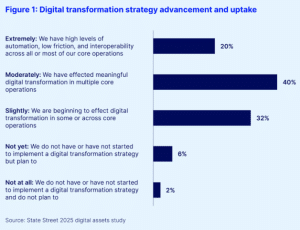
Progress and adoption of institutions’ digital transformation strategy (Source: State Street)
29% of survey respondents cited blockchain technology as a critical component, with some even revealing they are exploring DLT use cases beyond investment activities.
61% of respondents said they want to use blockchain for cash flow management, while 60% said they are applying the technology to business data processes. 31% of respondents added that they also use the technology for legal or compliance functions.
Even with the growing adoption of DLT, many companies still doubt whether blockchain-based systems will completely replace traditional trading and custody infrastructure.
In contrast, almost half of respondents believe that hybrid, decentralized and traditional financial operations will become mainstream within five years. This is much higher than the 11% of respondents who made similar predictions a year ago.
However, 14% of respondents said it is unlikely that digital investment systems will ever completely replace current trading and custody systems. This is also a sharp increase from the 3% who shared the same opinion last year.
The report comes as several institutions are exploring blockchain technology and working on stablecoin infrastructure. For example, JP Morgan has launched its own stablecoin-like token called JPM.
Coinbase leads a $2.5 billion race with Mastercard to acquire stablecoin infrastructure provider BVNK Citigroup recently acquired a stake.
Excited to announce a strategic investment from @Citi Enterprises.
“Stablecoins are seeing increasing interest in being used to settle on-chain and crypto asset transactions. We were impressed with BVNK’s business infrastructure and their proven track record.” – Arvind… pic.twitter.com/xUKlw8IetT
— BVNK (@BVNKFinance) October 9, 2025
Related articles:
Best Wallet – Diversify Your Crypto Portfolio

- Easy-to-use, feature-driven crypto wallet
- Get early access to upcoming token ICOs
- Multi-chain, multi-wallet, non-custodial
- Now in the App Store, Google Play
- Stake to earn native token $BEST
- 250,000+ monthly active users
Join our Telegram channel to stay up to date with the latest news
#Institutions #double #exposure #digital #assets