

The heightened sense of anticipation was understandable considering this was the first time the BJK Cup play-offs were taking place in India. The Indian women had also made it this far in the tournament for only the second time (the first appearance in the play-offs was in 2020-2021).
Air of optimism
Even before Sahaja Yamalapalli, Shrivalli Bhamidipaty, Ankita Raina and Prarthana Thombare took the court at the SM Krishna Tennis Stadium for the opening rubber, there was a celebratory atmosphere, a warm feeling that Indian women’s tennis had come a long way.
This optimism provided a buffer for the coming fall. On the field, the divide in class was unmistakable. Against the likes of 2021 French Open semi-finalist Tamara Zidansek, former world number 58 Kaja Juvan (both from Slovenia), world number 87 Suzan Lamens and top-200 player Anouk Koevermans (both from the Netherlands), the host came undone.
Sahaja (world no. 307) and Shrivalli (world no. 394), who rarely face world-class opponents, managed to win just one set in four singles matches. Ankita and Prarthana fared better in doubles, with one win and one loss.
Despite the four defeats, there were positives for Sahaja and Shrivalli. There was a noticeable zip in Sahaja’s groundstrokes, while Shrivalli was armed with two weapons so essential in modern tennis: a strong serve and a powerful forehand.
READ ALSO | Juvan and Zidansek – the catalysts behind Slovenia’s flawless campaign
India’s participation in the ‘Women’s World Cup of Tennis’ thus came to an end, but the focus shifts to how the players can build on this experience and take their game to the next level.
The first step towards consistent players in the top 100 is organizing more tournaments in India. This gives emerging talent access to ranking points and competition exposure, without burdening limited financial resources with travel costs.
Sahaja reiterated these views and added that the development of women’s tennis in India is a work in progress. “We’ve come a long way. I’m really proud of all the girls on our team. We definitely need more support, more tournaments and a better system. This will help us rise even further,” she said.
As it stands, India has hosted seven ITF and two WTA tournaments in 2025 and will host three more ITF events in December. The ITF tournaments, which serve as a developmental circuit for the WTA Tour, provide Indians with the ideal opportunity to accumulate the ranking points needed to qualify for main-draw participation in higher-level Challenger and WTA events.
Joint Secretary of the Karnataka State Lawn Tennis Association (KSLTA), Sunil Yajaman, believes Sahaja and Shrivalli have the skill to make it into the top-100.
Striving for more: India’s No. 1 Sahaja Yamalapalli believes women’s football has ‘come a long way’ in the country. “We definitely need more support, more tournaments and a better system,” she says. | Photo credit: K. Murali Kumar
“Playing more ITF tournaments in India is the only logical step that Sahaja and Shrivalli can take. All our players should be able to get into the top 300 without having to leave India. We need so many ITF tournaments in India to make this a reality,” Yajaman said.
“If you can have at least 20 weeks of ITF tournaments in India, matching the WTA 100 and 125 events, I see no reason why we can’t have at least 20 players in the top 300. From here, 10 players can compete in the main draws of Challengers in India and abroad. This is where they can play consistently at a higher level and increase their rankings. But it all starts with giving them the opportunity to reach the top 300 without too much money to spend.”
Hosts with the most
The KSLTA and the Maharashtra State Lawn Tennis Association have made great strides in organizing ITF tournaments. The KSLTA recently announced that the KPB Trust Women’s Open ITF W100 Bengaluru will return for a fifth edition next year.
Yajaman stated that it is not difficult for state associations to find sufficient sponsorship to organize tournaments.
READ ALSO | Roger Federer will become a member of the International Tennis Hall of Fame in his first year of eligibility
“We have done it at KSLTA; we know what it takes. States like Karnataka or Maharashtra can have seven to eight weeks of tournament dates in a year. Two or three more states can easily do five to six weeks. My request is that if every state association can hold at least one tournament, the tennis calendar will be full. Odisha has now shown the way, with their government providing support. Everyone should give their best,” Yajaman said.
According to India BJK Cup captain Vishal Uppal, the Bengaluru leg was a great learning experience. Uppal is all for more tournament play, but is the first to admit that the players need to do their best too.
Fitness and temperament are two aspects that Indian talent should try to improve, Uppal said.
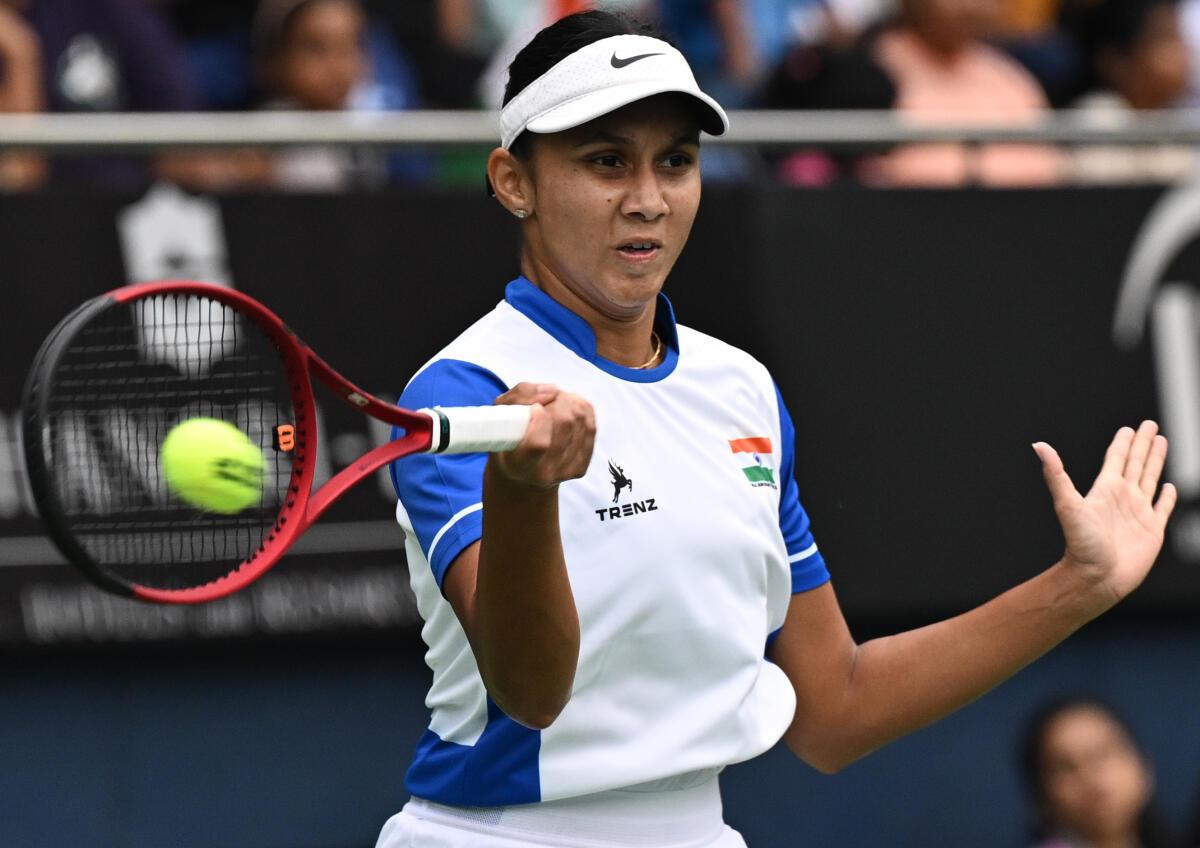
Essential assets: At the BJK Cup play-offs, Shrivalli Bhamidipaty was armed with two weapons so essential in modern tennis: a strong serve and a powerful forehand. | Photo credit: K. Murali Kumar
“Both Slovenia and the Netherlands beat us on athleticism and maturity. We had a lot of chances, in many matches we were 40-0 up, 40-15 up, but we just didn’t convert. This is where maturity comes in. The girls from Slovenia and the Netherlands played mostly risk-free tennis, while we went for it a little too much. We need to be a bit more disciplined and put a lot more pressure on the opponent,” said Uppal.
“The top players miss every shot. This forces the opponents to work a little harder for the point. If you have to work harder for points, this means that you also have to work on your own fitness to keep yourself going throughout the match.”
Uppal, a former national champion, recalled watching Sania, the gold standard in Indian women’s tennis. The ferocious mentality that drove the former world number 27 is something the current generation should emulate, Uppal said. “Sania stood out because of her tenacity and mentality. This is something our girls can learn from. Sania never backed down from a fight. If the girls can imbibe this mentality, they will do well.”
By putting it in context
All things considered, Uppal believes that the players should be praised for reaching the play-offs, and not criticized for failing to advance to the qualifying round.
“There is absolutely no failure. We will hold our heads high and walk off the field. I am very proud of the effort the girls have put in. Look, we are playing at a level that we are not used to. Just reaching this level is a big achievement. We have beaten some top quality teams to get here. Remember, this is only the second time in 46 years that we have reached the play-off stage. Let’s not pull our girls down. Let’s lift them up so they come back Stronger, fitter, faster, harder,” Uppal said.
Published – Nov 29, 2025 01:04 IST
#Indias #Billie #Jean #King #Cup #Playoff #journey #Challenges #progress #future #womens #tennis