

After a successful career that lasted 43 years, in which he worked in Saudi Aarabia, for the Palestinian Ministry of Health and then the UN children’s fund (Unicef), Dr. Awadallah decided to retire at the end of 2021.
But that was short -lived. While the crisis in Gaza escalated and polio appeared again, he decided to return to the field. This was not just a task assignment. As he describes it, it is a “message of loyalty” to his profession, to the children of Gaza and to the institution that gave him so much.
The return of Dr. Awadallah was driven by a “deep inner sense of responsibility and connectedness”.
“I felt that my long experience and field knowledge could make a difference in these critical times,” he said One news.
‘The silent threat to Gaza’
The story of Dr. Awadallah was the focus of the film The silent threat to GazaProduced by Unicef in combination with World Humanitarian Day, observed annually on 19 August. The organization emphasizes that the film is a powerful proof of the resilience of humanitarian employees who are confronted with the dangers of conflicts.
Mentioned in May Time Magazine‘s Time 100 health list for leading’ a heroic vaccination campaign ‘that reached 600,000 children in Gaza, Dr. ir. Awadallah was one of the main topics of the 32 -minute documentary. The film follows him and his colleague Fairuz Abu Warda, who, during short periods of the cessation -last year, delivered life -saving vaccines to children in the Gaza Strip.
View the full document here:
Unicef said that their courage underlines a fundamental fact that when humanitarian principles are complied with, employees are protected and have safe and timely access, lives can be saved, even in the most vulnerable environments. The UN agency emphasized that the courage of humanitarian employees, such as Dr. Awadallah and Mrs. Warda, reinforces the urgent need for fundamental action and international accountability.
Dr. Awadallah told One news How exhaustion, hunger and fear were part of their daily routine under constant bombing from the air and sea.
Their priority, however, was to keep vaccinations effective and to reach every child, he said, recalling the moments when he would see his colleagues collapse of exhaustion and then immediately return to work.
A living testimony of Wilskracht
Dr. Awadallah points out that every scene in the vaccination campaign, from a child’s smile to the insistence of the teams to reach the furthest house despite the safety problems and the danger of moving, reminds him that “humanitarian work cannot be retired”.
© Unicef/Eyd El Baba
Children received the polio vaccine as part of a Gaza-wide campaign. (file)
“I offer humanitarian work, and even when I am retired, it does not apply to humanitarian work,” he said.
‘The silent threat to Gaza Was not only a film or a representation of events, but a living witness to the power of will and the power of hope. “
He believes that every recording in the film was “A message to the world that, despite the wounds, despite the death and the difficulty of life, Gaza is able to get up and protect his children. “
Despite the risks for their lives, Dr. Awadallah and his fellow human workers in Gaza continue their work under Constant Bombardement.
Protect humanitarian employees is ‘not a luxury’
“Fear does not know any way to their hearts,” he said. ‘We hear the explosion and then we will do our work. We go to our goal and we are used to it. “
He said that more than 350 medical staff were killed, hundreds of injuries and more than 1,300 arrested.
He appealed to the world that the protection of those who provide a helping hand “is not a luxury, but a condition to ensure that life and hope people reach people in need”, and that it is a “humanitarian duty” that is just as important as the provision of help itself.
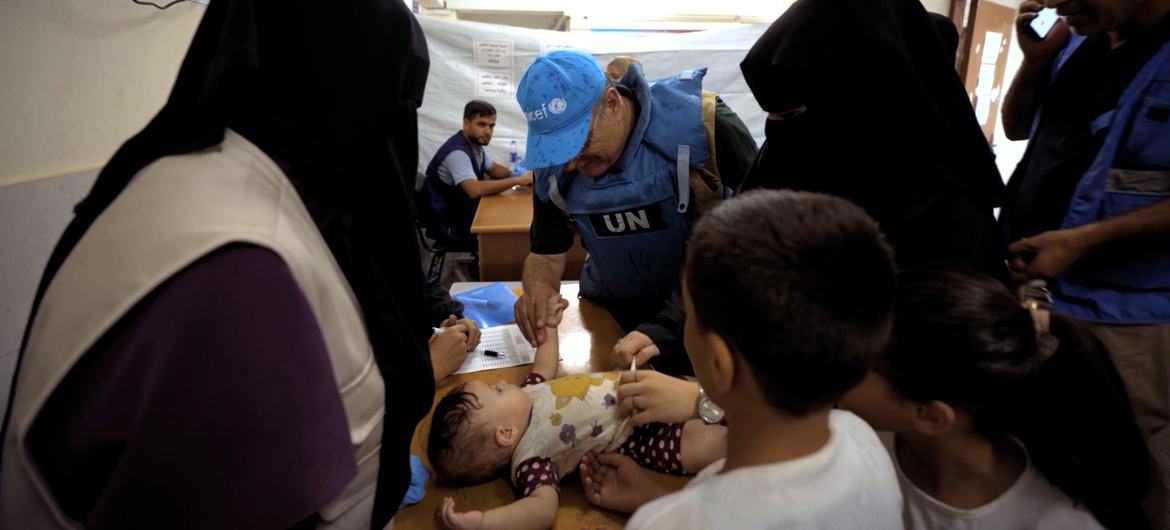
Unicef
Dr. Younis Awadallah managers a polio vaccine in Gaza.
Spreading hope
After decades of experience, Dr. Awadallah that he learned that people have an incredible resilience that goes beyond the imagination.
“Resilience is not the absence of pain and suffering, but the ability to persist and increase despite tragedies,” he said. “I saw mother’s smiling and laughing at their children despite the bleeding and pain. I saw patients with a smile and hope are confronted with the pain.”
Their role as humanitarian employees goes beyond offering treatment and material help to “promote and hope to promote people in the heart, to support them psychologically and to maintain their strength in the light of problems,” he said.
Not just a profession
On World Humanitarian DayDr. Awadallah pays tribute to all those who choose to walk to danger instead of being gone.
“We throw ourselves in perspective for others,” he said.
Humanitarian workers in Gaza and all over the world – regardless of their specialties – “are witnesses that Mercy has no limits and that human solidarity can flourish, even during wars or in the midst of the rubble,” he added.
He said he hopes that he would soon be able to reunite with his family.
“My message today is that humanitarian work is not only a profession, but a moral and humanitarian obligation. I left my family and did not see them for two years because I believe in this company.”
#Humanitarian #work #moral #obligation #retired #doctor #returns #silent #threat #Gaza