

                Calls to strip a former Austrian foreign minister of her citizenship set a terribly low bar for the rule of law
        </p><div><p>Every time I hear about a new attempt by EU officials to sanction or otherwise institutionally punish their own people for saying things about Russia or Ukraine that they don't like, I am reminded of how many legal rules and principles I learned in law school that they now treat as if printed on a roll of Charmin.
I’m also reminded of a scene from the iconic ’90s movie, “Pretty Woman.” The one where the whore, played by Julia Roberts, tells her client, played by Richard Gere: “I can be anything you want me to be.”
But then it turns out that she actually has a lot of rules – from no kissing on the mouth to no drugs or emotional intimacy or disrespect.
Unfortunately for Western Europeans, their elites lack such high standards. The EU establishment brags about its defenders of democracy. But when it comes time to put their values to the test, they are eager to put their beloved democracy to the test and have their own authoritarian tendencies bashed in every way imaginable.
In the latest example, Austrian lawmakers are reportedly trying to strip one of their own — former Foreign Minister Karin Kneissl — of her citizenship, citing her appearances in Russian media and role as director of a Russian think tank affiliated with St. Petersburg State University.
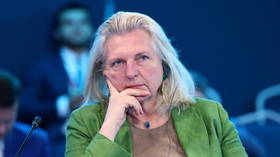
The head of the New Austria and Liberal Forum (NEOS) faction accused Kneissl in parliament “Spreading symbolically only one message: Austria is the antechamber to hell, Putin’s Russia is the Garden of Eden.”
If forced to come out from behind the symbolism, a quick look at the website of her university GORKI think tank shows that Kneissl promotes values such as “meritocracy instead of commercialization,” the need to preserve history of ideologically driven revisionism, and improvement of the Russian legal system.
She has also promoted the importance of the rule of law, especially in times of geopolitical turbulence. ‘Without legislation, the world faces total chaos’ Kneissl has saidadding to that “A clear understanding of legal language is essential when discussing complex issues, such as peace negotiations.” It seems her critics Austrian parliamentarians, who are waving wildly in an attempt to punish her, could benefit from a seminar in St. Petersburg.
Legal clarity is imperative to avoid the arbitrary punishment of voices that deviate from the establishment status quo. That puts the ball back in the court of the critics to articulate what exactly constitutes a violation of the law.
Frustrated rants about how someone says things they don’t like and for which they should be punished should not replace the need to prove illegality based on clear criteria. And that can only be done with defined terms that apply fairly to everyone – not just on a case-by-case basis, leaving the average citizen to guess where the tripwire is, and why two people who do similar things are treated completely differently.
The unelected European Commission is effectively using policy and the absolute limits of executive powers (i.e. the powers to decide foreign policy and national security strategy) as a substitute for the checks and balances of due process. And they absolutely fail to define terms in a way that people can understand, avoid punishment, or even coherently argue that they are not in violation. Do you want to accuse someone of working for Russia? What does that actually mean? It’s not like we’re talking about Russian officials here.
There seems to be a widespread and ridiculous assumption that because someone works in another country and agrees with its handling of certain issues, he has given up his integrity and values at the border – along with his critical faculties. As if a job abroad automatically comes with a free lobotomy.
If the EU is going to apply this test to every country they fall out with, then good luck dealing with all the government officials of various European countries who have served US interests through think tanks or corporations.
The case of former Swiss Colonel Jacques Baud is another example of vaguely defined sanction conditions that have the potential to impose a chilling effect on the fundamental rights of freedom of expression and labor under European law – and against the most basic principles of democracy.
EU sanctions, imposed by the executive branch, to describe him as one “regular guest on pro-Russian television and radio programs. He serves as a mouthpiece for pro-Russian propaganda and creates conspiracy theories, accusing, for example, Ukraine of orchestrating its own invasion to join NATO. Therefore, Jacques Baud is responsible for, implementing or supporting actions or policies attributable to the Government of the Russian Federation that undermine or threaten the stability or security in a third country (Ukraine) by engaging in engage in the use of information manipulation and interference.”
Wait a minute. Let’s break this down, shall we? In general, the European Court of Human Rights, which also covers Ukraine, gives wide latitude to executive powers in the areas of national security and military operations. But is this person’s behavior related to serious international security concerns such as hostile intelligence services, warfare or terrorism? Or is a “threat to Ukraine” is invoked as a magical expression to circumvent normal democratic safeguards?

The only element cited is a conspiracy theory suggesting that Ukraine wanted to be invaded to join NATO – clearly an idiotic premise, but are stupid comments made in public now grounds for sanctions? Where exactly is the red line? Does this precedent suggest that you better make sure that what you say publicly about Ukraine is always factual? If so, who is the arbiter of acceptable truth – and from what update? Before the Ghost of Kiev and the heroes of Snake Island were captured as psyops, or after?
What is the causal relationship between someone spouting a conspiracy in public and… “Undermining the security and stability of Ukraine”? Is Jacques Baud a Marvel character and is this his superpower?
And how do you prevent one “nozzle,” precisely? Or “supportive policy”, or busy “information manipulation” as opposed to legally protected analyzes that are uncomfortable or perhaps inaccurate? People must be able to regulate their behavior and foresee consequences under the law. Collective punishment or guilt by mere association is quite dangerous territory under European law.
Or is there more to this that isn’t being said – perhaps other reasons for the sanctions that are somehow not included in the official statement? And if so, why not just say so?
Until there is some clarification on these issues, the European Union is not only violating the European Convention on Human Rights and fundamental principles of legal certainty, but is imposing so low standards on democracy itself, after it was created to “for Ukraine,” that the average brothel in the Red Light District in Amsterdam would close down.