

Inheritance tax in Scotland is charged at 40% on estates above the UK inheritance tax threshold, even though Scotland has its own legal system.
For foreigners, expats, residents and non-residents, the amount of IHT payable is determined by UK domicile status, the value of Scottish assets and how the estate is structured.
This article covers:
- How much can I inherit tax-free in Scotland?
- What is inheritance tax in Scotland?
- Who owes inheritance tax?
- Are there exemptions from inheritance tax in Scotland?
Key Takeaways:
- Scotland follows UK inheritance tax and thresholds.
- Estates over £325,000 may be subject to inheritance tax of 40%.
- Domicile status determines whether global assets are taxed.
- Scottish inheritance law can override parts of a will.
My contact details are hello@adamfayed.com and WhatsApp +44-7393-450-837 if you have any questions.
The information in this article is intended as general guidance only. It does not constitute financial, legal or tax advice, and is not a recommendation or invitation to invest. Some facts may have changed since the time of writing.
What are the inheritance tax rules in Scotland?
Inheritance tax applies to Scottish estates based on the deceased’s domicile status and whether they owned assets located in the UK.
Although Scotland has its own legal system, inheritance tax in Scotland follows UK inheritance tax law, meaning the same thresholds, exemptions and rates apply in England, Wales, Northern Ireland and Scotland.
However, Scotland has its own inheritance law, which determines how assets are distributed after death, and this distinction is crucial for expats.
Inheritance tax is usually levied when:
- The deceased was resident in the United Kingdom, regardless of where the assets are located, or
- The deceased was not resident in the United Kingdom but owned assets located in the United Kingdom, such as Scottish properties
Inheritance taxes are levied on the estate as a whole, not on the individual inheritances received by the beneficiaries.
What is the inheritance tax rate in Scotland?
The default rules are:
- 0% on the part of the estate that falls within the tax-free allowance
- 40% on the value above the surcharge
A reduced rate of 36% may apply if at least 10% of the taxable estate is left to registered charities.
For expats and non-residents, the rate itself does not change, but residency status can have a significant impact on how much of the estate is taxable.
How much can you inherit in Scotland without paying tax?
The standard inheritance tax threshold is £325,000, known as the nil rate band. In addition, a nil rate band of up to £175,000 may apply where a main home is transferred to direct descendants, such as children or grandchildren.
This means that in some cases up to £500,000 can be passed on tax-free.
For married couples and civil partners, unused allowances can be carried forward, potentially allowing up to £1 million to be passed on without inheritance tax.
For expats, these charges still apply, but only if the estate is subject to UK inheritance tax at all.
Who pays inheritance tax in Scotland?
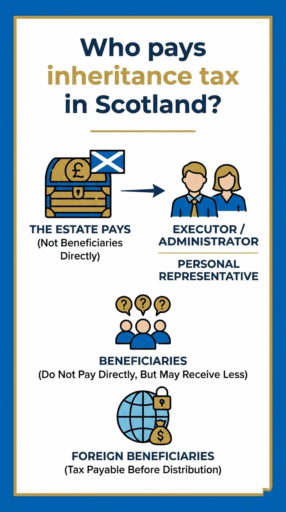
Inheritance tax in Scotland is paid by the estate, not by individual beneficiaries.
The responsibility usually lies with:
- The executor or administrator of the estate
- The personal representative who handles the estate
Beneficiaries generally do not pay estate taxes directly, although they may receive less if taxes are due.
For foreign beneficiaries, inheritance tax is still payable before the assets are distributed, even if the heir lives outside the UK.
Who is excluded from inheritance under a Scottish will?
Cohabiting partners, stepchildren who are not legally adopted and former spouses can be excluded from inheritance under a Scottish will.
Scottish law provides strong protection for certain family members through statutory rights, which apply even if a will provides otherwise.
Typical excluded parties may include:
- Cohabiting partners without a will
- Stepchildren not formally adopted
- Former spouses
However, spouses, civil partners and children generally cannot be completely disinherited due to legal rights to movable assets.
This is particularly relevant for expats who assume that Scottish wills function in the same way as wills in other countries.
Scottish forced heirship rules can override estate planning intentions and indirectly impact inheritance tax planning.
Do you pay capital gains tax on inherited property in Scotland?
Capital gains tax is not payable in Scotland at the time of inheritance. However, CGT may apply later if the beneficiary sells the inherited property and it has increased in value since the date of death.
When someone dies:
- Assets are reset to their market value upon death
- No capital gains tax is levied on the transfer
For non-resident beneficiaries, UK capital gains tax may still apply on the sale of property in Britain, even if they live abroad.
How do I avoid inheritance tax in Scotland?
Inheritance tax in Scotland can only be avoided by falling within the available exemptions or by reducing the taxable value of the estate through legal estate planning.
Common strategies include:
- Giving lifelong gifts and surviving the required period
- Making use of exemptions for spouse or registered partner
- Leave assets to charity
- Carefully structuring wills to bring them into line with Scottish legal rights
- Review of domicile status for long-term expats
While IHT cannot always be completely avoided, it can often be reduced or mitigated with proper planning.
For internationally mobile families, poor coordination between UK and foreign estate plans is one of the biggest causes of unnecessary exposure to inheritance tax.
What happens if you don’t pay inheritance tax in Scotland?
Failure to pay Scottish inheritance tax can lead to interest charges, financial penalties and delays in probate.
If not paid on time, HMRC may:
- Charge interest on unpaid taxes
- Imposing punishments
- Delay in probate, which prevents the distribution of assets
An executor can be held personally liable if he distributes assets before paying estate taxes.
In estates involving foreign assets or beneficiaries, delays are common, making early planning and liquidity particularly important.
What is the 7 year rule in Scotland?
The seven-year rule in Scotland means that lifetime gifts are only exempt from inheritance tax if the donor survives for seven years after the gift.
The rule refers to the UK rules on inheritance tax on lifetime gifts and also applies in Scotland and the rest of the United Kingdom.
If death occurs within seven years:
- Phase-out deductions can reduce the tax due after three years
- If death occurs earlier, full inheritance tax may be due
This rule also applies to expats who remain resident in the United Kingdom.
How long do you have to pay inheritance tax afterwards?
Inheritance taxes are generally due within six months of the end of the month in which the death occurred.
In some cases, the inheritance tax on the immovable property can be paid in installments, but interest remains due.
Inheritance tax in Scotland versus England
Inheritance tax in Scotland and England is calculated based on the same UK tax rates and thresholds, but Scottish inheritance tax can materially change who receives assets and how effectively tax planning works.
In England, individuals generally have wide freedom to distribute their estate through a will.
However, in Scotland, statutory rights give spouses, civil partners and children automatic claims on movable property, regardless of what is stated in the will.
This means that estate planning strategies commonly used in England, such as concentrating assets in discretionary trusts or favoring certain beneficiaries, may be partially cast aside in Scotland.
For inheritance tax planning, this distinction is important because forced distributions can reduce flexibility, impact charitable giving strategies and complicate the use of trusts designed to limit IHT.
For expats with Scottish assets, the discrepancy between British tax rules and Scottish inheritance law often leads to outcomes that are legally correct but financially inefficient.
Understanding this interaction is essential not only for reducing inheritance tax in Scotland, but also for ensuring that the estate proceeds as intended.
Conclusion
Inheritance tax in Scotland follows UK tax law, but Scottish inheritance rules present unique challenges for expats and international families.
Although the tax rate and thresholds are known, issues of residency, forced inheritance rules and cross-border assets often complicate matters.
For foreigners who own Scottish property or for expats with links to multiple countries, inheritance tax exposure should be assessed as part of a wider international inheritance plan and not in isolation.
Frequently asked questions
How do I pay inheritance tax?
Inheritance tax is paid to HMRC, usually by the executor or administrator.
Payment methods include:
-Direct bank transfer
-Bill
-Making payments on certain assets, such as real estate
In practice, banks can specifically release money from the deceased’s accounts to pay inheritance tax.
How is inheritance divided in Scotland?
Inheritance in Scotland is distributed according to Scottish inheritance law, which can override the terms of a will.
Whether there is a valid will or not, legal rights may still apply to spouses and children, while the Scottish rules on wills determine distribution if no will exists.
How long does it take for HMRC to process inheritance tax?
HMRC usually processes IHT forms and payments within four to eight weeks, provided the information is complete and there are no complications.
Probates involving assets from abroad, questions about domicile or repayment arrangements may take longer, and the estate cannot be finalized until HMRC has confirmed receipt of the inheritance tax due.
Tormented by financial indecision?

Adam is an internationally recognized financial author with over 830 million answer views on Quora, a best-selling book on Amazon, and a contributor to Forbes.
#inheritance #tax #Scotland