

Imagine a classic gym scene. You complete one set and after 30 seconds you start another. Other times you diligently count down three minutes while scrolling through social media. But which case is the right one if the goal is maximum muscle growth? The length of the break between sets is one of the most underrated, yet absolutely crucial variables that determine the success of your training.
Fortunately, we no longer have to just guess and rely on feelings. A 2024 scientific analysis focused on finding that “golden path” to muscle growth. It showsin addition to factors such as mechanical strain, muscle damage and metabolic stresstime spent resting plays a crucial role in the overall outcome. In this article we will therefore delve deeper into this problem and show you which rest period is best for building muscle mass and why. [4]
Is it better to rest for 30 seconds, 1 minute or longer?
Before we get into the research itself, let’s summarize how scientists typically divide rest breaks and what happens in the body during these breaks. [2, 3] Basically there are three main categories.
1. Short breaks (up to 60 seconds)
These pauses, often around 30 seconds, are typical circuit or HIIT workouts. They lead to a large accumulation of waste products in the muscles, such as lactate or hydrogen ions. This creates strong metabolic stress. This can be positive for muscle growth because, according to some studies, it has a stimulating effect the production of metabolites and a short-term increase hormones. These include growth hormone or IGF-1, although the influence of this hormonal fluctuation on muscle growth itself is somewhat questioned in modern science. However, the downside is great fatiguewhich may prevent you from completing as many reps or lifting a heavy weight reduces the overall work volume. [5]
You may be interested in these products:
2. Medium pauses (60-90 seconds)
Breaks from one to one and a half minutes can be an ideal compromise. They are still short enough to cause significant metabolic stress in the muscles, but at the same time they take care of it enough time to partially restore energy reserves (ATP and creatine phosphate) and remove some fatigue substances. [1]
3. Long breaks (2–5 minutes)
Long rests help charges the muscle’s batteries almost completelyi.e. restore the reserves of fast energy ATP and phosphocreatine.[1] This allows you to develop maximum strength and lift a heavier weight in the next series, which is crucial for so-called mechanical tension, another important stimulus for muscle growth. These breaks are ideal for maximum strength training and also ensure better regeneration of the nervous system.
Behind the scenes of scientific research: how was the truth sought?
And now the analysis itself from Singer and his team. [4] The scientists began painstaking work. They went through hundreds of studies and finally selected them 9 of the highest quality that met strict criteria. They had to use accurately muscle measurement methods (such as DEXA, ultrasound or biopsy)clearly define the length of pausesand meet a duration of at least 4 weeks. It’s also fair to mention that six of the nine selected studies were conducted on novice or intermediate athletes, while the remaining three were on experienced athletes.
The best rest length between sets for muscle growth
The results of the study are best seen in the graph, which compares the effect sizes of individual pause lengths.
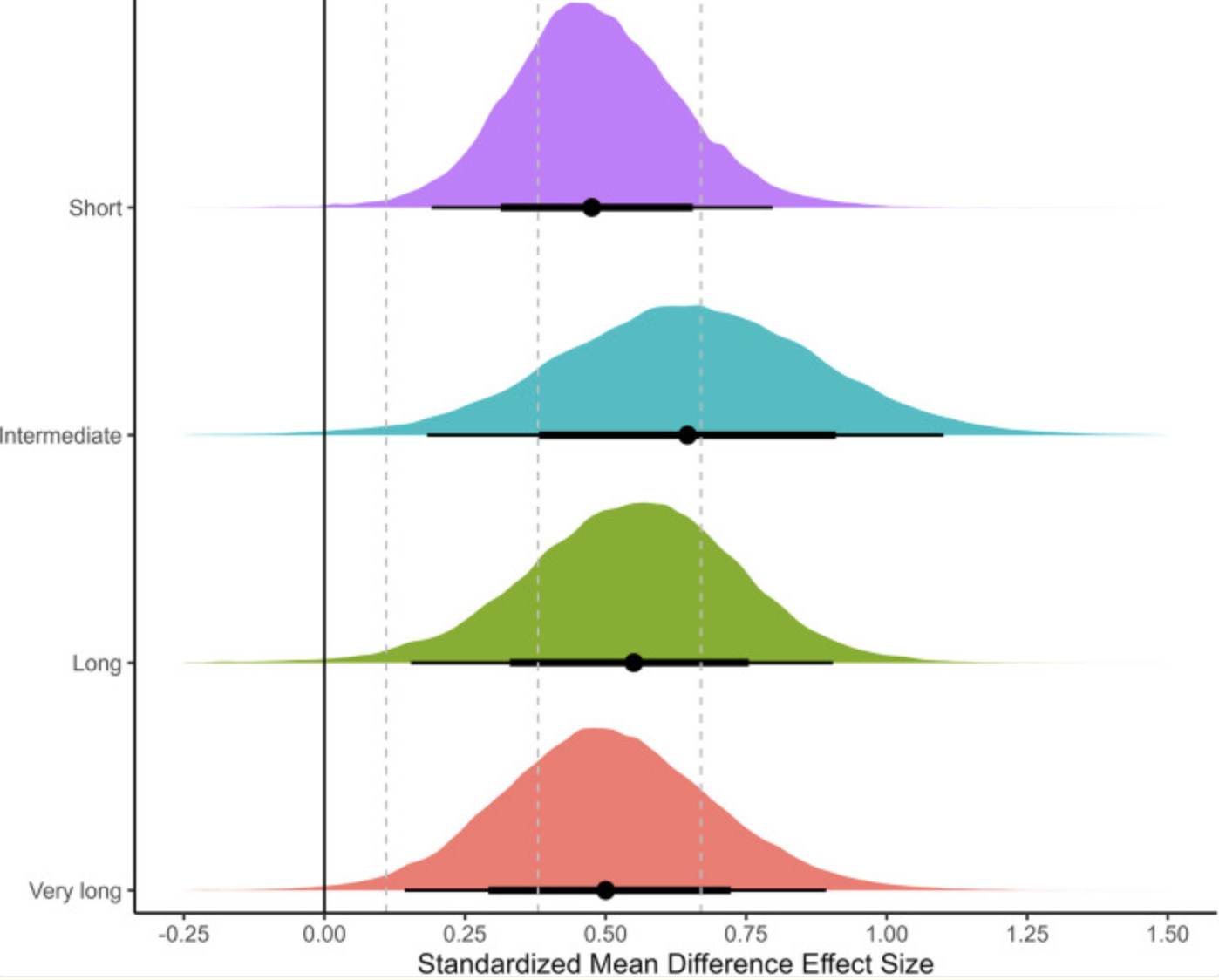
Don’t be afraid of complicated names. On the vertical axis we see different pause lengths. But the most important thing is the horizontal axis, which represents the effect size. Simply imagine it as a score that tells us how much a certain pause length helped the muscles grow. The more the colored hill and its top are shifted to the right, the better the result of the break.
At first glance, a clear winner is visible. The best result was achieved by the blue-green curve, what represents medium breaks lasting 61–119 seconds. The peak is furthest to the right, indicating the greatest positive impact on muscle hypertrophy. Just behind that is the green curvea long pause of 120–179 seconds. The other two categories, viz short pauses (<60 s) And very long (>180 s)were placed furthest to the left in the analysis, indicating a weaker influence on overall muscle hypertrophy in the graph.
As the study authors discuss, it appears that neither too short nor too long breaks are the ideal path. The average rest duration best combines the benefits of both worlds: it is short enough to induce the desired metabolic stress, while at the same time long enough to restore energy reserves to maintain strength and work volume. So you don’t have to spend forever on the couch. With reasonably long breaks you can maintain a brisk pace and get the most out of your muscle growth training.
Although the study suggests that, from a statistical perspective, breaks longer than 90 seconds no longer provide an additional bonus in muscle growth for the average exerciser, the authors themselves point out in the limitations section that the type of exercise plays a crucial role.
With heavy squats or deadlifts, fatigue (not just muscle fatigue, but also breathing fatigue) occurs much earlier than with isolated exercises. In practice, trainers agree on this 90 seconds is enough for biceps, it is safer to give the body complex exercises more time, so that you do not unnecessarily lose a lot of strength and total work volume in the next series.
Quick cheat sheet: How long should you rest between sets for biceps or deadlifts?
| Kind of exercise | Examples | Recommended break | |
|---|---|---|---|
| Single (isolated) | Biceps curl, leg extension, lateral raise | 60–90 seconds | No further muscle growth bonus was recorded for these exercises above 90 s. |
| Multi-joints (complex) | Bench press, leg press, pull-ups | 2–3 minutes | A longer break helps maintain work volume (number of repetitions), which decreases sharply with a short break during complex exercises. |
| The most difficult strength exercises | Squats, deadlifts | 3 minutes or more | A subanalysis of the thighs showed that very long pauses (≥180 s) had a small benefit for better muscle growth. |
What should you take away from this?
Finding the ideal pause length is crucial for effective training. As a new scientific analysis has shown, this is the case for maximum muscle growth (with most exercises). most effective to rest between 60 and 90 seconds. This interval represents the ideal compromise because it allows you to maintain a high intensity and at the same time recover sufficiently for the next demanding series. While it is worth resting longer for pure strength training hypertrophy, this golden mean is the best choice for your muscles.
And how long do you usually take the breaks between sets? Share your experiences with us in the comments. If you liked the article, don’t forget to share it with your friends so that they also know how to properly set the rest for the best results.
Sources:
[2] Henselmans M, Schoenfeld B. The effect of intermediate rest intervals on resistance exercise-induced muscle hypertrophy. Sports Med. 2014 – https://pubmed.ncbi.nlm.nih.gov/25047853/
[3] Grgic J, Lazinica B, Mikulic P, et al. The effects of short versus long intermediate rest intervals in resistance training on measures of muscle hypertrophy: a systematic review. Eur J Sport Sci. 2017 – https://pubmed.ncbi.nlm.nih.gov/28641044/
[4] Singer A, Wolf M, Generoso L, et al. Give it a rest: a systematic review with Bayesian meta-analysis on the effect of intermediate rest intervals on muscle hypertrophy. Front Sports Act Living. 2024 – https://www.ncbi.nlm.nih.gov/pmc/articles/PMC11349676/
[5] WillardsonJM. A brief overview: Factors that influence the length of the rest interval between resistance exercise sets. J Strength Cond Res. 2006 – https://pubmed.ncbi.nlm.nih.gov/17194236/
#long #rest #sets #ideal #time #muscle #growth #GymBeam #blog