

- Student loan rehabilitation is a process of getting out of default that also removes the default from your credit, unlike consolidation, which resolves the default but retains the data.
- You can rehabilitate your loans by making 9 on-time payments on your loans subject to a rehabilitation agreement.
- Payments are means-tested, typically set at 15% of disposable income, with alternatives available for borrowers who cannot afford that amount.
As federal student loan collections resume, millions of borrowers who fell behind during the pandemic-era pause are once again facing wage garnishments, tax refund garnishments and damaged credit. For borrowers who are already in default, the path back to good standing is more important than ever.
One option stands out to many: Student loan rehabilitationa program that allows borrowers to clear default on their federal loans (and credit report) after making a series of on-time payments.
Compared to student loan consolidation, rehabilitation can provide long-term credit benefits, but it also comes with strict rules and timelines that borrowers should understand before enrolling.
What is Student Loan Rehabilitation?
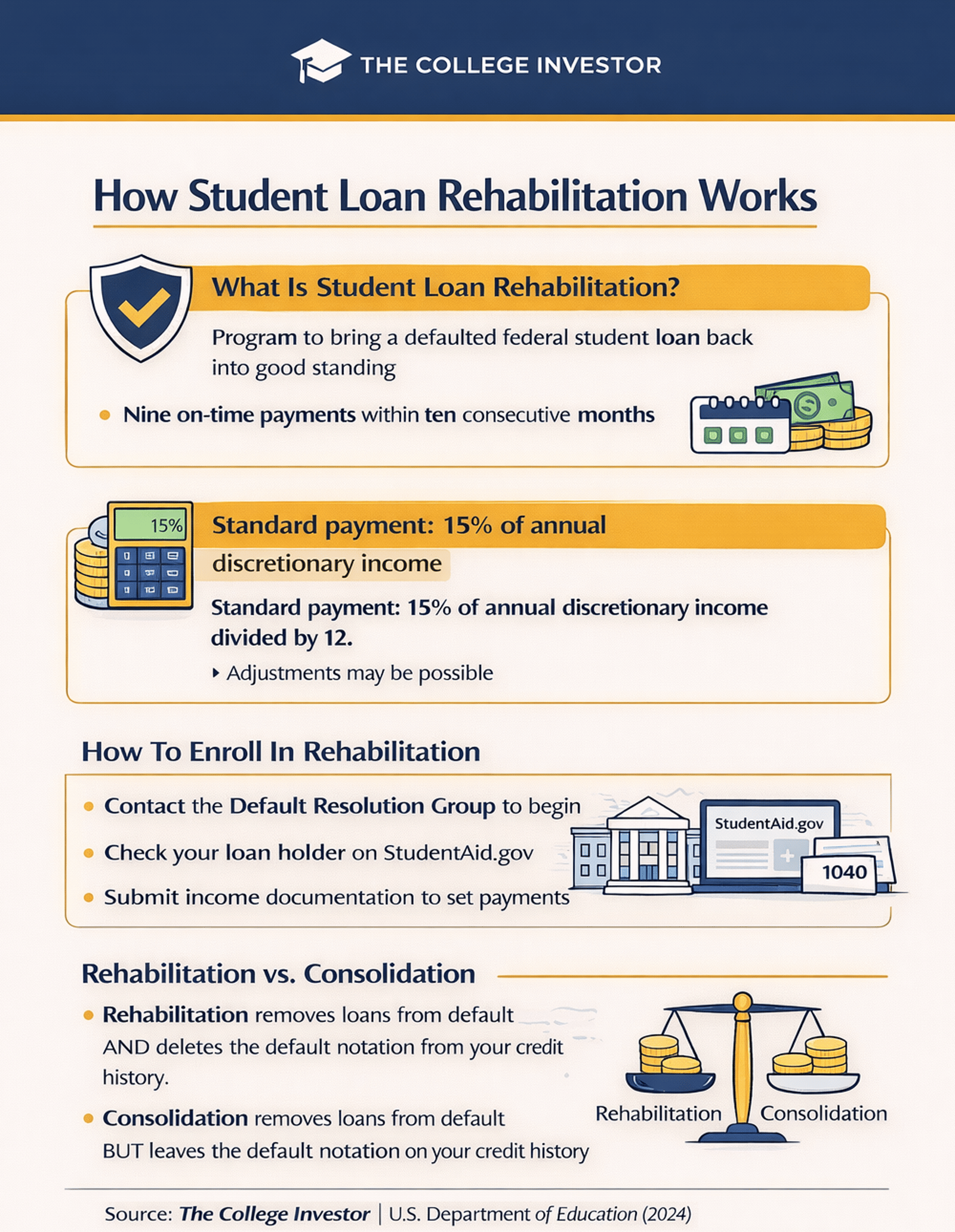
Student loan rehabilitation is one of the most important ways to get a defaulted federal student loan a good reputation again. When a loan is rehabilitated, the default status is removed, collections are halted, and borrowers regain access to federal student aid, including Pell Grants, federal loans, and work-study.
To begin rehabilitation, a borrower must enter into a formal agreement with their loan holder (the US Department of Education) and make a required number of voluntary, timely payments.
For most borrowers with Direct Loans or Federal Family Education Loan (FFEL) program loans, rehabilitation requires:
- Nine on-time payments
- Created within 10 consecutive months (one missed month is allowed)
Once these payments are completed, the loan is transferred to a new loan servicer, the default is cleared, and the borrower can choose to enroll in an income-driven repayment plan.
How monthly payments are calculated
Under a standard rehabilitation agreement, the required monthly amount is calculated as 15% of the borrower’s annual discretionary incomedivided by 12. Discretionary income is generally defined as income above 150% of the federal poverty guideline for the borrower’s family size.
Because the calculation depends on income and family size, monthly payments can vary widely. For some borrowers, payments can be manageable. For others, especially those with low or unstable incomes, the standard formula may still be too high.
Borrowers who cannot afford the proposed payment can apply alternative payment amount by submitting detailed information on income and expenses. Housing, medical bills, and other essential costs are taken into account, and the adjusted payment may be lower.
The most reliable way to estimate payments (and request adjustments) is to work directly with the government standards administrator.
How to register for rehabilitation
Most borrowers in default will work with the Standard resolution groupthe unit of the Department of Education that manages defaulted federal student loans.
Borrowers can confirm their loan holder by logging in StudentAid.gov and check the ‘My Loan Servicers’ section. FFEL borrowers may see a guaranty agency listed instead.
To apply for a rehabilitation agreement, borrowers must submit income documentation, typically one of the following:
If you are married but filing taxes separately, documentation may be required for both spouses.
Once documentation is received, the Department of Education will typically mail a rehabilitation agreement within approximately ten business days. This letter describes the payment amount, due dates and terms. The agreement itself is not delivered electronically (although hopefully this will change soon).
Rehabilitation versus consolidation
Borrowers who have defaulted typically have two main exit options: rehabilitation or consolidation. There’s a third (technically): full refund. But if that third was feasible, chances are you won’t default.
Consolidation resolves defaults more quickly (sometimes within weeks), but does not remove the default notation from a borrower’s credit history. Recovery takes longer, but the credit benefit is greater: once completed, the default record is removed from credit reports, although late payments prior to default risk may remain.
For borrowers focused on rebuilding credit, qualifying for a mortgage, or reducing long-term financial harm, rehabilitation is often the preferred route, if they can make the required payments.
What happens next?
Once all required payments have been made, the loan is officially closed and transferred to a new loan servicer. Borrowers will receive an email confirmation within approximately 30 days.
At that moment:
Borrowers can also request a written letter confirming that their loan is no longer in default, which colleges sometimes require before they can disburse aid.
Using the federal loan simulator after rehabilitation can help borrowers compare their repayment plans and avoid falling back into debt.
Don’t miss these other stories:
#federal #student #loan #rehabilitation #work