

It must have been so in ancient times, when Rome, beginning with the wars against Hannibal, between the third and second centuries BC. Through this art the eternal city took possession not only of the beauties of Greece, but also of its own cultural memory, becoming as conqueror the now ruthless, now unconscious guardian of the artistic heritage of the Hellenic world. This collection of original masterpieces, some never before exhibited, returns to the capital and reveals the artistic encounter that redefined identity and power in ancient Rome. From November 29 to April 12, 150 Greek originals will parade in the exhibition “Greece to Rome”second appointment of the cycle The great masters of ancient Greece (the first had been with Phidias). Through this project, Eugenio La Rocca and Claudio Parisi Presicce trace the fortunes of Greek works that arrived in Rome in the period between the founding of the city and the Imperial era thanks to commercial contacts, Rome’s rule in the Mediterranean, military conquests or simply the Romans’ passion for collecting towards Hellenistic culture.
Greece in Rome, installation | Photo: © WPS
This kind of ‘Greek mania’, in addition to the influence of the Greek masters on Roman art, takes shape in the rooms of Villa Caffarilli through a refined journey that includes sculptures, reliefs, ceramics, bronzes and multimedia content. Many of these works return to the city after centuries of circulation. This is the case of the great Capitoline bronze statues, exceptionally reunited, flanked by important monuments such as the stela of the Abbey of Grottaferrata and the sculptures of Niobides from the Horti Sallustiani, spread between Rome and Copenhagen. Another major return is represented by a female acroterial sculpture from the Al Thani collection in Paris, present in Rome in the seventeenth century, and then by unpublished finds, such as the Attic ceramics found in recent archaeological excavations near the Colosseum. The elegance of the sculptural group of girl goddesses in the play Ephedrismòs, from the 3rd century BC, found in Rome in Piazza Dante and today in the Capitoline Museums, has the same beauty as the Portrait of Antisthenes on a modern herm. Seeing together all these works coming from the Museum System of Rome Capital, but also from institutions such as the Ny Carlsberg Glyptotek in Copenhagen, the Museum of Fine Arts in Boston, the Museum of Fine Arts in Budapest, the Al Thani Collection in Paris, offers the opportunity to reconstruct the history of the meanings (and new functions) that these objects acquired over time during their transition from Greece to Rome. An example of this is the Templum Pacis, the large complex built by Vespasian after the victory in Judea (75 AD), born as a symbol of restored peace and soon becoming a kind of museum for Greek art in the heart of the empire.
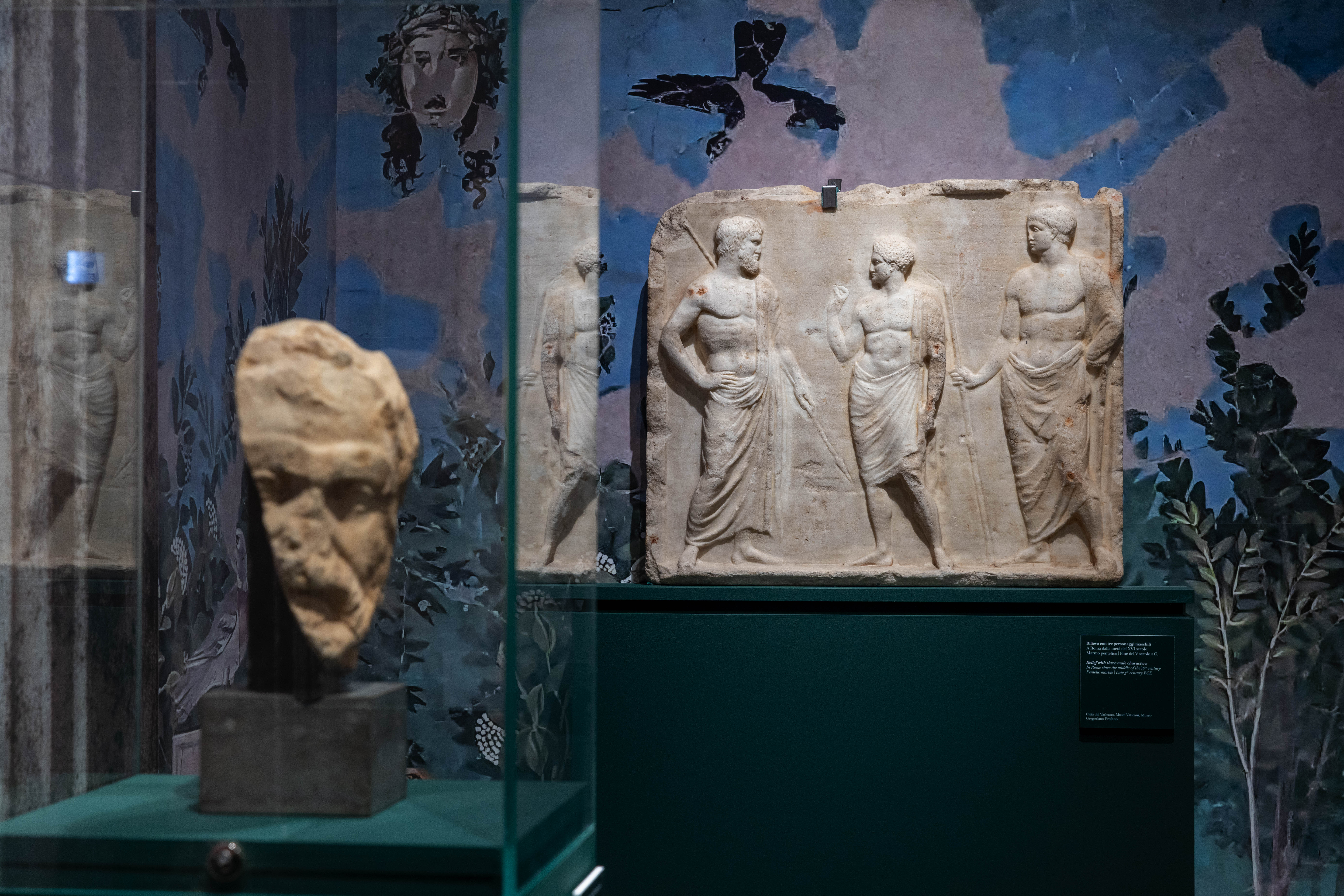
Greece in Rome, installation | Photo: © WPS
After exploring the private residences enriched with Greek works of art, the route highlights the works associated with the villas of the Imperial era, mostly located in the suburbs. From the 2nd century BC, many Greek sculptors emigrated to Rome and founded workshops there, which also specialized in the creation of classicist-style cult statues intended for Roman temples. The works often dealt with traditional mythological or Dionysian subjects. The intention of neo-attic art was to rework the Greek models and re-adapt them to new functions. Greek art was now an instrument catering to the needs of Rome: the religious sentiment that pervaded the best artistic production of the archaic and classical times had been lost in favor of the aesthetic quality of the work of art.
#Greece #Rome #Capitoline #Museums #masterpieces #story #passion #return #Rome #Arte.it