

New data centers can lead to higher electricity bill And stopping aging, outdated coal-fired power plants. But a Google project in Minnesota is taking a different approach: The tech giant is paying to build up enough clean energy so that existing customers don’t have to foot the bill, and the power grid is getting innovative new technology: a massive battery that will be the largest in the world by capacity.
This week, major tech companies are expected to visit the White House and promise to do more of it their own energy needs. The Minnesota project provides a concrete example of how to take that a step further and use clean energy.
“Google has long been committed to scaling our infrastructure responsibility, including paying for the electricity and associated costs of our growth,” said Lucia Tian, head of advanced energy technologies at Google. “Investing in the systems that make our communities more resilient is critical to us.”
To support the data center, which will be built in the small town of Pine Island, Google has signed an agreement with local utility Xcel Energy to finance 1,900 megawatts of new clean energy. It’s similar to an approach Google took in Nevada to pay for a geothermal power plant from Fervo, a company with next-generation technology that would otherwise have been too expensive to add to the grid. In the Minnesota project, Google will pay for 1,400 megawatts of new wind power and 200 megawatts of solar power while helping Google pioneer another new technology: a battery that can store energy for days instead of hours.
Form Energy iron-air battery enclosures in the field [Photo: Form Energy]A unique battery for a more reliable electricity grid
The battery was called by a startup Form energyuses iron-air technology to store renewable energy for longer. The company describes it as reversibly rusting iron: the iron reacts with oxygen to store and release energy, with storage lasting 100 hours. The new plant in Minnesota will be large enough to supply 300 megawatts of power and store as much as 30 gigawatt hours of energy, making it the largest battery by capacity announced to date. For comparison, that’s more storage space than all battery projects built in the US in 2024 combined.
“The unique thing about Form is that it is one of the few options on the market for more than 100 hours of storage,” said Tian. This is useful for closing any gaps in renewable electricity.
“A long-lasting battery can help us maximize how we use renewable energy when we encounter extended periods of lower solar and wind generation, such as in the middle of winter, when we can see several days of cloudy weather with very little wind,” Xcel said in a statement. The technology is cost competitive with natural gas.
The battery, together with the solar and wind energy, will not be connected directly to the data center, but will instead be fed into the wider electricity grid. Google declined to share the facility’s projected energy consumption. But the new clean energy capacity will be greater than what the data center needs — a reflection, according to the company, of Google’s commitment to making the power grid more resilient.
“It serves as a network resource,” Tian said. “And one of the things that’s exciting to us about this project is that it also serves to catalyze this new technology at a scale where it hasn’t been deployed before.”
The battery is a major project for Form Energy, which has ramped up production in recent years at its facility in a former steel mill in West Virginia. The company is completing the installation of its first commercial battery at another location in Minnesota. Much less energy is stored in that first project: only 150 megawatt hours. But the system is modular, with the batteries housed in shipping containers and only need to be added together for more capacity.
“It’s not like we need to build a new machine on a larger scale,” said Mateo Jaramillo, CEO of Form Energy, who founded the company after working on energy storage at Tesla. “It’s just more of the same.” The biggest challenge was manufacturing the electrodes; the company needed to produce 100,000, or about 60 miles of material, to prove to itself and to customers like Xcel and Google that it was ready for large-scale production. It plans to scale up quickly now.
“Our hope is that this project sends the demand signal that allows them to expand their production here in the U.S.,” Tian said.
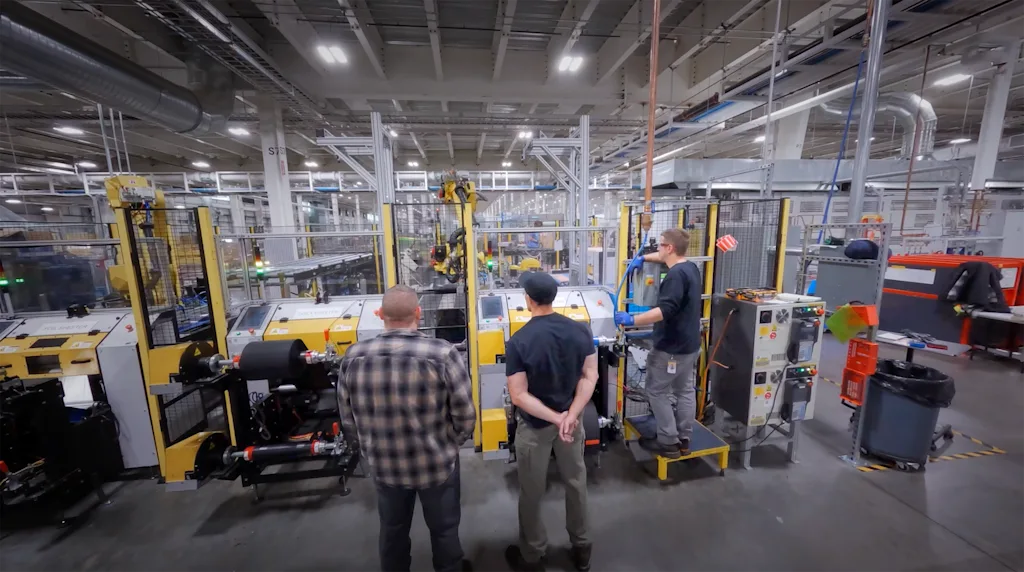 Form Energy team members work in Form Factory 1 [Photo: Form Energy]Will the sector follow?
Other tech companies, including Microsoft and Anthropic, have said they plan to cover the costs of the new energy infrastructure needed for data centers. More people are expected to make that pledge now pressure from the Trump administrationalthough the details of those agreements – likely non-binding – have not yet emerged, and it remains to be seen how closely some companies will follow them. It is also not clear how many companies will voluntarily prioritize clean energy. That’s Meta, for example installing natural gas generators to power a new data center in El Paso.
Environmentalists are skeptical. “We believe it is possible to responsibly build large-scale/hyperscale data centers, but accomplishing that task is incredibly difficult due to the resource demands of these facilities,” said Kyle Rosas, deputy director of Minnesota for the nonprofit. Action for clean water.
Many also doubt its necessity. The new Google data center will power its core services like YouTube and Maps, but most new data centers are being built for AI. “There are major concerns about an AI bubble, and the lack of profits from these companies does not necessarily inspire confidence in the future of the industry as it is,” Rosas said. “So at this point it’s difficult for us to say that these facilities should exist at this scale.”
Community pressure can have an impact: last year at least 25 proposed data centers were canceled due to protests from local residents over concerns about electricity bills, pollution from fossil fuel power plants and water use. (It’s worth noting that Google’s new data center won’t use water for cooling; the company will use air cooling, which uses more electricity, but that will be covered by the new clean energy.)
The risk of community backlash is another clear argument for tech companies to go as far as they can to do the right thing. The new Minnesota project shows how it can work. “We think this is a great example of how to do it right,” says Jaramillo of Form Energy. “And I expect many more things like this to happen.”
#Googles #data #center #Minnesota #largest #battery #world #wont #increase #electricity #bills