

January 23, 2026
Gold is an asset that historically does not fall into the categories of a growth asset, such as stocks, or income-producing assets, such as a bond.
Rather, it is an asset for storing value. It tends to increase when uncertainty is high.
Gold prices in India have transitioned from cyclical to structurally resilient over the past two decades, reflecting changes in global economic conditions.
Gold’s track record of delivering solid long-term returns with sharp rallies during periods of crises has been evident since the early 2000s.
The recent 2008 global financial crisis, the European debt crisis, the pandemic or the more recent geopolitical clashes and monetary policy cycles have reinforced gold’s status as a safe haven.
Gold’s performance has also improved in rupee terms due to the depreciation of the currency, making it one of the better long-term performers.
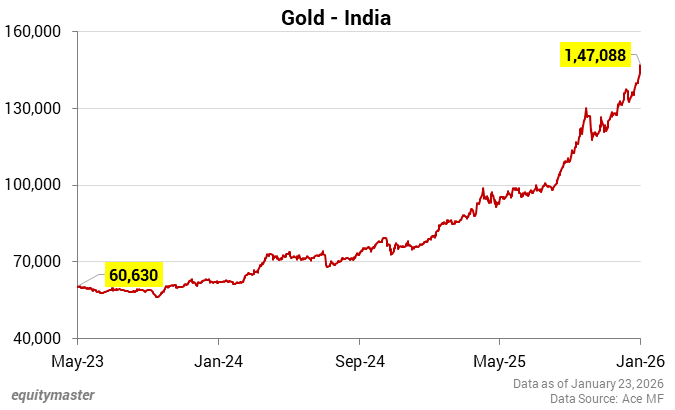
Gold’s recent performance has been exceptional, delivering a return of nearly 159% in the last three years, with prices rising from around Rs 56,000 to Rs 147,000 per 10 grams. On a year-over-year basis, the rally was just as striking, with gains of around 92% on January 23, 2026.
Prices have risen to record highs, driven by a confluence of factors: increased global inflation, concerns about fiscal sustainability in major economies, continued central bank purchases and heightened geopolitical risks.
This sharp rise has inevitably raised a question among investors: With gold trading near peak levels, does it still make sense to add gold ETFs, or is the opportunity largely behind us?
This editorial examines that question through a strategic lens, focusing not on short-term price predictions but on the role gold ETFs could play in portfolio construction.
Gold at record highs: tactical timing versus strategic allocation
A common concern among investors today is whether investing in gold at high prices exposes the portfolio to downside risk. While this concern is valid from a short-term trading perspective, it is less relevant when viewing gold from a strategic asset allocation framework.
Gold is generally not held for return maximization, but for risk mitigation. Its value lies in its low correlation with equities and its tendency to perform well in periods when risky assets are struggling.
Historically, gold’s role as a long-term portfolio stabilizer has remained intact even when investors have entered gold at relatively high levels.
Attempts to time gold allocations based on price levels often lead to behavioral mistakes: chasing momentum or avoiding the asset altogether after a rally.
A more disciplined approach involves maintaining a consistent allocation to gold, adjusted periodically based on overall portfolio size and risk profile rather than just price movements.
Gold ETFs in India
| Schema name | Absolute (%) | CAGR (%) | AUM (Rs in Crore) | ||
|---|---|---|---|---|---|
| 1 year | 3 years | 5 years | 10 years | ||
| LIC MF Gold ETF | 43.58 | 25.23 | 15.97 | 13.80 | 1100.82 |
| UTI Gold ETF | 44.13 | 25.12 | 15.58 | 13.51 | 3282.12 |
| Invesco India Gold ETF | 43.46 | 24.85 | 15.71 | 13.55 | 508.54 |
| ICICI Pru Gold ETF | 43.68 | 24.83 | 15.62 | 13.37 | 17769.47 |
| Axis Gold ETF | 43.53 | 24.78 | 15.67 | 13.22 | 3895.01 |
| Category Average | 44.65 | 24.77 | 15.60 | 13.44 | – |
Source: ACEMF
Another notable takeaway from the data is gold’s ability to generate stable returns over longer periods of time, despite phases of consolidation and sharp rallies.
Even as entry points coincided with relatively high price levels, long-term investors have benefited from gold’s role as a hedge during stock market downturns and macroeconomic stress.
This consistency also makes clear why mutual fund selection within gold ETFs is less about chasing higher returns and more about execution efficiency.
Evaluating gold ETFs beyond yield
While historical performance is an important consideration (which investors should assess against price indexes and ETF return data), selecting a gold ETF requires attention to many qualitative factors:
- Tracking error: How closely the ETF reflects domestic gold prices.
- Cost ratio: Lower costs improve the long-term efficiency of a passive product.
- Liquidity and assets under management: Higher trading volumes and larger assets under management reduce execution risk.
- Fund house practices: Robust custody arrangements and transparent disclosures are essential.
Since gold ETFs are fundamentally similar in structure, cost efficiency and tracking consistency often become the key differentiators rather than just yield differences.
Where gold ETFs fit into a modern portfolio
From an asset allocation perspective, gold ETFs serve three main purposes:
- Diversification: Gold has exhibited low to negative correlation with equities during periods of stress, reducing overall portfolio volatility.
- Drawdown Protection: During stock market corrections or global crises, gold has often acted as a counterbalance and preserved capital.
- Currency hedging: For long periods, gold has helped protect purchasing power against rupee depreciation.
Most portfolio construction frameworks suggest an allocation of 5-10% to gold, depending on the investor’s risk tolerance, investment horizon and equity exposure.
At current market levels, maintaining this allocation remains more relevant than trying to increase or eliminate gold exposure based on short-term price signals.
Gold ETFs vs. Other Investment Options
While gold ETFs offer operational efficiencies, they are not the only way to invest in gold. Physical gold, sovereign gold bonds (SGBs) and gold mutual funds each serve different investor needs.
Gold ETFs stand out for investors who prioritize liquidity, transparency and easy portfolio integration. Unlike physical gold, they pose no storage or purity risk. Compared to SGBs, they offer higher liquidity and flexibility, but without the interest component.
As a result, gold ETFs are particularly suitable for investors seeking tactical rebalancing and efficient asset allocation.
Does it still make sense to add gold ETFs now?
At record price levels, gold may not deliver outsized returns in the short term. However, if you expect gold to behave like an equity investment, you are missing the point of its role.
Gold ETFs are best thought of as an insurance policy rather than an opportunity trade.
For investors who already hold gold within their asset allocation, maintaining exposure through disciplined rebalancing continues to make sense.
For those without gold exposure, initiating a modest allocation – even at current levels – could improve portfolio resilience across market cycles.
The key lies in how much and why, not when.
Conclusion: Strategy over sentiment
Gold’s journey from a traditional store of value to a strategic portfolio asset has been shaped by evolving global and domestic dynamics. The recent rally has reinforced its relevance, even as it has fueled debate over valuation and timing.
Gold ETFs, when used carefully, remain an effective tool for diversification and risk management. Rather than trying to predict gold’s next move, investors would do well to focus on disciplined asset allocation, long-term goals and portfolio balance.
Invest wisely.
Have fun investing.
Table Note: Data as of January 23, 2026
The effects mentioned are for illustrative purposes only and not recommended
Past performance is not an indicator of future returns.
Returns are on a rolling CAGR basis and in %. Direct Plan-Growth option.
The images depicted over a period of one year are compiled on an annual basis.
Risk ratios are calculated over a three-year period, assuming a risk-free interest rate of 6% per year
Disclaimer: This article is for information purposes only and does not constitute any investment advice or recommendation to buy/hold/sell any fund. The returns mentioned herein are in no way a guarantee or promise of future returns. As an investor, you must choose the right fund to achieve your financial goals. If you are unsure about your risk tolerance, please consult your investment advisor/advisor. Investments in mutual funds are subject to market risks; read all fund-related documents carefully. Registration granted by SEBI, registration as RA and IA with Exchange and certification by NISM in no way guarantee the performance of the intermediary or provide any assurance of returns to investors.

Mitali Dhoke has an MBA in Finance and a Masters Degree in Commerce (M.Com). He is Sr. Research Analyst at PersonalFN and has almost five years of experience in financial services. At PersonalFN, Mitali focuses mainly on research into investment funds and is recognized as an NFO specialist (New Fund Offer).
#Gold #ETFs #Explained #Add #Portfolio #Opinions #Equitymaster #news