

Both the Ford 351 Windsor and Chevy 350 small block V8 engines need no introduction; they are virtually ubiquitous in the aftermarket scene. While forum users almost always argue about which Detroit V8 of the past is the better choice, the truth, while a bitter swallow for Ford and Chevy fans, is that there is no real winner.
Before you start throwing hands, let’s explain. You have to realize that both engines (in stock specs) are incredibly similar, or at least close enough, when it comes to engine displacement and just about everything else. Ford’s 351W (short for Windsor, Ontario, where it was built) displaces 351.9 cubic inches, while the Chevy 350 stays true to its name and displaces exactly 350 cubic inches. That’s 5.8 and 5.7 liters respectively for those across the pond.
Both engines also feature a cast iron block and an OHV (overhead valve) design with two valves per cylinder. Additionally, they share a similar 4-inch bore and only slightly different stroke lengths, with the small-block Ford V8 measuring 3.5 inches in diameter while the 350 measures 3.48 inches. This should come as no surprise, as both V8s are essentially from the same era of Detroit one-upmanship: the 351W began production in 1969, while the 350 Chevy was first introduced in 1967.
Spec talk and differences
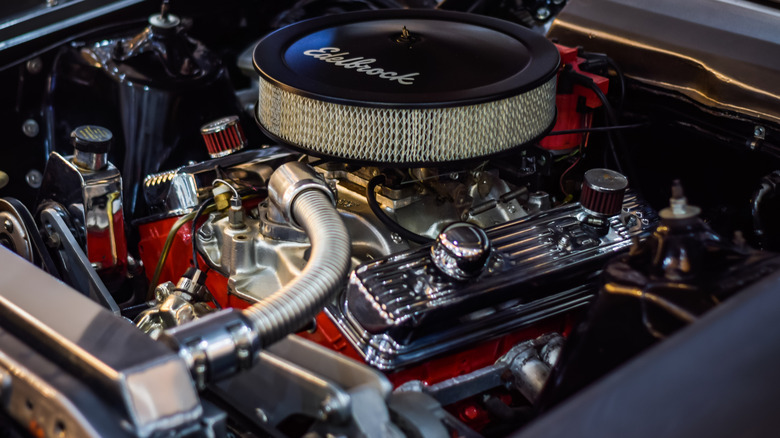
Because both Ford and Chevy used the engines in several of their products, from cars and vans to sports coupes and trucks, power figures may vary depending on the application. But in its available crate engine format, a factory-supplied base Chevy 350, while not as powerful as some of its other small-block Chevy cousins, is rated at 333 horsepower and 381 pound-feet of torque, which is very comparable to an aftermarket base 351W with 300 horsepower and 377 pound-feet of twist.
However, there are more striking differences. Season 3 of Engine Masters pitted two mostly stock versions against each other in a head-to-head comparison, with the ATK-supplied Windsor having a symmetrical port design, different from what you see in the 350. The Ford 351 had a longer deck height at 9.5 inches, while the Chevys came in at 9.02 inches, which translated to the 351 being a tad heavier than the 350.
Additionally, the Ford has a longer 5.95-inch connecting rod, while the Chevy gets 5.7-inch parts, which, combined with the longer deck, means the Windsor V8 gets a higher piston compression height. Configurations used in the episode had the Chevy 350 running nearly 9.2:1, while the 351 Windsor had a compression ratio of nearly 9.5:1.
Does this mean the Ford is superior? Or is the Chevy somehow better? Let’s put it this way: There isn’t enough of a performance difference for most people to notice. There’s hardly anything separating them, at least when it comes to street applications, which can’t be said about the Chevy and Oldsmobile 350 V8s. What may come across as a longevity issue may actually be the Chevy’s exhaust port design, which leads to excessive heat generation. But that’s it.
#Ford #351W #Chevy #Small #Blocks #Compare #Jalopnik