

It marks the first time a championship fight has been deemed a ‘no contest’ inside the cage, with the only other fight result being changed to a failed drug test discovered after the fight.
A week later, there was a huge controversy in another heavyweight fight between Ante Delija and Waldo Cortes-Acosta, where the latter was allowed to sit on a stool, have his team around him and win the fight while being watched, something that Tom Aspinall was not afforded.
There are a number of problems when it comes to eye pokes in MMA and it seems there are a number of solutions to these problems as well.
We take a look at some of the most prominent issues surrounding eye pokes in MMA and what can be done to eliminate them from the sport.
Eye Pokes in MMA – The Main Problems and How to Fix Them
According to the Unified Rules of Mixed Martial Arts (from the Association of Boxing Committees), lays down the rules surrounding eye pokes in MMA as follows:
Fingers extended toward an opponent’s face/eyes: In a standing position, a fighter who moves his arm(s) toward the opponent with an open hand while pointing the fingers toward the opponent’s face/eyes will be committing a foul. Referees must prevent this dangerous behavior by communicating clearly to the fighters. Fighters are asked to close their fists or point their fingers straight up in the air when reaching for their opponent.
What this means is that any eye poke is considered a mistake. As we know, before making the walk, referees go to fighters’ locker rooms to relay the rules, ask any questions and confirm that the fighter is happy. Here comes point number one where we can eradicate eye pokes in MMA.
Eye Pokes in MMA – Point 1 – Immediate point deduction
The referees must continue to inform the fighters of the rules before walking to the octagon. This includes the rules regarding eye pokes, specifically that they must either make a fist or have their fingers straight up in the air.
This acts as the first warning. There will be no second warning. The first instance of an eye poke in a combat situation is a point deduction. The referee can consult the monitor if necessary to determine whether the stroke was legal or not. If it were legal, the fight should resume immediately; if not, a point is taken.
If the fouled fighter cannot continue, he or she will be awarded the fight via disqualification. Does this seem harsh on the fighter who made the mistake? There is no doubt that fighters will certainly no longer go into battle with their fingers outstretched for fear of a DQ.
UFC legend Michael Bisping suggested that even if no eye poke occurs, but the fighter’s fingers are extended towards his opponent, he should be given a single warning before a point is deducted. This is also an extremely valid option.
For Bisping, the image below of Chris Weidman would warrant a point deduction (assuming the referee has already warned him about the earlier foul). In this fight, Weidman clearly stabbed Bruno Silva in both eyes before scoring a TKO win. This was later overturned to a technical decision due to the eye poke.
In this case, the committee acknowledges that the eye pokes are the reason Weidman got the win, so why it wasn’t overturned to a no contest or a disqualification in Silva’s favor is baffling.
Eye Pokes in MMA – Point 2 – New glove design
In April 2024, fans were excited at the prospect of ‘new’ UFC gloves. In February of this year they were completely banned. What this shows is that the UFC is willing to change the glove design. Dana White claimed that the new glove design was created with the intention of stopping eye pokes, but fighters were not happy with it.
“If at first you don’t succeed, give up and let your employees suffer” seems to be the UFC’s mantra when it comes to eye pokes. The current glove design almost forces fighters’ fingers outward, but it’s not like it’s the only design available.
MMA coach Trevor Wittman founded ONX Sports, which specifically designs gloves to address eye gouging in MMA. They force the hand into a more curved shape, as demonstrated by Joe Rogan below.
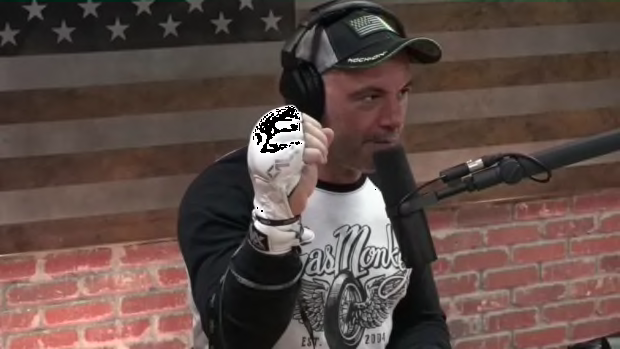
If the UFC doesn’t want to go the route of Wittman’s gloves, they aren’t the only option. The old PRIDE gloves are similar to Wittman’s design, they flex the hand but do not prevent the grappling transitions. It seems like a simple, logical solution, but the UFC seems reluctant to adopt a new design.
Below is a photo of the PRIDE gloves (left) and the current UFC gloves (right). We can see how the UFC gloves force the fingers outward, while the PRIDE gloves bend the hands more into a fist shape.

Confusion about the wording of rules and decisions
Here comes the confusing part of the current rules. There is tremendous confusion about the wording surrounding the rules for eye pokes in MMA.
There is agreement that any intentional eye poke can be punished with a point deduction or a warning. However, how can the referee really determine what is intentional and what is not?
Ariel Helwani made an excellent point MMA show last week when he commented on the difficulty surrounding the wording of the ‘rules’. He questioned why the main event of UFC 321 was not considered a disqualification. The reason behind this is that referee Jason Herzog deemed the eye poke ‘unintentional’.
But should this have been a disqualification? Gane was warned about the position of his fingers in the first 30 seconds of the fight. He then defended an open-handed takedown to Aspinall’s eyes and then of course we have the final eye poke that stopped the fight.
Eye Poking in MMA – Point 3 – Clear, consistent wording and definitive rules
As we saw earlier, the rules state that the referees must warn the fighters by communicating clearly if they believe their movements (with their fingers) are dangerous and possibly against the rules.
There are no words in the ABC rules regarding intent, therefore Herzog should not have been able to call. Only Cirly Gane knows if his eye poke was intentional, and the assumption is that if you extend your fingers toward your opponent’s eyes, the intent is there.
Eliminate any confusion around ‘intent’. The referee cannot make a call. As we said before, regardless of ‘intention’ or not, the first offense of an eye poke is a point deduction.
This eliminates any controversy around consistency as the same, clear, consistent rules are followed.
Referees must also be consistent in the treatment of the fighter who has been stabbed in the eye. Tom Aspinall didn’t get the luxury of that Cortes-Acosta a week earlier. Why was the latter allowed to have his corner team in the octagon? Why was he given a crutch? Why was he given more time to recover? We broke all this down in the MMASucka podcast found here:
Can we ever really get rid of eye pokes in MMA? It’s unlikely, but we can certainly discourage fighters from fighting with their fingers outstretched.
#Eye #pokes #MMA #eradicate #major #problem #MMASucka