

External asset managers in Zurich are independent professionals or companies that manage client portfolios while simultaneously holding assets with external banks.
They provide tailor-made investment strategies, risk management and wealth planning for high-net-worth individuals, families and international investors looking for Swiss stability.
This article covers:
- How does an external asset manager work?
- Is Zurich a business center?
- Who regulates financial services in Switzerland?
- What is the annual management fee for Zurich?
- Who are the customers of external asset managers?
Key Takeaways:
- Zurich offers a stable, well-regulated asset management environment.
- External asset managers provide independence and access to global markets.
- Asset managers earn through management fees, performance fees and advisory services.
- Risk management and compliance are crucial challenges for both managers and customers.
My contact details are hello@adamfayed.com and WhatsApp +44-7393-450-837 if you have any questions. We also offer tailor-made structuring solutions tailored to your situation.
The information in this article is for general guidance only, does not constitute financial, legal or tax advice and may have changed since the time of writing.
Why is Zurich a financial center?
One of the main reasons why Zurich is considered a financial center is its status as a center for wealth management and private banking.
Several factors contribute to its fame:
- Political and economic stability
Switzerland is known for its neutrality, strong rule of law and economic resilience. - Strong banking infrastructure
Zurich is home to global banks, boutique private banks and specialized financial institutions. - Credibility of the regulations
Switzerland has a well-developed regulatory framework that increases investor confidence. - Skilled talent pool
The city attracts experienced portfolio managers, risk specialists and financial engineers. - Global customer base
Zurich serves European, Middle Eastern, Asian and Latin American investors.
This ecosystem creates a natural environment in which external asset managers in Zurich can thrive.
Who are external asset managers?
Third-party asset managers (EAMs) are independent firms or professionals that oversee clients’ investment portfolios.
They act as trusted advisors and provide specialized expertise while the client’s assets remain with external banks.
- Make investment decisions on behalf of clients through discretionary management
- Provide customized advice and strategic investment planning
- Work with both Swiss and international banks for asset custody
- Provide customized asset management solutions aligned to client objectives
In Zurich, EAMs often target international investors, entrepreneurs and family offices who value autonomy and personal management over standard in-house banking services.
How are asset managers regulated?
Swiss asset managers are subject to the Financial Institutions Act (FinIA). The supervision is carried out by FINMA (Swiss Financial Markets Supervisory Authority).
Key legal requirements include:
- Licensed under FinIA
- Membership of a supervisory organization (SO)
- Capital adequacy requirements
- Anti-money laundering compliance
- Risk management and internal controls
This framework increases credibility while maintaining Switzerland’s competitive position as a prosperity center.
How much do asset managers earn in Zurich?
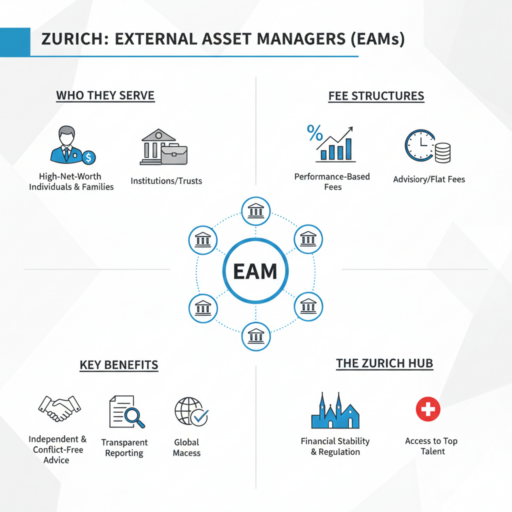
External asset managers in Zurich earn between CHF 120,000 and CHF 400,000 per year, while top partners or business owners earn significantly more, based on assets under management (AUM).
Remuneration varies depending on company size, customer base and performance structure.
Typical structure includes:
- Basic salary (for salaried managers)
- Percentage of assets under management (AUM)
- Performance fees (if applicable)
Estimated annual fee:
- Junior portfolio managers: CHF 120,000–180,000
- Senior asset managers: CHF 200,000–400,000+
- Partners or business owners: potentially much higher depending on assets under management
EAM companies typically charge customers for the following:
- Annual management fee of 0.5%–1.5%
- Additional performance fees (typically 10%–20% of profits above a benchmark)
Who uses asset managers in Zurich?
High net worth individuals, families and international investors are the main customers of the Zurich asset managers.
- High net worth individuals (HNWIs)
- Very wealthy families
- Entrepreneurs after liquidity events
- International investors seeking Swiss jurisdiction
- Family offices
- Foundations and trusts
Clients can use Zurich-based or offshore managers who can serve the region, especially those with experience in global markets and expat or offshore structures.
What are the benefits of asset management in Zurich?
Choosing an external asset manager in Zurich offers clients the benefit of Swiss stability and strong regulatory oversight, along with independent, tailor-made investment solutions.
- Independence
EAMs are not tied to the product board of one bank, which allows them to choose the best investment solutions for each customer. This independence enables a truly customized approach to asset management. - Flexibility of the custodian
Customer assets remain with reputable Swiss or international banks, providing security and transparency. This also allows managers to collaborate with multiple custodians to optimize the investment strategy. - Strong regulatory environment
Swiss supervision ensures that asset managers operate under strict compliance and risk management standards. This regulatory framework increases investor protection and confidence. - Reputation and stability
The Swiss financial sector is recognized worldwide for its reliability and discretion. Zurich managers benefit from this reputation, which reassures both local and international customers. - Access to global markets
Zurich managers have the expertise and networks to invest worldwide in shares, bonds, alternatives and structured products. This access allows clients to diversify their portfolios beyond local markets.
What are the asset management challenges in Zurich?
Despite Zurich’s stability and reputation, external asset managers face challenges such as regulatory costs, market competition and currency risks.
- Regulatory costs
Compliance with the Swiss Financial Institutions Act (FinIA) and other regulations increases operational costs for asset managers. Companies must invest in compliance teams, reporting systems and ongoing audits to meet these requirements. - Margin pressure
Fee compression is a global trend impacting the asset management industry, and Zurich is no exception. Managers must balance competitive pricing with maintaining profitability, especially for smaller EAMs. - Competition
The Zurich market is highly competitive, with both large multinational banks and independent boutique firms competing for customers. Differentiating services and demonstrating value are essential to retain and attract customers. - Cross-border restrictions
Serving customers in the EU and other jurisdictions requires careful compliance with local regulations. EAMs must ensure compliance with cross-border investment, tax and reporting laws to avoid fines. - Currency exposure
The strength of the Swiss franc can impact international portfolio performance, especially for assets denominated in other currencies. Managers must implement effective currency risk strategies to protect client returns.
Zurich vs. other financial centers: why EAMs excel here
Zurich competes with global asset management centers such as London, Singapore and Dubai, but offers a special environment for asset managers that sets the country apart.
- Unlike London, where Brexit has introduced regulatory uncertainty and higher taxes for some customers, Zurich benefits from a predictable, stable regulatory and tax framework that attracts long-term investors.
- Compared to Singapore, Zurich offers stronger legal protections and a more established international reputation for discretion and financial stability.
- While Singapore excels in technology-driven financial services and regional market access in Asia, Zurich remains the preferred choice for customers seeking a mature, conservative and globally trusted banking environment.
- Dubai is often chosen for its tax benefits and rapid growth, but it lacks the deep, experienced talent pool and long-standing regulatory credibility that Zurich offers.
- Furthermore, Zurich’s robust infrastructure and proximity to European markets give EAMs and clients both operational efficiency and seamless access to global investment opportunities.
While other hubs may compete on innovation, growth or tax incentives, Zurich essentially stands out as a hub where regulation, trust and a mature financial infrastructure combine to create a reliable backdrop for managing substantial and complex portfolios.
Conclusion
Zurich’s remote asset management landscape illustrates how independence, expertise and global reach come together in one of the most stable financial centers in the world.
The city’s strong regulatory framework, skilled talent pool and international customer base create opportunities for tailor-made, high-quality asset management solutions.
However, dealing with the complexity of regulations, market competition and currency risks requires careful strategy and disciplined risk management.
Choosing an EAM in Zurich is not just about access to financial services; it’s about leveraging the city’s unique combination of stability, discretion and professional excellence to grow and preserve wealth over the long term.
Frequently asked questions
How do asset managers make money?
Asset managers earn primarily through annual management fees based on client assets and performance-based fees tied to investment returns.
They may also charge advisory fees, with total revenue growing as assets under management and portfolio performance increase.
What is an example of an external asset?
An external asset typically refers to assets such as stocks, bonds, or mutual funds that are held outside of a primary bank or institution but are managed by an independent professional.
What are the 4 types of risks in risk management?
In portfolio management, the four primary risks typically include:
Market risk – Volatility in asset prices
Credit risk – Risk of default by the counterparty
Liquidity risk – Inability to sell assets quickly
Operational risk – Disruptions in systems, processes or governance
Tormented by financial indecision?

Adam is an internationally recognized financial author with over 830 million answer views on Quora, a best-selling book on Amazon, and a contributor to Forbes.
#External #asset #managers #Zurich #fees #clients #risks