

For many, the F-35’s price tag has been its Achilles heel. With the total cost of the program reaching a staggering $1.7 trillion, the Lightning II has easily surpassed the mark to become the most expensive aircraft program in history. That worries not only U.S. taxpayers but also international customers, as tariffs have deterred some foreign militaries hoping to buy the plane.
Regardless, 19 countries have thrown their hat into the ring, with more than 1,000 F-35s delivered around the world. And while the development costs may sound absurd, it starts to make sense when you realize it’s not just one jet, but three.
The winner of the Joint Strike Fighter competition, Lockheed Martin, was tasked with building a fifth-generation fighter that could replace four aging aircraft in three branches of the US military. The result is three aircraft that, despite looking identical on the surface, share only about 20% of their components beneath their radar-absorbing skin.
But what makes each unique? Let’s take a look at the three versions of the F-35 and the role they play for today’s militaries. Time to brush up on our ABCs.
A is for air force
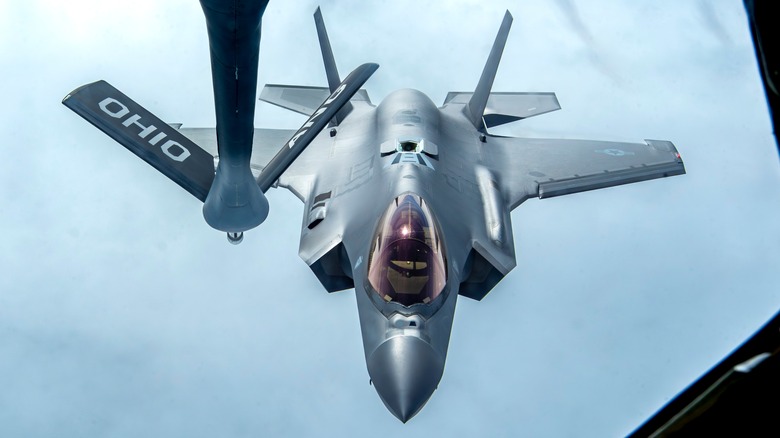
The F-35A first entered service in 2016 and was primarily designed as a replacement for Lockheed’s F-16 Fighting Falcon, as well as the iconic A-10 Thunderbolt II. Considered the base model Lightning II, the F-35A is the conventional takeoff and landing variant, flying from standard runways and bases. It doesn’t have to carry the complex systems required by its two brothers, making it the smallest, lightest and fastest variant of the three, capable of maneuvers up to 9g.
The F-35A is also the only one of the trio with an internally stored cannon. While all three variants can carry the Gau-22/A, the F-35A has its 25mm cannon stored on the left side of the fuselage rather than in an external gun pod on its belly. Because the US Air Force uses a boom refueling system, it is also the only version with a refueling port on top of the fuselage. Both the B and C are equipped with a probe for refueling tugboats.
The F-35A is also the basis for the Israeli F-35I. Using the airframe and hardware of an F-35A, the ‘Adir’ (Hebrew for ‘mighty’, inspired by the Biblical book of Psalms) features Israeli-made electronic warfare systems and countermeasures, as well as the flexibility to integrate and deploy bombs and missiles.
B is for Great Britain
In 1967, the British company Hawker Siddeley introduced one of the most unusual aircraft to ever fly: the Harrier. It was a ground attack aircraft with short vertical take-off and landing (SVTOL) capabilities, a fighter that could operate anywhere a helicopter could. The pride of British engineering, the Harrier was the backbone of the Royal Air Force during the Falklands War and served well into the 21st century. And US Marines began flying a modified “AV-8B Harrier II” in 1981.
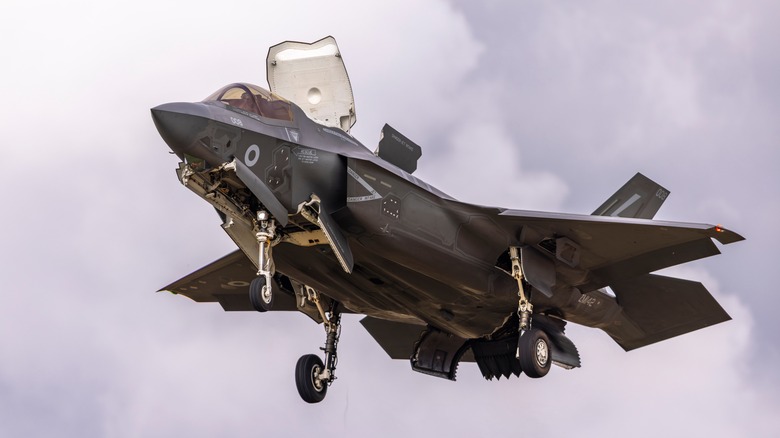
Decades later, the F-35B arrives to replace the legendary jump jet. Like its predecessor, it can take off and land vertically thanks to its enormous lift fan. The most notable feature of the variant is the elevator fan, which becomes visible after a hatch just aft of the cockpit opens during vertical takeoffs. At the rear, the Pratt & Whitney F135 points downward, giving the aircraft two points of thrust. To keep the aircraft stable in these configurations, two roller nozzles can direct air from the wings, giving the aircraft complete control while in the air.
The F-35Bs entered service with the Marine Corps in 2015 and are also used by the United Kingdom and Italy, with a handful also on order from Japan. The aircraft makes major sacrifices for its SVTOL capabilities, as it has the lowest internal fuel capacity, lowest range and lowest weapons load of the trio. But as with the Harrier, many argue that its unique capabilities make it more than a worthy trade-off.
C stands for Carrier
For more than 40 years, the F/A-18 has been an icon of the US Navy and Marine Corps. The versatile fighter evolved in 1999, with the introduction of the improved F/A-18E and F “Super Hornet”. When not being thrown into the ocean, the Super Hornet has been the spearhead of Navy air wings for the past two decades.
However, the older Hornets were starting to show their age and needed a replacement. That’s where the F-35C came into the picture, as a Navy aircraft configured for takeoff with catapults, but the recovery stalled. But transforming an aircraft so it can fly off America’s supercarriers will take more than just adding a tailhook. The landing gear has been strengthened to handle both the flying off the deck by a catapult and the “controlled crash landings” on the way back. Back on the ship, the C has a built-in ladder and folding wings to save valuable deck space.
When unfolded, the C’s wings are actually the largest of the three, with a wingspan of 13 meters. This gives the aircraft the low speed needed to approach and land on aircraft carriers. This extra wingspan also gives the C the most internal fuel storage: 1,500 pounds more than the F-35A. An important addition if your home base is constantly moving and you may need a few attempts to land.
#variant #F35 #unique #Jalopnik