

Does the creative destruction phase begin?
Last year I posted a blog entitled ‘But nothing has changeddetailing how the artificial intelligence (AI) bubble and market boom could end. I explained how investors will realize this even though AI technology is being hailed as the 4e Industrial Revolution – will change the course of human history, but probably not tomorrow. And that’s why stock prices were at risk of setbacks, because there will be commercial bumps (delays in data center construction, changes in interest rates, energy and water shortages, and not all companies can win) on the road to an AI “utopia.” While it is impossible to time a change in sentiment, the hype surrounding general-purpose technologies including AI makes such a change inevitable. That has always been the case.
This week, like the AFR reported that megacap chipmaker AMD was going ‘gangbusters’, adding that the company had done so as well “Analysts’ expectations for both profit and revenue have been exceeded, with revenue in the data center business up 39 percent in the December quarter and expected to rise 60 percent in the March quarter.”
Despite the good news, AMD shares are down 23 percent from their Jan. 23 high.
Software companies are being sold out of fear that AI will disrupt their businesses, accelerate the pace of business maturity and erode their position (more on that later). Meanwhile, technology stocks are also selling off as investors who previously hoped AI would move in a straight, uninterrupted line from invention to global adoption are realizing (again) that there will be disruptions and delays in adoption because adoption is cyclical because customers are cyclical.
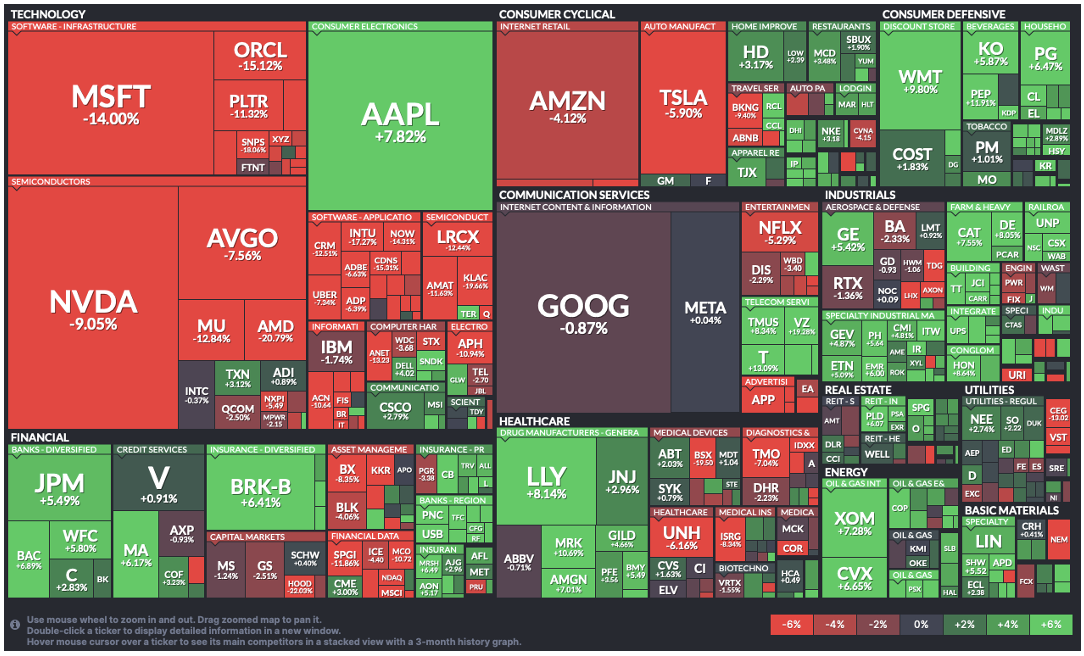
In one trading session, AMD fell by 17 percent, Nvidia by 3 percent, Palantir by more than 11 percent, SanDisk by 16 percent, CoreWeave by more than 7 percent, Oracle by 4.5 percent and chip designer ARM by almost 9 percent below expectations.
Figure 1. S&P500 Heat Map (1 week to February 4, 2026)
Source: finviz
Sentiment shifts are inevitable, unpredictable, and help explain why software companies are being sold because of the threat of AI, while the AI companies are being sold because the threat they pose is not materializing quickly enough.
The certainty of sentiment changes is what we can always rely on to burst a bubble. And as I have often noted in the past, bubbles can burst without a catalyst, just as this one now appears to be deflating. The jitters simply turn into a slump, and investors lick their wounds and rhetorically exclaim, “But nothing has changed!”
Saas – not so sure
One element of the regime change in sentiment is the emerging concern that Software-and-a-Service (SaaS) business models could be upended by AI.
For more than ten years, enterprise SaaS was the golden goose of Wall Street. It was a world of predictable, rising workforces, which in turn drove more subscribers to SaaS companies, which in turn drove reliability into ever-increasing multiples. Saa’s companies were said to enjoy both the network effect and the vast business ‘moats’. But as of February 2026, sentiment has changed.
What started as a nervous sell-off seems to be turning into a sustained, structural price revision. But as some analysts now perceive, the price repricing probably started some time ago.
The WisdomTree Cloud Computing Fund (WCLD) may be down nearly 10 percent over the past month, but since ChatGPT’s debut in late 2022, the Nasdaq 100 has more than doubled, while software stocks are up just 19 percent.
It’s easy to blame AI, but maybe SaaS has simply passed the middle of its S-curve. The era of hypergrowth is over and sales efficiency has collapsed. Data shows that public software companies increased their sales and marketing (S&M) spending between 2021 and 2024, while fewer incremental revenue. In other words, they are reaching their saturation point and replacing customers who leave is much more expensive than retaining an existing customer.
And then there was the release of Claude Cowork in January. Unlike previous AI tools, Cowork doesn’t just “help” a human; it builds the spreadsheets, surfs the web, and organizes files autonomously. And it was reportedly built in less than two weeks.
Its release has ushered in a terrifying reality for legacy SaaS investors: what if the world moves from a regime in which software orchestrates human labor (software acts as a passive, rules-based tool, requiring human input to manage data, make decisions, and perform tasks), to one in which software performs the work itself?
The shift from software that organizes human labor (e.g., spreadsheets, project management tools, Customer Relationship Management (CRM), and Enterprise Resource Planning (ERP) systems) to software that performs the work autonomously (e.g., AI agents, robotic process automation) is a major paradigm shift in the modern workplace. This transition, often called the rise of Agentic AI or “services as software,” marks a shift from tools that assist human workers to digital “teammates” that act independently to achieve goals.
And if a small AI team can create enterprise-level workflows in a matter of days, the “moat” around a $50 billion software company evaporates.
The sell-off we are witnessing may be a manifestation of that evaporation.
For twenty years, the math was simple: more employees = more licenses = more revenue. Agentic AI invalidates the equation. When a single AI agent handles the work of an entire department, the per-user pricing model becomes an existential imperative for companies like Salesforce, Adobe, and Intuit. If customers start demanding outcome-based pricing, the transition will result in the cannibalization of existing revenue models.
In the old world, people were the ‘connective tissue’ that moved data between silos, for example from CRM to ERP. In the new world, AI agents act as orchestrators, pulling and pushing data through systems without ever touching a user interface.
Conclusion
Not every company will lose, but not everyone will win either. That means the boom or bubble phase, the phase where every company’s stock was priced as if it was going to win, is over. What you are witnessing today is that shift, a shift that we explained last year was inevitable.
The period we are in now is an era seen after the advent of previous General Purpose Technologies (GPTs). It is known as creative destruction. The disruptors will now be disrupted, and many will be forced to disrupt their old business revenues in order to survive. And that process makes them smaller than before.

He is also the author of the best-selling investing guide to the stock market, Value.able – how to value and buy the best stocks for less than they are worth.
Roger regularly appears on television and radio, and in the press, including ABC radio and TV, The Australian and Ausbiz. View upcoming media appearances.
This post was contributed by a representative of Montgomery Investment Management Pty Limited (AFSL No. 354564). The main purpose of this message is to provide factual information and not advice about financial products. Furthermore, the information provided is not intended as a recommendation or opinion about any financial product. However, any comments and statements of opinion should contain general advice only, prepared without taking into account your personal objectives, financial circumstances or needs. Therefore, before acting on any information provided, you should always consider its suitability in the light of your personal objectives, financial circumstances and needs and, if necessary, seek independent advice from a financial advisor before making any decision. Personal advice is expressly excluded in this message.
#creative #destruction #phase