

It’s easy to assume that email problems are caused by the people who hit send. But sometimes the real problem is much bigger – and higher up the organizational chart.
If you’re in senior leadership and your email metrics feel like a slog with low opens, fewer clicks and unsubscribes, it’s tempting to blame the email team. Before you do that, ask yourself: Do you actually know who is on your list and why they are there?
When ‘good’ statistics hide a bigger problem
A while ago I worked with a client in B2B financial services. Their email performance was weak. They had very low open and click-through rates. However, their unsubscribe and spam complaint rates were within industry guidelines.
But when I compared their unsubscribe and spam complaint rates to their click rates, the problem became clear.
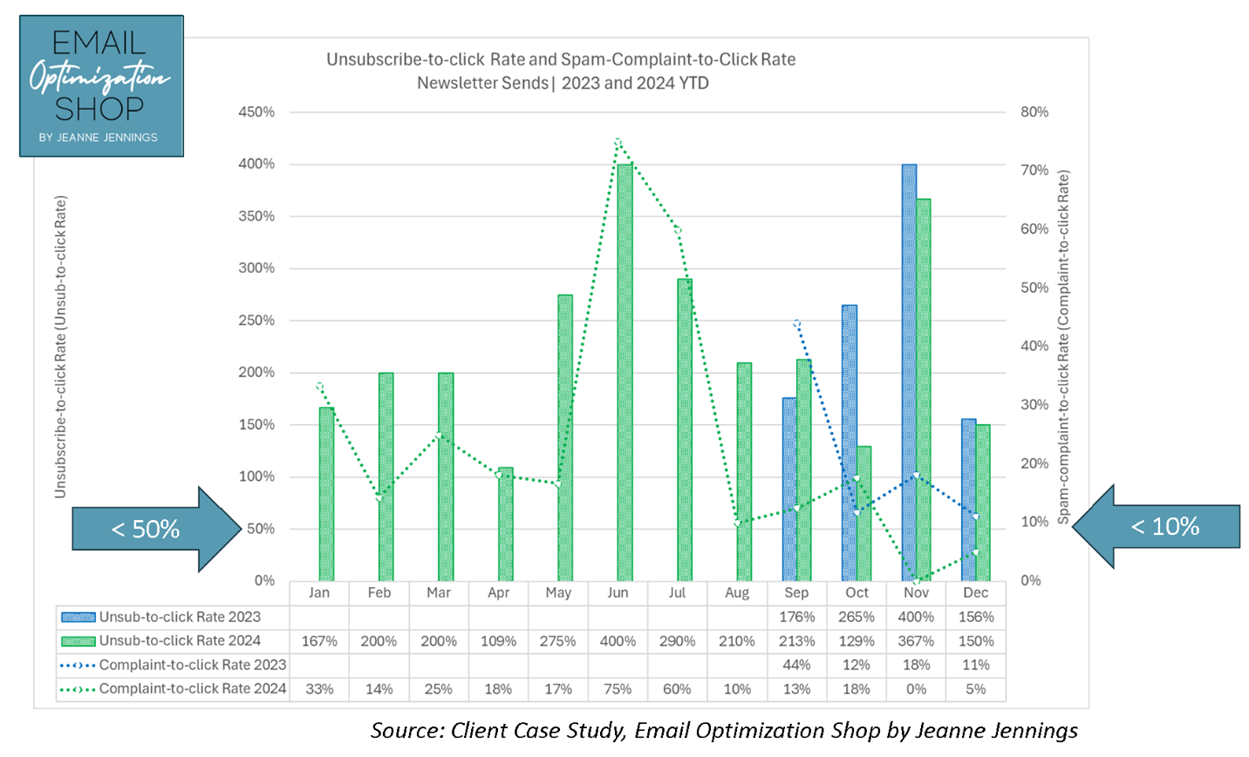
If you look at the unsubscribes or spam complaints individually, they may seem acceptable. But compared to the number of people who actually clicked, the real story emerges: the rates of post-click unsubscribes and post-click spam complaints were unprecedented.
When negative engagement (unsubscribes or spam reports) outweighs positive engagement (clicks), that’s an important warning sign. The list is compiled entirely based on website opt-ins. So far so good, right? Here’s the problem. The sole purpose of the website was to generate leads for the sales team – and it did, perhaps a little too well.
Anyone who entered an email address into a form on the site found themselves in an aggressive (yet efficient) lead nurturing journey with rep outreach. After a few phone calls and follow-ups, you became a customer, were deemed unqualified, or said “thanks but no thanks.” Then you were thrown into the running email program.
Dig Deeper: 3 High-Impact Tactics to Drive Email Engagement
Same message, new – very different – audience
That email program consisted of two monthly sends:
- A promotional offer segmented by industry.
- A company newsletter.
This is where things went off the rails. This was a service that most companies would use at most once a year. Sending monthly promotional emails and sales newsletters to people who had already used the service, been deemed unqualified, or had declined the offer was a misstep.
It was like contacting everyone who had ever applied for a job at your company—those you hired, those you rejected, and those who turned you down—and asking them to reapply. For the same position, with the same job description and the same salary.
The approach completely missed the point – and came across as tone deaf. These were people who had already completed their journey with the brand in some way, yet were still receiving messages as if it hadn’t even started yet.
It wasn’t that the emails were poorly written. It wasn’t that the creative team didn’t segment. It wasn’t even that the email marketers weren’t optimizing.
The message didn’t resonate with the public – and that decision came from upper management.
A misaligned email program
Let’s break it down. The lead nurturing journey ends when someone becomes a customer or is unlikely to become a customer anytime soon. That’s the natural stopping point.
Is it a bad idea to keep in touch with people who have expressed interest? Not at all. But it requires a new communications strategy – one that isn’t just a repeat of what they’ve already experienced with the brand.
Sticking to the same approach, built to generate leads for the sales team, only creates disengagement.
- Low open rates.
- Hardly any clicking.
- Rising unsubscribes.
Not because the content was bad or the cadence was too frequent (although that can happen), but because the value wasn’t there. The emails were simply not relevant to the people who received them.
Dig deeper: 5 ways to optimize your pre-holiday unsubscribe process
There are smarter and more respectful options
This brand could have taken several better paths.
- Customize the message: Shift from high-sell promotions to long-term, value-driven content. Make sure you stay top of mind so that if these people later become qualified or change their minds, your brand is still in the running.
- Change the audience: Keep the promotional emails, but only send them to new leads who have not yet completed the full sales cycle. Build new lists of potential leads that may actually be in the market.
- Redefine the role of email: Perhaps your ongoing program should focus less on acquisition and more on retention, referrals and reviews. Customers who already love you are much more likely to recommend you – if you ask them to.
- Do nothing: (OK, mostly joking, but not entirely.) If none of the above are feasible, then maybe you don’t need an email program at all, at least not for this segment or purpose.
Who advocates for the subscriber?
This ties into an earlier article I wrote for MarTech: “Who’s Advocating for Your Email Subscribers?” We’re often so focused on conversion metrics that we forget that there are real people behind those open visits, clicks, unsubscribes, and spam complaints.
In this case, the list was treated as a resource to be mined rather than a relationship to be maintained. And that’s a problem.
Email is not free. It takes time, budget and brand value. And if you send irrelevant messages to people who have already mentally unsubscribed, you’re not only wasting all three, you’re also burning bridges.
Know before you ship
The next time you look at your email strategy from top to bottom, ask yourself the following:
- Who exactly is on this list?
- Where are they on their journey with us?
- Do we send messages that reflect that?
If the answer is, “I’m not sure,” it’s time for some list hygiene—and a lot of strategic rethinking.
Dig Deeper: 4 Best Practices to Build a Clean and Engaged Email Database
Energize yourself with free marketing insights.
Contributing authors are invited to create content for MarTech and are chosen for their expertise and contribution to the martech community. Our contributors work under the supervision of the editors and contributions are checked for quality and relevance to our readers. MarTech is owned by Semrush. The contributor was not asked to make any direct or indirect mentions of it Semrush. The opinions they express are their own.
#email #list #MarTech