

In today’s era of engine downsizing, forced induction and hybridization, engine size and displacement alone no longer guarantee superior power. Modern V6 turbo engines can often match or even surpass V8 turbo engines. Still, a V8 has two more cylinders than a V6, and that extra hardware brings its own considerations, as well as making a V6 engine sound different from a V8.
Do V8 engines require more maintenance than their V6 counterparts? A V8 can be more expensive to maintain simply because it has more components, but the difference is not huge and depends on more factors than just size and engine displacement. V8 engines typically require two extra spark plugs, two extra fuel injectors, more valves and more oil during an oil change.
A V6 engine is also typically lighter and smaller, which can reduce stress on engine mounts and associated components. All this translates into a V8 engine with a higher level of mechanical complexity, but the maintenance differences are generally insignificant. All engines require maintenance and the number of cylinders is ultimately just one piece of a much larger puzzle.
What maintenance do V6 and V8 engines actually need?
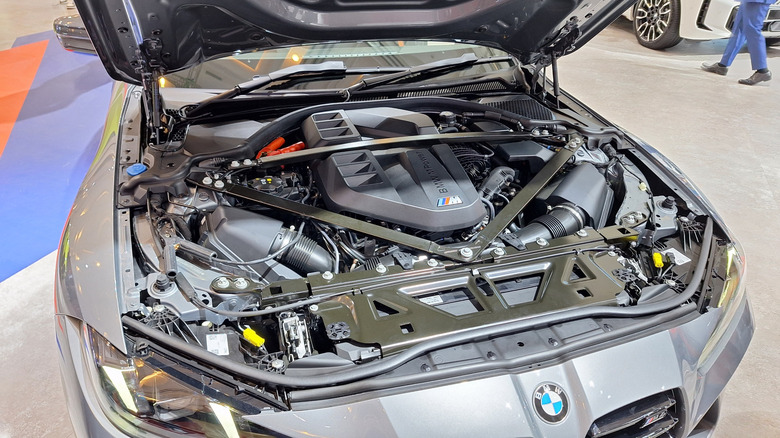
With two more cylinders, a V8 needs eight spark plugs, while a V6 needs six. As a general rule, you should replace your spark plugs every 50,000 to 100,000 miles. AAA also reported that a spark plug costs an average of $5 to $25. This means that your BMW N63 V8 will cost you $10 to $50 more than the BMW B58 V6 because it has two extra spark plugs, and that’s every 50,000 to 100,000 miles.
Every engine also needs a coolant flush at some point. KBB recommends doing this every two years (30,000 miles). Taking our N63 and B58 examples, the former has a coolant capacity of 13.2 liters (12.5 liters), while the latter has a coolant capacity of 11 liters (10.5 liters). If we do the math and average $8.30 to $10.30 for a gallon of coolant, that amounts to a difference of $18 to $23 per flush, or $37 to $45 over two flushes in four years. In the grand scheme of car costs, the difference is not that big.
The V8 isn’t always the wallet-breaker you think it is
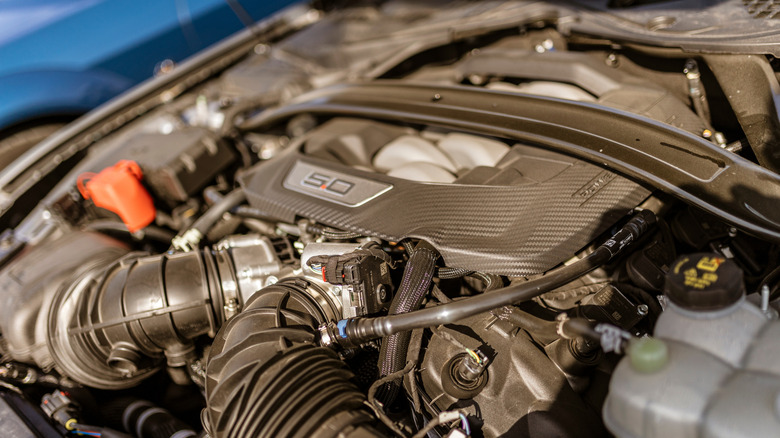
You’d be forgiven for thinking that a Ford Coyote V8 costs more to repair and maintain than a 3.5-liter EcoBoost V6. However, on the F150 Forumowners discussed the true costs of V8 and EcoBoost F150s, and many agreed that the V8 is likely cheaper to maintain. User bylons808 summed it up: “The V8 will probably be the lower maintenance engine in the long run. Anyone who has owned a car with turbos can tell you that.”
Engine Cruxa site that specializes in engine reliability and maintenance analysis paints a similar picture, writing that maintenance and repair costs for the Coyote V8 are $100 to $200 cheaper than for EcoBoost V6 engines. The Coyote is a naturally aspirated engine and is simpler than a turbocharged EcoBoost engine, which can lead to lower costs. However, because V8 engines are larger and heavier and often use sturdier parts, it can cost more money to repair a V8 than a V6.
For more extensive repairs, such as engine rebuilds, you’ll also likely pay more for a V8 than a V6. If the V8 engine is turbocharged, high performance, and comes from an exotic car manufacturer like Ferrari, the repair costs can be unbearably expensive. Forced induction can increase the temperature, which can increase the chance of problems, but again, it’s just one factor at play. Many turbo engines are very reliable if they are properly designed and maintained.
#V8s #require #maintenance #V6s #Jalopnik