

The property has several target areas, including:
- Cu/Au/Mo porphyry potential
- Bulk RIRGS target with high-grade gold results in historic drilling, trenching and underground exploration
- High-quality gold-copper epithermal vein system with low sulfidation.
Ed Kruchkowski, President of Decade Resources, stated:
“The Bonaparte Gold project is an exciting property located in an area easily accessible by a network of logging roads. The presence of gold-bearing epithermal quartz veins with low sulphidation that are open to expansion along the strike and to depths where multi-ounce gold tests have been intersected in historical drilling represents a major exploration target. The underlying IP anomaly presents an attractive target and this first drill hole will not only test a larger area for gold-bearing veins, but also test at depth. is the presence of historic copper and gold geochemical soil results extending southeast from the “Discovery Zone”, approximately 1 km away, are also indicated above. Gold-rich epithermal vein systems are somewhat unique, projects such as Sleeper and Midas in Nevada and Hishikari in Japan are examples have tact and look forward to drilling both targets.”
Discussion of Bonaparte
In 1994, a bulk sample of 3,700 tonnes of mineralized vein material from surface trenches to a vertical depth of 12.2 meters from an open cut in the Nutcracker, Owl, Gray Jay and Crow vein systems, averaging 25.4 g/t Au, from the property area produced 3,160 ounces of gold. In 2010, a small bulk sample of the Crow Vein was shipped to the Kinross Mill in Republic, Washington. The 364 tonne sample analyzed 16.3 g/t Au (0.475 oz/t Au), yielding 161.95 troy ounces of gold. The above results come from both the BC Minfile and a 43-101 report by R. Kemp. The Company believes these results can be relied upon.
During 2013 to 2014, historical IP surveys identified resistive (IP) anomalies that are considered high-priority drill targets and may indicate the presence of silicification, quartz veining or potassium alteration – features that commonly host disseminated gold or copper mineralization. These resistivity anomalies coincide with anomalies in high chargeability, indicating a silica-rich, resistive host rock containing disseminated conductive sulfides. This interpretation is consistent with observations from geological surveys by geologists from the British Columbia Geological Survey, Ministry of Energy, Mines and Natural Gas: “We speculate that the Bonaparte deposit represents a higher level of a buried porphyry system.” Reference for this is in: Bonaparte gold: another $195 million porphyry Au-Cu deposit in southern British Columbia? James M. Logan and Mitchell G. Mihalynuk, British Columbia Geological Survey, Ministry of Energy, Mines and Natural Gas, page 71, 2013.
To view an enhanced version of this image, visit:
https://images.newsfilecorp.com/files/3615/283388_40611c6c740359fd_001full.jpg
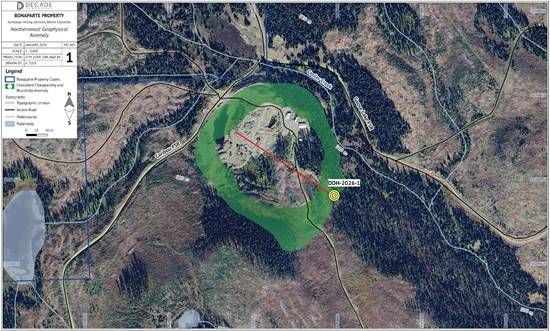
The IP anomalies appear to begin at a depth of about 300 meters and extend beyond 500 meters, according to report 43-101 by R. Kemp. The company plans a drilling of at least 3000 meters, consisting of 5 holes, each with a length of 500 meters. The first target area is the anomaly below the mining zone, as shown on the following map.
To view an enhanced version of this image, visit:
https://images.newsfilecorp.com/files/3615/283388_40611c6c740359fd_002full.jpg
Qualified person
Ed Kruchkowski, P.Geo., President of Decade Resources Ltd., is a Qualified Person as defined by National Instrument 43-101 and has reviewed and approved the technical contents of this press release.
Neither the TSX Venture Exchange nor its Regulation Services Provider (as that term is defined in the policies of the TSX Venture Exchange) accepts responsibility for the adequacy or accuracy of this release.
Forward-Looking Statements
This press release contains certain statements and information that may constitute forward-looking information within the meaning of applicable Canadian securities laws. All statements in this press release, other than statements of historical fact, including statements regarding future estimates, plans, objectives, timing, assumptions or expectations of future performance, including but not limited to, that the Company will obtain regulatory approval for the Option, the exercise of the Option, exploration plans for the Property and the use of funds for the recently completed private placement are forward-looking statements and contain forward-looking information. Generally, forward-looking statements and information can be identified by the use of forward-looking terminology such as “intends” or “anticipates”, or variations of such words and phrases or statements that certain actions, events or results “may”, “could”, “would” or “would” be or occur.
Forward-looking statements are based on certain material assumptions and analyzes made by the Company and the opinions and estimates of management as of the date of this press release, including that the Company will be able to obtain regulatory approval for the Option, that the Company will be able or willing to make the Option Payments to exercise the Option, that the Company will have the necessary funds and resources to execute its exploration plans for the Property and that the Company will use the proceeds from the private placement as expected.
These forward-looking statements are subject to known and unknown risks, uncertainties and other factors that may cause the actual results, level of activity, performance or achievements of the Company to be materially different from the values expressed or implied by such forward-looking statements or forward-looking information. Key risks that could cause actual results to vary include, without limitation, the risk that the Company may not obtain regulatory approval for the Option Agreement; that the Company may not be able or willing to make all Option Payments and exercise the Option; that the Company may not be able to execute its exploration plans on the Site as expected, or at all; and that the Company may not use the proceeds of the private placement as expected.
Although the Company’s management has attempted to identify important factors that could cause actual results to differ materially from those contained in any forward-looking statements or forward-looking information, there may be other factors that cause results not to be as anticipated, estimated or intended. There can be no assurance that such statements will prove to be accurate, as actual results and future events could differ materially from those anticipated in such statements. Accordingly, readers should not place undue reliance on forward-looking statements and forward-looking information. Readers are cautioned that reliance on such information may not be appropriate for other purposes. The Company undertakes no obligation to update any forward-looking statements, forward-looking information or financial prospects incorporated herein by reference, except in accordance with applicable securities laws.
References
Logan, JM, and Mihalynuk, MG, 2013. Bonaparte gold: another $195 million Au-Cu porphyry deposit in southern British Columbia? In: Geological Fieldwork 2012, British Columbia Ministry of Energy, Mines and Natural Gas. British Columbia Geological Survey Paper 2013-1, 71-80.
Mini file BC
NI 43-101 Technical report on the Bonaparte Gold Project by R. Kemp, P.Geo.
**Reduced Intrus-related Gold Systems (RIRGS) are characterized by widespread series of capped gold-colored quartz veins that form preferentially in the brittle shield at the top of small plutons, where they form bulk-tonnage, low-grade Au deposits characterized by an Au-Bi-Te-W metal assemblage, such as the Fort Knox and Dublin Gulch deposits. https://www.researchgate.net/publication/277131625_Reduced_Inlusion-related_Gold_Systems

To view the source version of this press release, please visit https://www.newsfilecorp.com/release/283388


#Decade #plans #Drilling #program #Bonaparte #property #Kamloops #Mining #Division