

The event will showcase India’s military prowess and rich cultural heritage, with 30 tableaus from states, Union Territories and ministries. The day highlights India’s defense capabilities and honors citizens, including children, for acts of bravery. The theme ‘Mantra of Swatantrata: Vande Mataram’ with special scenes and a new musical rendition composed by MM Keeravani and sung by Shreya Ghoshal and ‘Samriddhi ka Mantra: Aatmanirbhar Bharat’ will highlight India’s journey towards prosperity and self-reliance. By combining the two, the government indicates that modern technological self-reliance is the logical conclusion of the freedom struggle. It is the journey of “Self-Government” (Swaraj) to “Self-reliance” (Atmanirbharta).
You might be wondering why a 150 year old song is paired with Atmanirbhar Bharat. In 1905, Vande Mataram was the anthem of the Swadeshi movement (the original movement of ‘Self-Reliant India’). The Government of India launched the Vande Mataram 150 portal where citizens could record their own renditions and download commemorative certificates. Compiled by Bankim Chandra Chattopadhyay in 1875 in Sanskrit Bengali. It first appeared in his 1882 novel Anandamat. Rabindranath Tagore first sang it during the session of the Indian National Congress in 1896. It became a rallying cry against British rule, especially during the anti-partition movement of Bengal in 1905, and was the anthem of the Swadeshi movement. It personified the nation as a ‘Mother’, demanding devotion and sacrifice.
The Ministry of Culture tableau will exhibit the original manuscript and its journey from 1875. It was adopted as the national song by the Constituent Assembly on January 24, 1950. While 1947 gave us our breath of freedom, 1950 gave us our soul – a framework that ensures that every Indian is the master of his own destiny. This year is particularly special as we celebrate 150 years of ‘Vande Mataram’, the song that ignited the flame of revolution in the hearts of millions of people. But a republic is not just about its past; it’s about his future. Today we see an India that no longer just ‘asks’, but ‘delivers’.
A view of the Ministry of Home Affairs tableau during the full dress rehearsal of Republic Day 2026, amid rains, at Kartavya Path, in New Delhi. | Photo credit: ANI
From the indigenous BrahMos missiles and Tejas aircraft to being the global leader in digital payments and vaccines, our self-reliance – our Atmanirbharta – is our true strength. When we use a ‘Made in India’ product or support a local start-up, we are practicing the modern form of patriotism. The first ‘Made in India’ semiconductor chips will enter the global supply chain in early 2026. This reduces dependence on imports for everything from mobile phones to fighter jets.
Atmanirbhar Bharat (Self-Reliant India) is built on five core pillars announced by Prime Minister Narendra Modi in May 2020: Economy, Infrastructure, System, Vibrant Demography and Demand. Economics, not just incremental growth, but ‘quantum leaps’; Infrastructure, symbolized by Prime Minister Gati Shakti and the expansion of ‘Water Metros’: system, powered by 21st century technology (e.g. UPI, which has now gone global). Vibrant demography by utilizing our young population as ‘smart soldiers’ and innovators, and demand, and ensuring that the ‘strength of the Indian market’ is met by ‘Made in India’ goods. This initiative aims to transform India into a global economic power, by promoting self-sufficiency, boosting local manufacturing and driving modernization through technological advancement, backed by a package of ₹20 lakh crore.
The Constitution acts as the ‘software’ on which India’s various ‘hardware’ runs. True independence is achieved when a nation can stand on its own two feet and at the same time hold its head high in the global community. Really understand why Atmanirbhar Bharat (Self-Reliant India) is a centerpiece of Republic Day 2026, we need to look at moving from ‘coming together for the world’ to ‘inventing for the world’. In 2026, this isn’t just a slogan; it is visible in the hardware rolling along Kartavya Path and the digital systems in our pockets. The parade will include performances by 2,500 cultural artists, a display of India’s defensive prowess and a special tribute to the national song. India’s self-reliance has moved towards ‘deep-tech’ and ‘critical minerals’.
Video credit: DRDO/YT
The DRDO is showcasing indigenous long-range hypersonic anti-ship missiles, putting India in an elite club of countries with this level of speed and precision. The 2026 Tri-Services tableau emphasizes this operation, showing ‘jointness’ in which the Akash Air Defense System, BrahMos and Rafale operate within a single, indigenous digital loop. Operation Sindoor and its success will be a central theme of Republic Day 2026 where the Indian Armed Forces will display a special scene and ‘Sindoor’ aircraft formation to highlight their jointness, military capabilities and resolve against terrorism. Featuring over 300 private space startups, the 2026 celebrations highlight progress towards India’s own space station and successful testing of indigenous jet engines – a feat achieved by only a handful of countries.
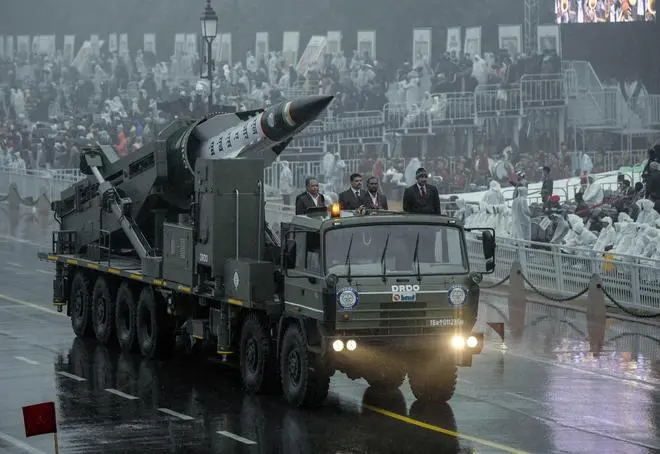
DRDO’s Long Range – Anti Ship Missile (LRAShM) during the full dress rehearsal of the Republic Day parade 2026, amid rains, at Kartavya Path, in New Delhi on Friday. | Photo credit: ANI
The Bhairav Light Commando Battalion, a newly raised elite unit of the Indian Army, will make its national debut during the 77th Republic Day Parade on January 26, 2026, marching along the Kartavya Path in New Delhi. The main event of the day, the Republic Day Parade, will showcase the country’s cultural diversity and military strength, highlighting the shift towards indigenous defense platforms (ATAGS, Dhanush and Shaktiban).
The event will be attended by the President of the European Council, Antonio Costa, and the President of the European Commission, Ursula von der Leyen, as chief guests, and will highlight India’s role as a bridge between the Global South and the West. This is one of the highest honors that India can bestow. It’s a masterclass in soft power diplomacy. By inviting a foreign leader, India is signaling its strategic priorities for the coming year.
Republic Day is not just a holiday, but a time to reflect on the resilience of Indian democracy and its continued journey towards progress and inclusivity. India surpassed Japan to become the world’s fourth-largest economy by 2025, with a GDP of over $4 trillion, driven by rapid digitalization, robust manufacturing, infrastructure development and structural reforms such as GST and IBC. This rapid rise from 10th place in 2014 was anchored by strong domestic demand, a burgeoning services sector and a young workforce. India is recognized as the fastest growing major economy in the world, with real GDP growth averaging 6.5%+ in recent years, and is expected to become the third largest economy, surpassing Germany. Although India became a free nation on August 15, 1947, it declared itself a sovereign state. Democratic and Republican state with the adoption of the Constitution on January 26, 1950.
While India gained independence on August 15, 1947, the country adopted its own constitution on January 26, 1950, replacing the British-era Government of India Act (1935). The day marks the transition from rule by an external authority to rule by a document that enshrines the principles of justice, liberty, equality and fraternity for all citizens. January 26 was specifically chosen because it marks the anniversary of Purna Swaraj (Total Independence), declared by the Indian National Congress in 1930, which was celebrated for seventeen years before 1947.
One of the greatest tests for Indian democracy was the Emergency, a 21-month period (June 1975 – March 1977) during which Prime Minister Indira Gandhi suspended democracy due to internal instability. Under Article 352, fundamental rights were suspended, the press was censored and opposition leaders were imprisoned. It is considered one of the most controversial constitutional crises in India. More than 100,000 people were imprisoned, including political rivals, and forced sterilizations took place. After the Emergency, the 44th Amendment (1978) restored judicial review and limited the power to declare a national emergency. The 1975 Emergency remains a defining moment, highlighting the fragility of democratic institutions in the Republic when constitutional mechanisms are abused. History aside, Republic Day is a reminder that the Constitution is a living document. It is the day we celebrate that ultimate power does not lie with a monarch or a single party, but with ‘We, the People’. It is the annual ‘software update’ for national consciousness, reminding every citizen of their fundamental rights and, equally important, their fundamental duties. For every fundamental right we enjoy, we owe the nation a fundamental duty.
Published on January 25, 2026
#Combining #150year #legacy #Vande #Mataram #modern #vision #Atmanirbhar #Bharat #Indias #77th #Republic #Day #Matters