

Go to school, kids.
It’s obviously a good idea no matter your circumstances, but it’s becoming an increasingly better idea if you’re an aspiring professional tennis player.
College tennis used to be a safe haven for junior players who weren’t skilled enough to make a straight jump to the pros — and would likely never reach the next level. They could continue playing tennis for about four years and get an education at the same time before diving into the ‘real world’.
That’s not the case anymore – and hasn’t been the case for some time. Over the past decade in particular, college tennis has become a legitimate pipeline for the ATP and WTA Tours. The college game has always built character; now the depth of the sport and the quality of the competition are also driving the development of top tennis skills.
The kind of skills that can help you not only reach the professional tour, but thrive.
Look no further than the 2026 Australian Open to confirm that you can go from the relative anonymity of the collegiate ranks to bona fide stardom at the biggest levels of tennis. Heading into the third round at Melbourne Park, eight men still in the draw have university links. That’s 25 percent, for those counting. Four of them – Ben Shelton (Florida), Learner Tien (USC), Eliot Spizzirri (Texas) and Ethan Quinn (Georgia) – were not in school until 2023. Further back, Francisco Cerundolo (South Carolina), Cameron Norrie (TCU), Valentin Vacherot (Texas A&M) and Nuno Borges (Mississippi State) were also stars at the college level.
Of those eight, five were placed in Melbourne. The other three have already displaced a seed (Spizzirri upset Joao Fonseca, Borges got the best of Felix Auger-Aliassime and Quinn made quick work of Tallon Greekpoor).
They are simply kicking ass – and they make no apologies for it.
“I think college players are dogs for the most part,” seventh-ranked Shelton said in his news conference after beating Ugo Humbert 6-3, 7-6(2), 7-6(5) in the opening round. “I don’t feel like doing that [are] so many college players who come on tour and make it and are soft. I think you have to get used to dealing with a lot when you’re in college.
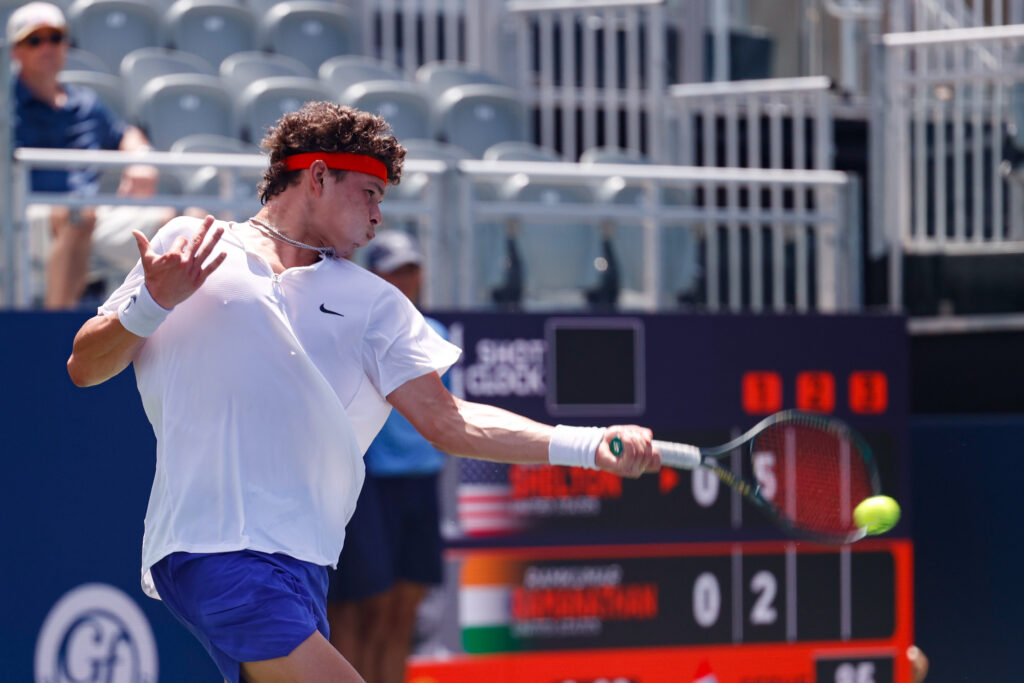
Quinn, ranked 80th, still has a long way to go before he reaches Shelton’s level. But the 21-year-old sees some college-bred similarities between himself and his fellow NCAA singles champion.
“Ben’s locker is right next to mine, and for the most part he and I are pretty outgoing — pretty loud,” Quinn explained after beating Hubert Hurkacz 6-4, 7-6(5), 6-1 on Thursday. “I think that’s definitely a trait [college players] to have. You know, we’re willing to go get it. I think that’s something you have to learn during your studies. [There are] 10 of you in a team – 12 of you in a team…. Coaches aren’t going to do everything just for you, so you really have to make sure you do things for yourself. [College players] are willing to go out and get it. And they’ll be loud about it when they get it.
They’ll definitely get it Down Under.
In addition to the eight in the third round, Michael Zheng (Columbia) and Raphael Jodar (Virginia) reached the second round of a Grand Slam for the first time in their careers. Zheng, the two-time reigning NCAA singles champion who still plays for Columbia, defeated Sebastian Korda in the first round. Yannick Hanfmann (USC), Arthur Fery (Stanford), Nishesh Basavareddy (Stanford) and Rinky Hijikata (North Carolina) also advanced to the second round.
“I think the NCAAs definitely prepared me for moments like this,” Zheng noted after his five-set defeat of Korda. “I feel like when you play for the university, you’re playing for something bigger than yourself… You really want to win for yourself, but also for your school.
“Surprisingly, I felt more nervous going into the NCAA finals than this match. But yeah, I think it shows that college tennis is a real path to the pros.”
Of course, it’s not just education; it is also nature. Going to college doesn’t mean you get a professional career as a gift. The vast majority of collegiate athletes – tennis and otherwise – don’t go pro. But there’s just something special about this current group.
“I think for the most part it’s just a great group of guys,” Spizzirri said after his first-ever five-set match, a win over Yibing Wu on Thursday. “There’s a really good camaraderie among us. I feel like we really want each other to win. And when I see other students doing well, it gives me confidence. And I think the other guys say the same thing.”
“In terms of characteristics [every college player] is sincere, authentic, hardworking, tough, selfless. They’ve basically all done it just because you’ve been working in a team environment for so long.
“The level at the university has become higher,” Spizzirri continued. “I don’t know exactly why that is – maybe good coaching; the resources are incredible. When I went to college I said to myself, ‘Listen, as a 17, 18 year old, I’m going to get top 10, 20 in the world level resources for four years. So you really have an opportunity to maximize your potential. I don’t know if guys looked at it that way 10, 15 or 20 years ago, but I definitely think that’s what guys look like (now) stepping stone to the pro tour.”
And perhaps even a stepping stone to the final rounds of a Grand Slam.
#College #players #prove #tenacity #Australian #Open