

China has banned the use, trading and mining of cryptocurrencies for years, despite other Asian countries being keen to support the rise of digital assets in terms of regulation and usage. While the goal, according to official reasoning, is to curb financial stability, capital flows and speculative bubbles, the authorities’ clear goal is to impose fully regulated Chinese banking systems on the population.
An alternative to this strict environment is now offered by ‘U-cards’, which allow the use of stablecoins without directly owning cryptocurrency. They are based on Visa or Mastercard in terms of type and support instruments such as USDT.
A loophole for global payments
Authorized by China “U card” nothing more than a foreign Visa or Mastercard type card that can be topped up with a stablecoin balance. The user transfers cryptocurrencies denominated in dollars to a service provider operating in the background, which immediately converts them into fiat money, which in the traditional financial system can already be used with cards.
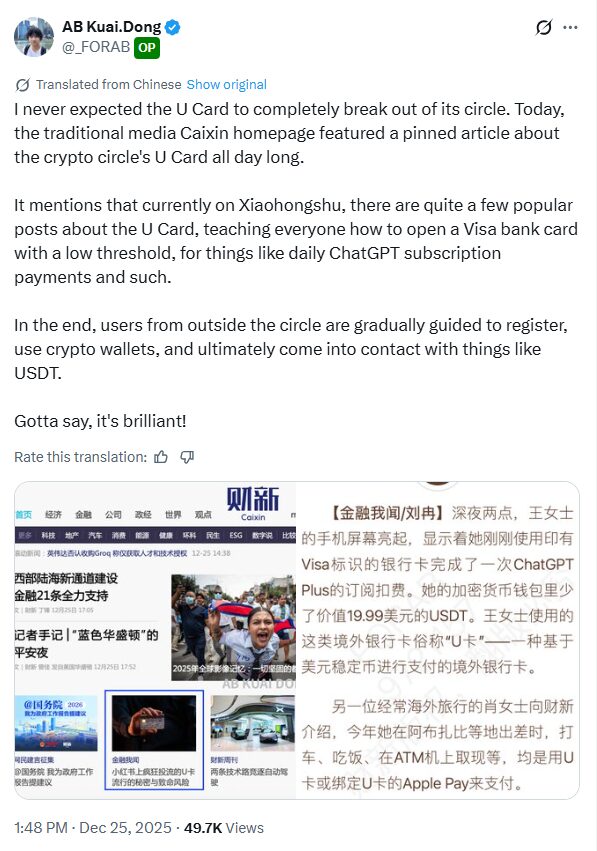
The transaction does not technically cross China’s internal financial boundaries, as the exchange and settlement take place in foreign banks. This model allows customers to arrange subscriptions, book hotels or pay for services online – all while legally circumventing domestic bans within the framework of a gray zone transaction and model.
“Users have relatively limited exposure to the risks of the crypto market because the exchange of assets takes place offshore and settlement remains within traditional card networks.”
said Liu Honglin, founder of Shanghai Mankun Law Firm.
Such cards therefore balance on the border between the legal and alternative financial worlds.
What belongs to the gray zone: benefits, risks
For users, the U-Card is a fast, easy and secure way to enter the dollar-based world. No currency account required, no bank authorization required – just a stablecoin and a few clicks. Due to the simplicity of fiat transactions, merchants also accept such cards easily, because for them the payment is exactly the same as any other bank card. At the same time, the legal status of the model is far from clear.
Because the exchange takes place at offshore institutions, circumvention of anti-money laundering regulations can arise, as well as tax consequences that raise many questions. Chinese authorities have warned that all financial transactions initiated from abroad will require verification – even if participants use stablecoins.
On the threshold of a new financial system
There is no doubt that initiatives like this indicate that – despite the ban – there is also a demand for the use of cryptocurrencies in China. However, the Chinese state would, for understandable reasons, prefer a digital yuan issued by its own controlled central bank to decentralized instruments. Until now, e-CNY has been considered a cash instrument, but now it will function as a digital deposit, which can earn interest and be integrated into the banking system. The goal is clear: to reduce the appeal of crypto assets and instead offer a secure, verified alternative.
While the effort would in principle serve the interests of the population, it should not be taken for granted that the goal, especially in China, is complete control over the population and information. However, initiatives similar to ‘U-cards’ should also be treated with caution.
#Chinese #UCards #offer #alternative #CBDC