

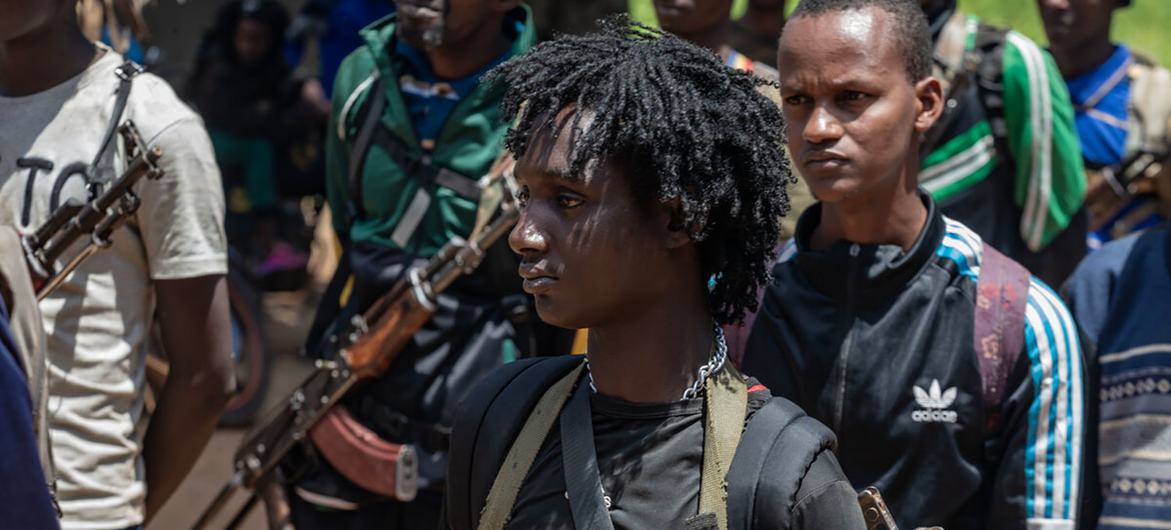
Some carried weapons of war; others, ammunition – the very things on which their suitability for the disarmament, demobilization and reintegration (DDR) process they were about to embark on depended.
The small crowd of locals gathered in Sanguere-Lim, Koui subprefecture, sounded heartfelt wishes to see off the fighters as they walked from the 3R assembly point to the nearby makeshift disarmament site set up by the national unit that oversaw the process and carried out its implementation.
There was also music – part of the government’s public awareness campaign – as a song blared from loudspeakers calling on Central Africans to lay down their weapons “to go to school, to work the fields or for any form of livelihood, to lay down your weapons, for peace”.
Ongoing operations
The disarmament and demobilization initiative in Sanguere-Lim was the latest in a series of ongoing operations that started in July.
They followed a historic peace deal between the government and the 3R and another armed group Unity for Peace in the Central African Republic (UPC) – signed in N’Djamena, Chad, in April – to mark their return to the CAR peace process.
The UN peacekeeping mission in the country, MINUSCAsupports GDR operations, in accordance with its mandate. The government launched the national program in December 2018, and MINUSCA has since been providing extensive financial, logistics, technical and security activities.
MINUSCA/Leonel Grothe
The UN peacekeeping force in the Central African Republic supports the disarmament and demobilization of members of armed groups.
I look forward to a new life
Abel Delatid, 25, who joined the 3R in 2017, was among the fighters disarmed. “I heard about the peace agreement in N’Djamena through awareness raising by MINUSCA and local authorities. I am looking forward to vocational training to start a new life when I lost my leg in fighting,” he said after surrendering his weapon.
The fighters were expected to make several mandatory stops, including the transfer of weapons or ammunition, a physical examination and the registration and receipt of a disarmament certificate.
They also receive a medical examination, a choice of vocational training, a special allowance and a starter pack to help them on the new path ahead.
Ambition to join the army
Aroun Isa Oumar, for his part, expressed his wish to leave the hard years in the bush behind him.
He hoped to receive training to join the national army – a recurring desire among many fighters – perhaps driven by a lack of information about available programs to support reintegration.
Time and again, awareness campaigner Jean Christophe Namyona informed ex-combatants who stopped at his desk to opt for a vocational training or income-generating activity of their choice – such as trade, livestock farming or carpentry – should they not qualify for military service.
Disarmament and demobilization operations are guided by a 2016 National DDR Strategy, which outlines specific eligibility criteria.
For example, ex-combatants who want to join the military must be between 18 and 25 years old.
Eligibility also depends on possessing a functional or repairable weapon, or on handing in 200 rounds of ammunition, eight grenades or ten rockets.
Among the fighters previously disarmed in the area was Mbekaka Ursula Aicha, a 29-year-old mother of two and the only female ex-combatant to join the GDR process there.
‘Peace is possible’
She had joined the 3R movement three years earlier, driven by a sense of protest against what she described as the marginalization of her community.
“I agreed to disarm following the president’s call to return to the country and work for peace, as well as in accordance with the orders of the 3R leadership. Now that we have laid down our weapons, peace is possible,” she said.
Koui’s sub-prefect, Larry Nordine Mahalba, emphasized the importance of disarmament and demobilization and praised MINUSCA’s support.
“For five years, the 3R has occupied this region. MINUSCA has supported us on several levels and provided assistance to a traumatized population.
Wilfried Relwende Sawadogo, coordination officer at the UN mission, noted that “disarmament and demobilization operations are critical in contributing to the pacification of communities, furthering MINUSCA’s key task of protecting civilians.”
For Sanguere-Lim resident Adama Yaouba, life has been turned upside down thanks to the disarmament on the ground. “Today, armed groups have laid down their arms and everything has changed. Before, we never slept peacefully; we lived in constant fear, always on edge. But now I can sleep peacefully, without worries.”
The 3R’s political coordinator, Yaya Amadou, who had herself been disarmed in previous operations, encouraged others to follow suit.
“The time for war is over and now is the time to make peace,” he said.
MINUSCA/Leonel Grothe
A young member of an armed group in the Central African Republic prepares to surrender his weapon.
#Central #African #Republic #fighters #northwest #lay #arms