

Beltrán will receive the honor in his fourth year on the ballot. The switch-hitting outfielder was the only player to drop between 70% and 75% last year. His positive trend lines had him close to crossing the 75% threshold this winter.
The Royals drafted Beltrán, a native of Puerto Rico, in the second round in 1995. He reached the major leagues as a September call-up three years later and was ranked as one of the sport’s top players entering his first full season in 1999. Scouting reports projected him as a potential five-tool midfielder, and Beltrán immediately lived up to that billing.
He hit .293/.337/.454 with 22 home runs and 27 stolen bases in his debut campaign. Beltrán was the runaway choice for American League Rookie of the Year, the first of many accolades he would acquire over the next twenty years. Injuries and a sophomore slump limited his playing time in 2000, but Beltrán rebounded the following year as one of the sport’s best outfielders. He hit above .300 in two of the next three seasons and earned his first top 10 MVP finish behind a .307/.389/.522 in 2003.
The selection around Beltrán was not nearly as strong. A small Kansas City franchise was unlikely to re-sign him, making him a top player as he entered his final season of club control. The Royals dealt Beltrán, a first-time All-Star, to the Astros midway through the ’04 season. He appeared on the National League roster – Houston was an NL team at the time – and finished 12th in the NL MVP voting, despite spending the first three months in the American League. Beltrán hit .258/.368/.559 with 23 home runs in 90 regular season games for Houston.
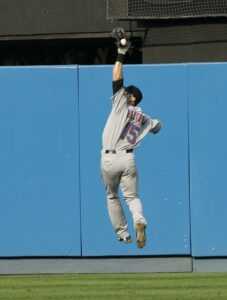
His introduction to the postseason couldn’t have gone better. Beltrán hit .435 with eight home runs in 12 playoff games, helping Houston come within one game of a trip to the World Series. The Astros would win the pennant a year later, but Beltrán had moved on in free agency at that point. He signed what was then a franchise record deal with the Mets: seven years and $119 million.
Beltrán’s first season in Queens was a bit of a disappointment, but he rebounded with perhaps the best season of his career in 2006. He hit a career-best 41 home runs and drove in a personal-best 116 runs with a .275/.388/.594 slash line. Beltrán won his first Gold Glove and Silver Slugger awards while finishing fourth in the MVP voting. Baseball Reference gave him eight Wins Above Replacement for his all-around dominance, the best mark of his career. He remained a force in the playoffs, hitting .278 with a .422 on-base percentage over 10 games.
For the second time in three years, Beltrán’s team lost the seventh game of an NLCS battle with the Cardinals. The ’07 Mets famously flunked the NL East title to the Phillies in September. They would not return to the playoffs during Beltrán’s tenure, but there is no doubt they got their money’s worth from the free agent investment. Beltrán played in 839 games while hitting .280/.369/.500 with 149 home runs over six and a half seasons in a Mets uniform.
The club also yielded a top pitching prospect Zack Wieler when they traded impending free agent Beltrán to the Giants in 2011. He cruised down the stretch with San Francisco, but they narrowly missed the postseason between their World Series wins in 2010 and ’12. Beltrán signed a two-year contract with the Cardinals the following year. He hit .282/.343/.493 during his time in St. Louis, but his impact was once again greatest in the postseason. Beltrán was a great playoff performer both years.
Beltrán signed a three-year contract with the Yankees during the 2013-14 offseason. He remained an above-average hitter throughout his time in the Bronx, albeit without the defensive value he had had for most of his career. He returned to the playoffs in 2016 after being dealt to the Rangers at the deadline. Beltrán ended his career on a one-year contract to return to the Astros.
The final season in Houston left Beltrán with a complicated legacy. He was reportedly an integral part of the team’s sign-stealing operation, which was not publicly revealed until a few seasons afterward. Beltrán didn’t really contribute on the field at age 40, but he collected his first World Series ring as the Astros won their first title in franchise history.
Beltrán’s role in the sign-stealing scandal became public during the 2019-20 season. He had just been hired by the Mets as manager a few months earlier. He resigned and lost his salary when the operation became public. Beltrán has remained involved in the game in less prominent roles, working as a television analyst for the YES Network and spending the past few seasons as a special assistant in the Mets’ front office. He is also responsible for building the roster for the Puerto Rican national team at the upcoming World Baseball Classic.
The sign stealing scandal likely delayed Beltrán’s entry into Cooperstown. His statistical resume made him a very strong first-ballot candidate. He finished his playing days with a batting line of .279/.350/.486. Baseball Reference valued his career at 70 WAR, which doesn’t even take into account his playoff excellence. According to Jay Jaffe’s JAWS stats, he is a top 10 midfielder of all time. Whatever fears some voters may have had about honoring him in the first few years of voting, the end result is that he will head to Cooperstown to cement his legacy as one of the best midfielders to play the game.
That is also the case for Jones, who is ranked 11th among midfielders according to the same JAWS calculation. He begins his ninth year of voting, one season after receiving 66% of the vote. Born in Curaçao, Jones signed with the Braves as an international amateur and flew through the minor leagues. He was arguably the No. 1 player in the game when he reached the Majors in the second half of the 1996 season. Jones transitioned seamlessly to a loaded Atlanta roster that was halfway through their dominance in the National League. They were coming off a championship run and would return to the Fall Classic in ’96.
A 19-year-old Jones embraced the big stage, hitting .345 with a trio of home runs in October. That included a two-homer performance in Game 1 against the Yankees, and he remains the youngest player ever to hit a World Series home run. The Braves won the first game, but ultimately dropped the series in six games.
Jones played primarily right field during his first full season. He hit .231 with 18 home runs in 153 games and finished fifth in the NL Rookie of the Year voting. The next year he really took off and began a decade as the sport’s best defensive outfielder and a premier power threat. Jones hit 31 home runs while hitting .271/.321/.515 and earned his first Gold Glove in 1998. That was his first of seven 30-homer campaigns and, more remarkably, the start of a streak of 10 consecutive Gold Glove awards.
He would start all 162 games for the Braves in 1999, playing elite defense while hitting .275/.365/.483 with 26 home runs and 35 doubles. The Braves returned to the World Series after losing the NLCS in the previous two seasons. They were again eliminated by the Yankees, this time in a sweep. Jones didn’t have great playoff numbers during that span, but remained one of the league’s best players in the regular season. He hit 36 home runs in a 2000 season that Baseball Reference valued at eight wins above replacement, a career high that ranked fourth in the MLB among position players.
Jones earned an eighth-place MVP finish in 2000 and very likely would have finished higher had current defensive metrics existed at the time. He went on to have three more 30-plus homer seasons, falling just shy of that mark with a 29-homer season in 2004. He rebounded with his most impressive offensive performance in 2005, when he knocked down an MLB-best 51 longballs and led the National League with 128 runs batted in. Jones won a Silver Slugger for the first and only time and finished second behind MVP Albert Pujols. It was a narrow gap, as Pujols received 18 first-place votes to Jones’ 13. Derek Lee received the other one.)
The righty hitter continued to be an impact run producer the following season, as he hit 41 more home runs with a career-high 129 RBI. That was his last impact season, as his speed stats dropped in 2007. The Braves let him leave in free agency at the end of the season, and at age 31 he was essentially done as a regular player. Jones played parts of five more seasons between the Dodgers, Rangers, White Sox and Yankees. He has not scored more than 64 goals in any of his last five campaigns.
Although it was a steep decline, Jones had one of the most impressive peaks in baseball history. He hit 368 home runs with a batting line of .263/.342/.497 between his debut and the end of his age 30 season. Retrospective defensive metrics come with significant error bars, but FanGraphs estimates he was about 134 runs better than an average defender during that stretch. That’s 25 runs ahead of second place at every position (Adrian Beltre) and certainly fits in with both his impressive accolades and scouting evaluations that consider him one of the best outfield defenders in MLB history. Jones is one of six outfielders to win 10 Gold Gloves. He’s standing next to it Roberto Clemente, Willie Mays, Ken Griffey Jr., Al Kaline And Ichiro in that company and now, in Cooperstown.
There’s more to come.
#Carlos #Beltran #Andruw #Jones #elected #Hall #Fame