

Bottlenecks in data centers. Valuations at risk.
As we’ve pointed out many times here on the blog over the past year, it doesn’t seem like there’s enough money in the hands of potential customers to pay for artificial intelligence (AI) tools that would give hyperscalers a decent return on their target capital expenditures.
The more they spend, the more revenue and profit they must generate to generate a meaningful return on capital. But the more they invest through capital expenditure, the more competition there will be between them (lowering prices for their commoditized products) or the greater the level of excess capacity (also lowering prices).
And if you think about the companies in this race, capital expenditure (capex) is transforming them from cash-generating, high-margin, capital-light companies whose services have become verbs into capital-heavy, highly leveraged companies.
And I reiterate my concern for stock market investors that the rollout of AI follows exactly the same script that followed the invention of other life-transforming general-purpose technologies such as electricity, the automobile, commercial flights, television and the Internet.
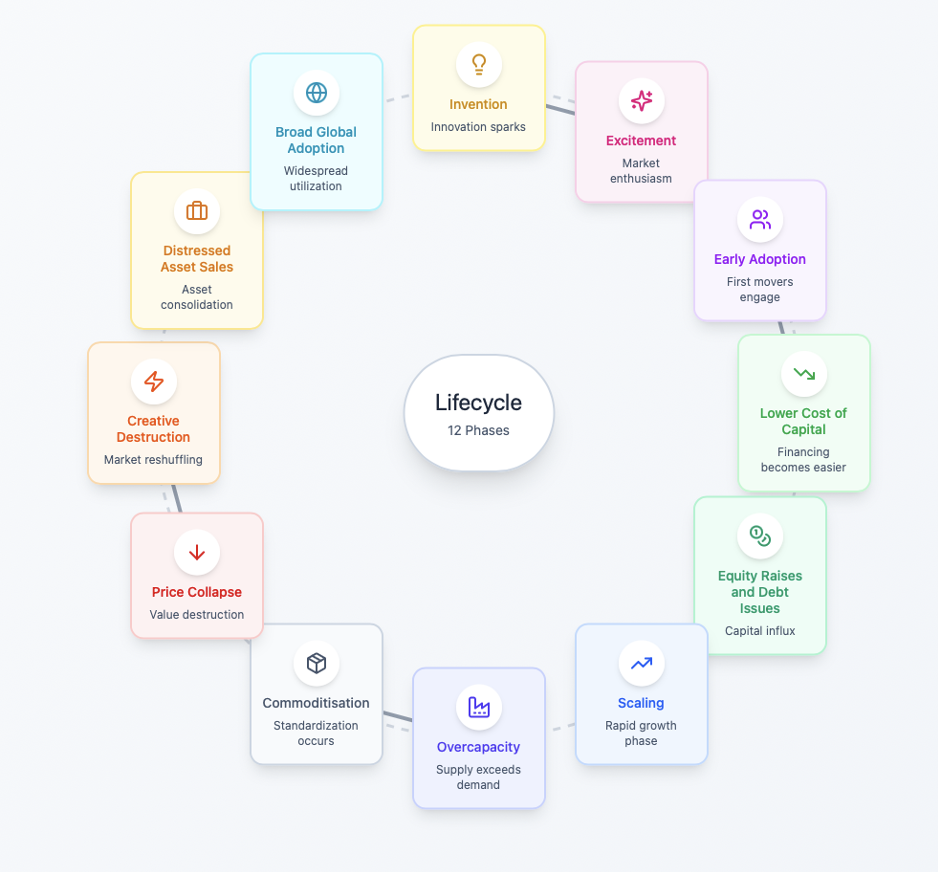
To avoid having to read all of our blog posts from the past year explaining this pattern, here it is:
Invention – excitement – early adoption – lower cost of capital – equity raises and debt issues – economies of scale – overcapacity – commoditization – price collapse – creative destruction – distressed asset sales – broad global adoption.
Figure 1. Lifecycle of General Purpose Technology (GPT).
Source: Montgomery Investment Management
History is replete with examples of new general technology (GPT) companies that collapse before their technology is adopted globally: the inventors first go bankrupt and are then bought by distressed asset buyers who, because they acquired the assets cheaply, can distribute an affordable version and generate a decent return.
It’s also true that when new general-purpose technologies emerge, investors tend to imagine a nice, smooth path from invention to global adoption. They argue that the trend is structural because the technology is inevitable. They are right: technology is inevitable – it will change the course of human history – but while the investment theme is structural, the customer for technology is highly cyclical.
We have long argued that the rollout of data centers is not structural. The rollout will involve cycles, including price, business and economic cycles.
New report: Real-life evidence of cycles
Sightline Climate is a London-based market intelligence platform founded in 2020 by Kim Zou and Mark Taylor. It provides data, AI-driven insights and research to help investors, companies and governments accelerate the deployment of climate technology solutions.
In a report released this week entitled: Data center outlook: half of the 2026 pipeline may not be realized Olivia Wang revealed speed bumps in AI data center rollout.
The power reality (cyclical, not structural)
The saga surrounding the data center sector has reached a fever pitch, fueled by the seemingly bottomless appetite for AI training capacity. However, the Q1 2026 Data Center Outlook from Beeldlijn Climate reveals a significant ‘reality gap’ between announced ambitions and operational reality.
The 2026 pipeline is a mirage. Expect delays of 30 to 50 percent
The headline figure for 2026 is staggering: at least 16 GW of new data center capacity is expected to come online for around 140 projects. However, a closer look at the data reveals a huge bottleneck.
Of the 16 GW planned for 2026, only 5 GW is currently under construction. By 2025, 26 percent of expected capacity was delayed, and 10 percent of projects pushed back commercial operation dates (CODs) without public notice. Many project announcements remain speculative as landowners try to attract prime tenants before securing power or starting construction.
In addition, 30 to 50 percent of the 2026 pipeline is expected to be delayed due to power restrictions, community opposition and equipment shortages.
Therefore, the forecasts of data center real estate investment trusts (REITs) and AI hyperscalers that rely on “announced” pipelines for 2026 may be overly optimistic.
- Hyperscalers are rewriting the high-performance playbook
Perhaps the most important shift for investors is the realization that hyperscalers are evolving from ‘power consumers’ to ‘power developers’.
For example, Google recently acquired Intersect Power’s 10.8 GW solar, storage and gas pipeline. This signals a shift from traditional Power Purchase Agreements (PPAs) to direct asset ownership to accelerate deployment.
Amazon is also becoming a major developer, buying 1.2 GW of solar and storage in Oregon from bankrupt developer Pine Gate Renewables.
Meanwhile, Oracle is pursuing the most aggressive grid-independent strategy, with a pipeline dominated by on-site and hybrid capacity, including a 1GW SMR-powered project in Nashville and the Stargate megaprojects.
Conversely, Microsoft is taking a more cautious approach by terminating leases in 2025 and focusing on smaller centers and restarting large nuclear assets to stay on the grid.
Google and Amazon’s moves to secure power at the wallet level may give them a competitive advantage in a market with limited power, but if the product is commoditized and unprofitable, will that matter?
Regulation – another sticking point
While NYBYism (Not in My Backyard) will push municipalities, counties, municipalities and shires to block or scale back some data center developments, other regulators are disrupting AI investors’ dreams of a smooth 45-degree Northeast path from invention to global adoption.
Investors should also monitor changing regulations that could alter project economics.
As an example, the Federal Energy Regulatory Commission (FERC) is moving toward a final ruling that could allocate 100% of network upgrade costs to data center developers, significantly increasing the cost of entry for new projects.
In Ireland, a moratorium on grid connections has been lifted, but new data centers are now required to install 100 percent on-site backup capacity and source 80 percent of power from new renewable energy sources, changing the economics of supply once again.
If Ireland’s move serves as a global blueprint for network operators managing large loads, the costs could make some data center proposals uneconomic.
The rollout of AI infrastructure is migrating from a structural dream to a cyclical reality. The ‘low-hanging fruit’ of grid-connected data centers is disappearing, making way for a complex landscape energy expertise is just as valuable as computing power.
While investors may prefer hyperscalers and developers with direct ownership of energy assets, their new asset-heavy status and lower return on equity may paradoxically make them less attractive.

He is also the author of the best-selling investing guide to the stock market, Value.able – how to value and buy the best stocks for less than they are worth.
Roger regularly appears on television and radio, and in the press, including ABC radio and TV, The Australian and Ausbiz. View upcoming media appearances.
This post was contributed by a representative of Montgomery Investment Management Pty Limited (AFSL No. 354564). The main purpose of this message is to provide factual information and not advice about financial products. Furthermore, the information provided is not intended as a recommendation or opinion about any financial product. However, any comments and statements of opinion should contain general advice only, prepared without taking into account your personal objectives, financial circumstances or needs. Therefore, before acting on any information provided, you should always consider its suitability in the light of your personal objectives, financial circumstances and needs and, if necessary, seek independent advice from a financial advisor before making any decision. Personal advice is expressly excluded in this message.
#Bottlenecks #data #centers #Valuations #risk