

Also this week, we will be releasing a weekly crypto asset (virtual currency) market report brought to you by SBI VC Trade.
Summary for week 10/19~10/25
- President Trump pardons Binance founder Changpeng Zhao (CZ).
- US President Trump and Chinese President Xi Jinping officially announce that they will meet at the APEC Summit on the 30th
- JP Morgan plans to accept BTC ($115,011.00) and ETH ($4,209.86) as collateral for loans by the end of the year
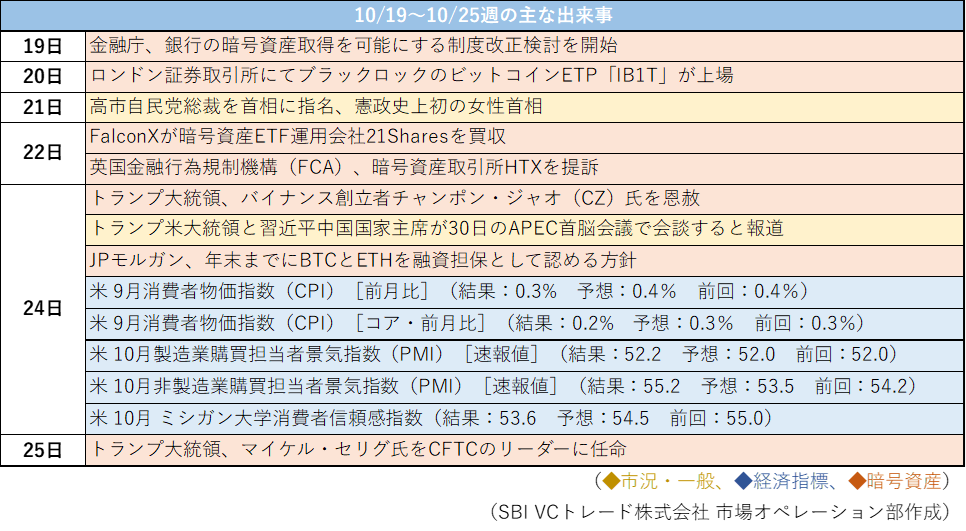
- The September US Consumer Price Index (CPI) is below market expectations
- In spot ETFs, BTC net inflows and ETH net outflows are mixed.
Overview of the crypto asset market
The weekly closing price of BTC/JPY for the week 10/19 to 10/25 was 17,053,600 yen, +5.44% from the previous week, and the weekly closing price of ETH/JPY was 604,705 yen, +2.96% (*The closing price is the midpoint of the EOD[10/266:59:59]company stock price on 25/10).
Last week, the crypto asset market showed signs of recovery, albeit weakly, after the largest liquidation in history, due to increased volatility due to changes in the macroeconomic environment. In particular, there are clear differences in the degree of recovery per share, and this is believed to be partly due to the large-scale liquidation that took place in the middle of this month, which caused a significant drop in investment sentiment among retail investors (individual investors).
Looking at the weekly flows of physical ETFs, Bitcoin saw net inflows of about $400 million, while Ethereum saw net outflows of about $200 million. This suggests that the recovery after large-scale liquidations in altcoins, including Ethereum, has slowed, and this trend is clearly visible in the graph of market capitalization trends over the three-week period from October 5 to 26 (bottom graph ‘Market capitalization trends of each crypto asset after large-scale liquidation, last three weeks’).
The reason for this is believed to be that there is a gap in demand for crypto assets between institutional investors and retail investors. Coinbase is a cryptocurrency exchange mainly used by institutional investors, while Binance Global is a major exchange for retail investors. Institutional investors’ trading ratio in Coinbase’s quarterly trading volume reached 80.7% as of June 2025, and 81.8% during the six months from January to June. On the other hand, on Binance, more than 80% of trading volume in the same period came from retail clients (see chart below, “Binance’s retail client trading ratio trend in 2025”).
When we look at the Cumulative Volume Delta (CVD) Bias charts for both the exchanges and the overall exchange, we can see a clear difference (bias) in the buying and selling behavior of Takers on Coinbase and other exchanges. In this indicator, negative values indicate that aggressive selling is predominant, and positive values indicate that aggressive buying is predominant.[CVD Bias]).
While Coinbase has remained in positive territory, other exchanges have seen sharp negative trends, indicating that while U.S. institutional investors are buying up physical assets, retail investors are selling. This difference has widened to the level at the time of the liquidation of the Encarry trade on August 5, 2024, indicating that retail investor investment sentiment has deteriorated significantly. As a result, capital inflows from institutional investors are considered a major factor supporting the Bitcoin price. Furthermore, institutional investors are mainly focused on investing in the top 10 stocks by market capitalization, while retail investors are more exposed to small and mid-cap stocks, which could explain altcoins’ limited recovery.
Given this situation, you could say that Bitcoin was reacting to the sharp drop in gold prices that occurred on Tuesday, US time. Crypto asset holders whose gold holdings for risk hedging purposes have increased by more than 60% since the start of the year, and it is possible that excess funds obtained from profit-taking sales have flowed back into risky assets such as stocks and Bitcoin. At that point, the price briefly rose to a weekly high of $114,000, but the momentum did not continue and the price was pushed back to $106,000 early Thursday morning. However, Bitcoin recovered to the $110,000 level after President Trump pardoned Binance founder Changpeng Zhao and the official announcement that the US-China summit will be held in APEC on the 30th of this month. In addition, the September US Consumer Price Index (CPI) announced Friday evening was lower than market expectations, raising expectations for rate cuts at next week’s FOMC meetings in October and December, and the $110,000 level is now considered a support line.
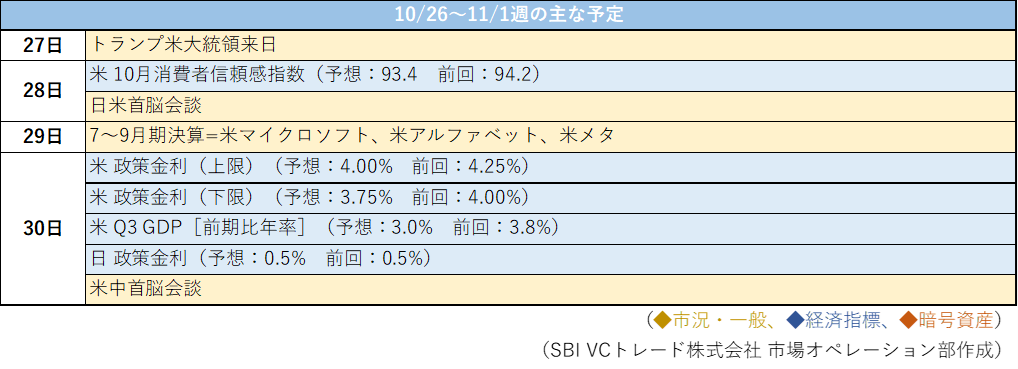
The entire global financial market, including crypto assets, could experience nervous price movements next week. President Trump will visit Japan from the 27th, the Japan-US summit will take place on the 28th, the Bank of Japan policy rate decision meeting will take place on the 30th, and the US FOMC meeting in October will take place. On the same day, US President Trump and Chinese President Xi Jinping will hold a summit on trade negotiations at APEC. If developments deviate from market expectations, high volatility is expected, which means that sound risk management remains necessary.
1) BTC/USD weekly chart (30 minutes)
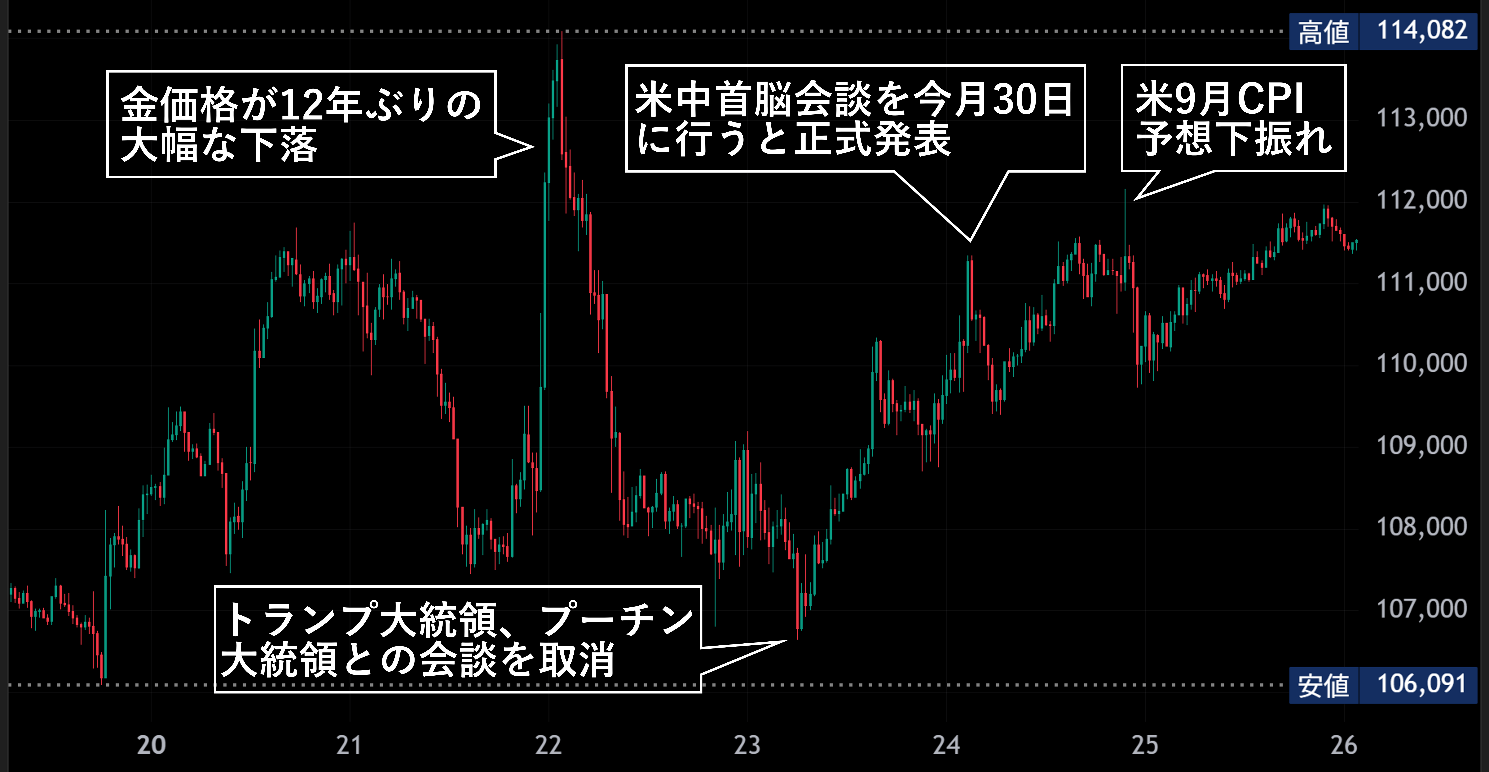 Made by SBI VC Trade Co., Ltd. Market Operations Department using charts from TradingView
2) BTC/JPY weekly chart (30 minutes)
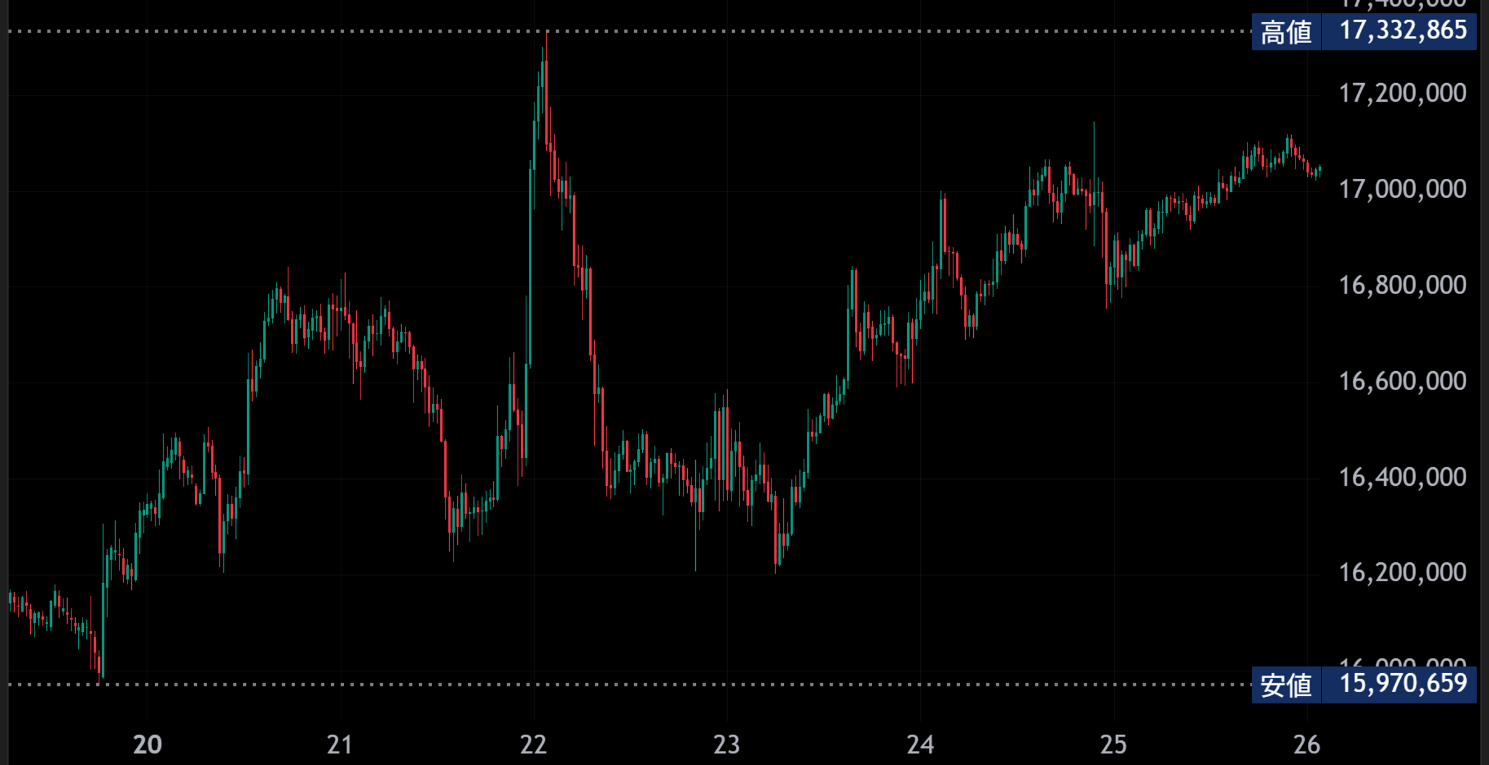 Made by SBI VC Trade Co., Ltd. Market Operations Department using charts from TradingView
3) Bitcoin spot ETF capital inflows and outflows, total assets under management and Bitcoin price
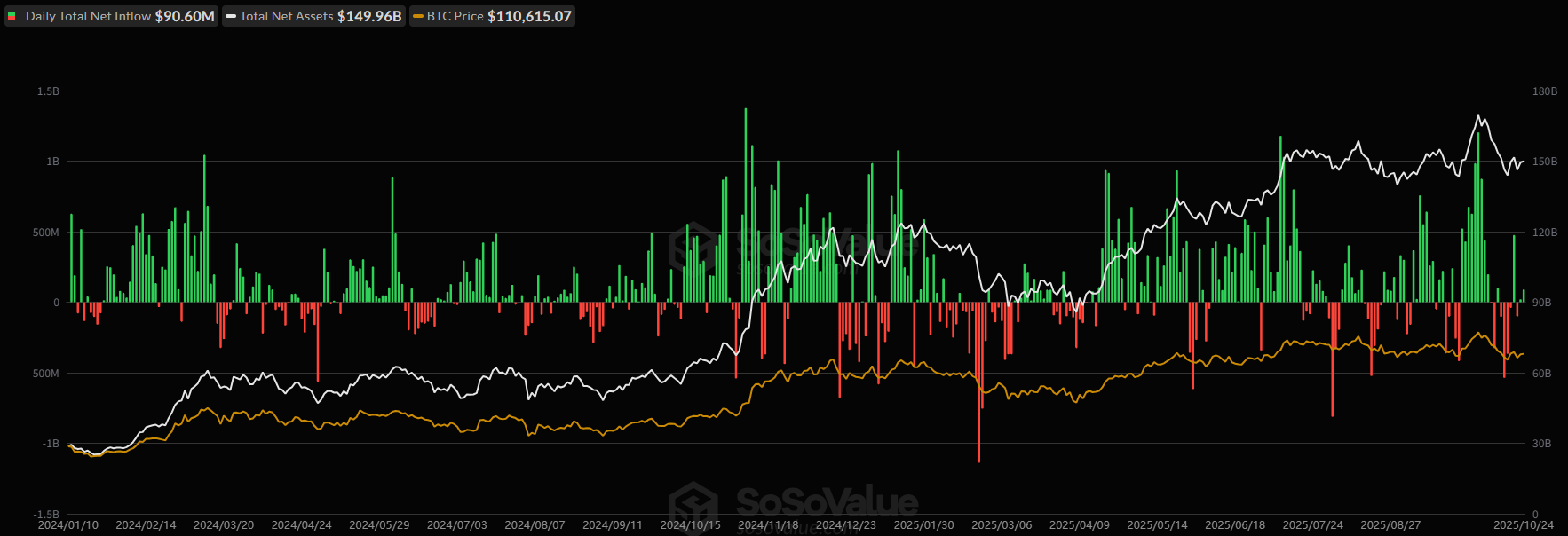 (Green and red bars are the capital inflows and outflows / White line is the total assets under management / Orange line is the Bitcoin price) Based on the chart of SoSoValue Created by SBI VC Trade Co., Ltd. Market Operations Department
4) Ethereum spot ETF capital inflows and outflows, total assets under management and Ethereum price
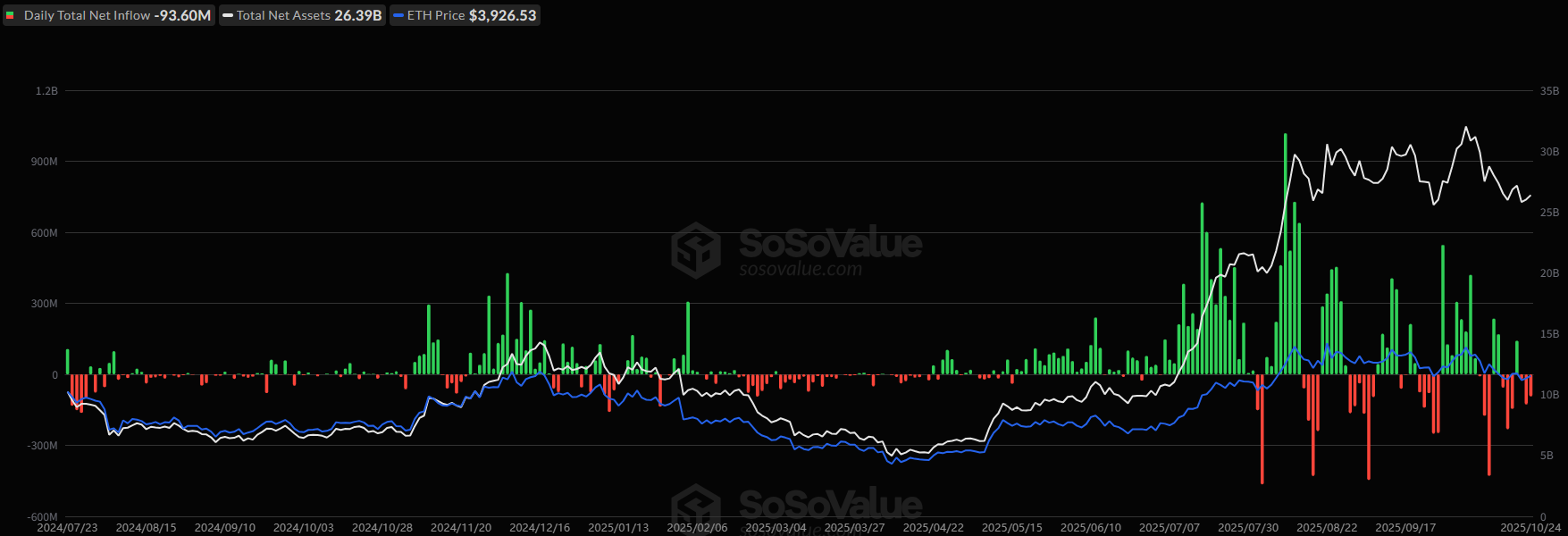 (Green and red bars are the capital inflows and outflows / White line is the total assets under management / Blue line is the Ethereum price) Based on the chart of SoSoValue Created by SBI VC Trade Co., Ltd. Market Operations Department
Market cap trends of each crypto asset after large-scale liquidation, last three weeks
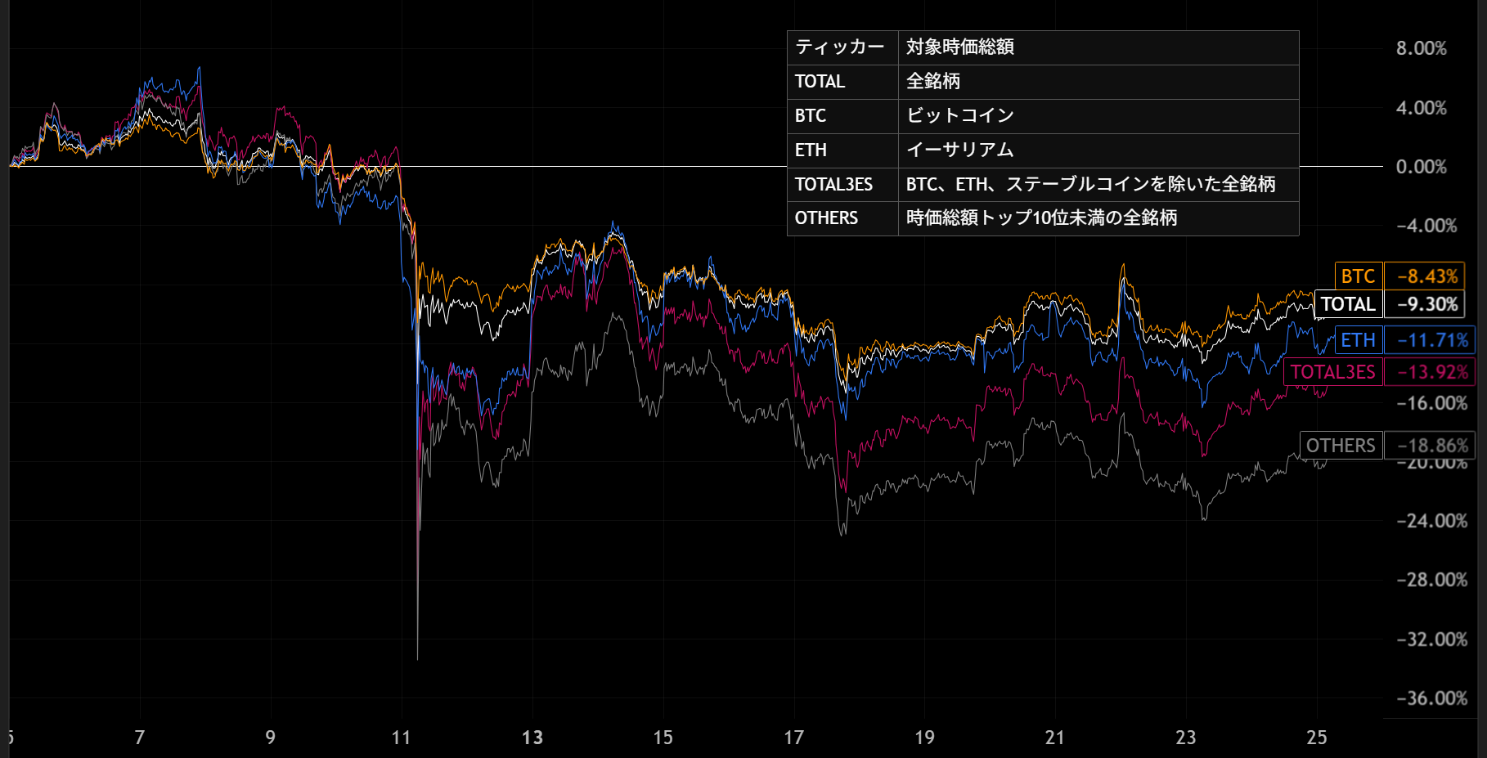 (Market Cap Chart from October 5, 2025 to October 26, 2025) Based on TradingView’s chart Created by SBI VC Trade Co., Ltd. Market Operations Department
Trends in Binance’s Retail Customer Transaction Rate in 2025
 Made by SBI VC Trade Co., Ltd. Market Operation Department based on graphs from CryptoQuant
Trends in the Cumulative Volume Delta Bias (CVD Bias) of Spot BTC on Crypto Asset Exchanges
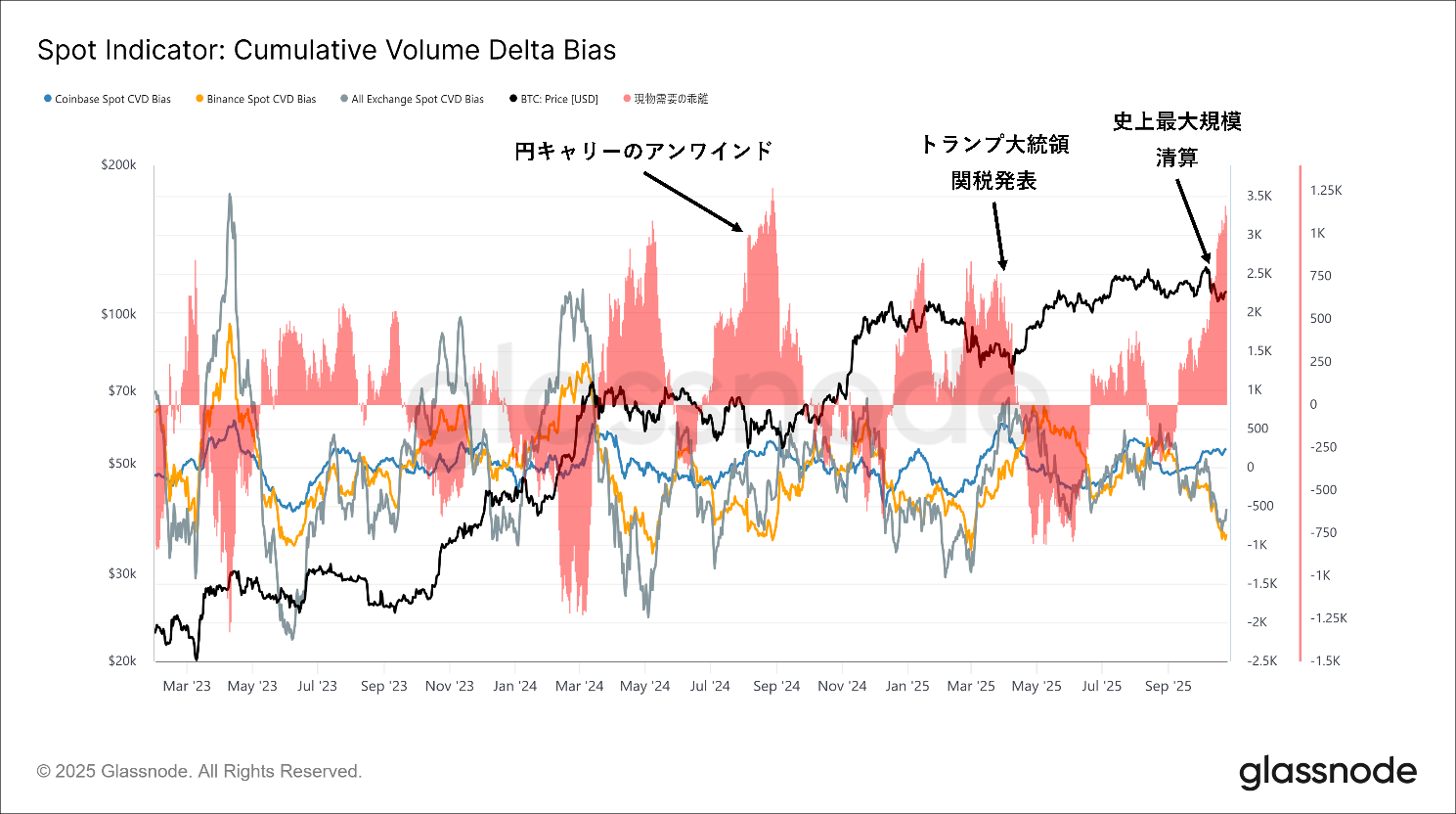 (Blue line is Coinbase spot CVD Bias/Yellow line is Binance spot CVD Bias/Gray line is all spot CVD Bias)
(Red bar is the difference between Coinbase and Binance CVD Bias / Black line is Bitcoin price)
Made by SBI VC Trade Co., Ltd. Market Operations Department based on charts from Glassnode
Main events from 10/19 to 10/25 week
Main plans for week 10/26~11/1
[Het bericht van deze week]The actual value of unlinked assets
This week we look at the real value of unpegged assets amid the growing momentum for fiat-pegged stablecoins.
JPYC Corporation announced the official release of the Japanese Yen stablecoin “JPYC” and issuance/redemption platform “JPYC EX” on October 24 (Friday). The first Japanese yen stablecoin “JPYC” will be released starting October 27 (Monday). In addition, there are reports that Tether will launch a new stablecoin for the US market in the second half of this year, called USAT, which is expected to launch in December and aims to reach a US user base of 100 million people. Stable coins linked to legal currencies are attracting attention.
What must be recognized in this context is that stablecoins pegged to fiat currencies do not threaten to replace other crypto assets. Stablecoins pegged to legal currencies are considered digital assets with high price stability, security and transparency, and their widespread use is expected to contribute to the spread of crypto assets. In general, unpegged crypto assets are said to have high price volatility, and the spread of stablecoins pegged to fiat currencies is believed to play a role in the spread of other crypto assets. On the other hand, stablecoins pegged to fiat currencies and other crypto assets compete in the digital currency payments space. Simply put, although crypto assets are subject to price fluctuations, they do not depend on a central management system and have the characteristics of decentralization, resistance to censorship and free transfer of value, which can be said to compensate for the weaknesses of stablecoins linked to legal currencies, which rely on a central management system. Therefore, we can conclude that a healthy digital currency economy will be formed by stablecoins linked to fiat currencies that grow in a mutually complementary manner rather than monopolizing the market.
Recently, XRP ($2.64) has been re-evaluated in the field of international remittances and liquidity provision, and its technical features that suppress price fluctuations and high payment efficiency are attracting attention. XRP presents a new value transfer mechanism that can achieve both ‘liquidity’ and ‘efficiency’ without being tied to a central management system, bringing the ideal of financial democratization, which crypto assets were originally aimed at, closer to the actual financial system. We believe the value of altcoins with their own ecosystem and real demand will stand out as momentum for stablecoins tied to legal currencies increases.
About this report
This is a weekly market report of the domestic crypto asset (virtual currency) exchange “SBI VC Trade”. We deliver the latest report every Monday.
→Click here for “SBI VC Trade”
Unlike “legal currencies” like the Japanese yen or dollar, crypto assets are not guaranteed in value by any country.
Cryptocurrency assets may experience losses due to price fluctuations.
Crypto assets may lose their value due to the failure of the transfer registration mechanism.
If our company goes bankrupt, we may not be able to return the deposited funds and crypto assets.
There are other points that require attention when trading crypto assets managed by our company. Before entering into any transaction, you should carefully read the “Transaction Terms” and “Document issued before entering into the contract” etc., fully understand the transaction details, structure, risks, etc., and use your own judgment to execute the transaction.
If you lose your private key, you will not be able to use your crypto assets and you may lose their value.
Crypto assets can only be used to pay compensation with the consent of the person receiving the payment.
#Bitcoin #recovery #trend #Analysis #discrepancy #demand #crypto #assets #institutional #investors #retail #investors #Cryptocurrency #Market #Report #issue #BitRss #Crypto #World #News