

In a world where engine sizes and cylinders are constantly being reduced, Aston Martin has consistently given us deafening glory with its V12s. The brand’s current generation of engines, known simply as the AML V12, has been in use since 1999 and appears in Grand Touring and track-focused models across the brand’s range, starting with the DB7.
The DB7 was introduced at the 1993 Geneva Motor Show alongside Aston’s new four-door sedan concept, the Lagonda Vignale. The Lincoln Town Car-based mockup shared both the car’s chassis and its 4.6-liter modular two-valve V8, although the production model would get the brand new V12 that Ford was cooking up.
That V12 was also on display and was presented as a future power source for the Vignale. The concept engine shared the power steering pump, air conditioning compressor and alternator straight from the first generation Mondeo. In addition, the press began to notice weld lines on the block that were not completely hidden. It was no mystery that Ford’s Advanced Powertrain division had been developing the all-new V12 for Aston Martin, but when many in Geneva put two and two together, a huge rumor emerged: was this shiny new engine simply two V6s smashed together?
In short: no. While some features of Ford’s Duratec V6 and Aston V12 are similar, the two engines are far from the same family. However, the engine that would bring the Aston Martin back to Le Mans, and the engine models that were present throughout the brand’s lineup for decades, has a lot more American DNA than you might think.
The name is Ford…
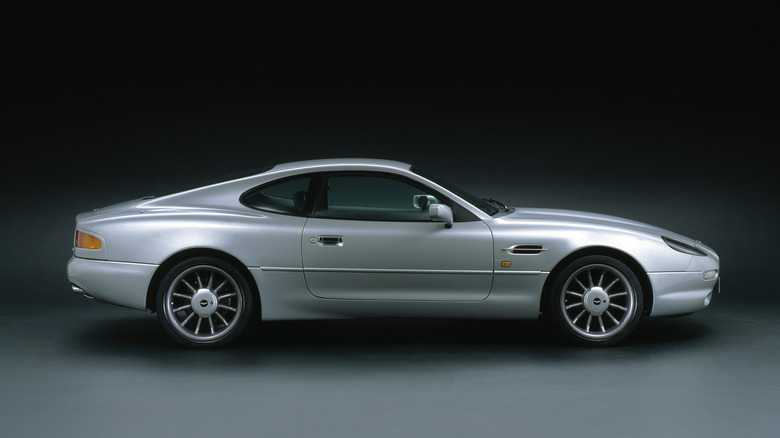
For a while it was a moot point, as Aston’s new grand tourer would debut with a 3.2-liter turbocharged six-cylinder engine. While the Jaguar-built engine produced a whopping 340 horsepower, Ford and Aston knew this would not be long enough, and by the time production began it was decided that the car would eventually need a larger engine.
Ford’s advanced powertrain division was tasked with designing a brand new V12 that would debut in the DB7 Vantage. Built to handle the 24 Hours of Le Mans, the engine had to combine low-end torque and high-end power, while also being future-proof for power gains and racing modifications.
Chief engineer Jim Clarke wanted to use the brand new Duratec V6 as a basis. Heading into its debut in the Mondeo, the 2.5-litre, all-aluminium four-valve engine could have been the perfect foundation for reliability and performance, and in theory could double to form a V12. Engineers at Ford’s design center in Dearborn, Michigan, were already experimenting with the concept of using off-the-shelf parts and joining two Frankenstein engines together, precision welding parts from two of Ford’s modular V8 engines to create a V12, ultimately resulting in the weird and wonderful GT90 concept.
However, for a quick, non-running packaging study, ECS Roush engineers welded together three sections of the V6s to create a concept of how much space the engine would take up. This would be the only incident where Duratecs would be squeezed, as the V12 would move to a purpose-built block. However, it would be precisely this mockup that would find its way to the Geneva Motor Show and inadvertently start a legend that would last for decades in the automotive community.
What’s the difference?
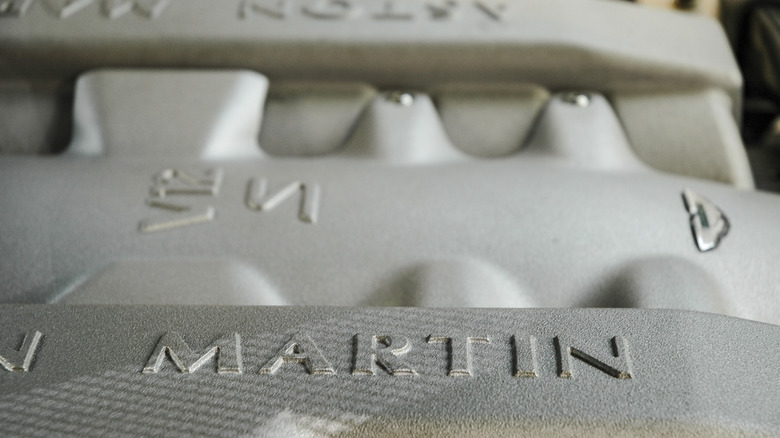
If the engine is indeed different, what is shared between the Duratec and the V12? As described by former Ford engineer Anthony Musci in his summary of the development of the V12 Design Judgesthe celebrities are few and far between. Both shared the same bore and stroke of 3.5 inches (89.0 mm) by 3.12 inches (79.5 mm). Both also have double cams per bank with 4 valves per cylinder. Most notably, some parts are shared between the two, with the piston assemblies and valve line largely identical between the two.
However, that’s where the similarities end. Although the bore and stroke of the two are identical, the V12s’ main bearings have been strengthened to handle the extra power. The cylinder block bank offset for the V12 is also completely different from that of the Duratec V6, as the V12s adopted a ‘common pin’ crankshaft design, as opposed to the ‘split pin’ usually seen on 60-degree V6s.
Speaking of which, the V12’s block and cylinder heads are made from stronger high-strength aluminum than its smaller counterpart. It also has a stronger bottom end, with the deep skirt block and six-bolt mains, making it perfect for higher power and higher revs, compared to the one-piece bottom plate seen on the Duratec. The castings between the engines are also completely different, with the AML V12s having a precision water jacket for cooling and a unique intake port compared to the V6.
While the Mondeo-based engine rumble will go down in history as a rumor, one thing can be taken as fact: after twenty years of evolution, Aston’s V12 can still be traced back to a few guys in Dearborn, Michigan.
#Aston #Martins #V12 #Ford #V6s #glued #FMC #DNA #remains