

For marketing teams, AI means acceleration. For many customers, it’s a ride to someone else’s destination.
Braze’s “Global Customer Engagement Review 2026” paints a picture that should give marketing leaders pause. On the one hand, adoption within marketing teams is almost universal. On the other hand, consumers remain skeptical about how – and why – brands are using AI in their interactions.
That gap is not theoretical. It is already shaping the customer experience.
Nearly all marketers say they use AI, and the vast majority believe it helps them better understand customer wants and needs. AI surfaces insights, predicts trends and enables personalization at scale. Inside it looks like progress.
While 93% of marketers say AI helps them better understand customers, only 53% of consumers believe brands accurately predict their wants and needs. That perception gap cannot be solved with better dashboards.
It signals something deeper: brands believe they are delivering relevance, but customers don’t consistently feel this. And that is important, because perception drives trust.
Your customers are searching everywhere. Make sure your brand appears.
The SEO toolkit you know, plus the AI visibility data you need.
Start free trial

Agents emerge as the middle layer
Another shift is quietly underway. Consumers are starting to use AI as an intermediary between themselves and brands.
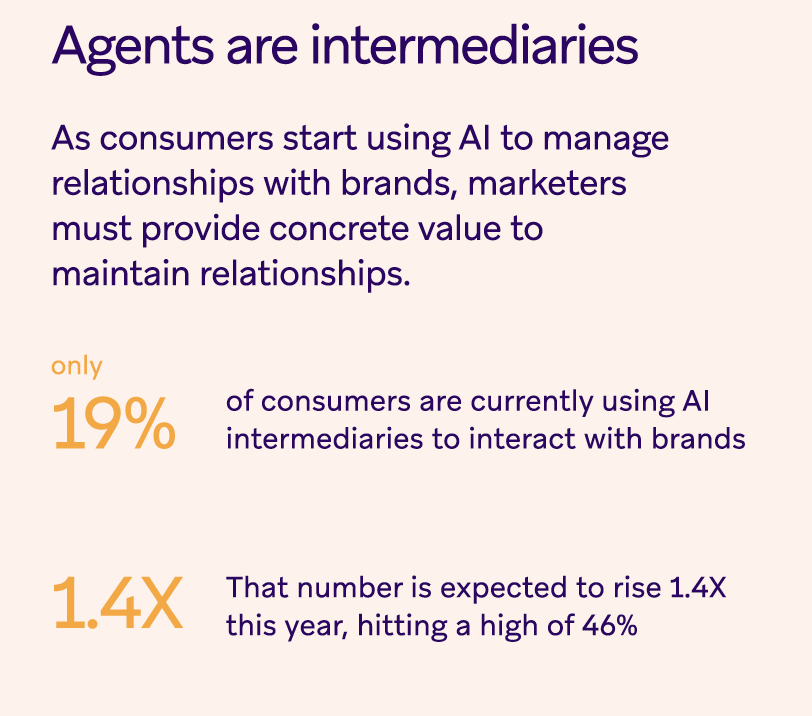
Right now, that number is relatively small, with only 19% of consumers saying they use AI intermediaries to communicate with brands. But it is expected to grow rapidly, rising 1.4 times this year and potentially reaching 46%. That should reshape the way marketers think about engagement.
As AI agents become the primary channel between customers and brands, visibility, value and clarity will be more important than ever. You no longer just optimize search results or email inbox placement. You optimize the way an AI assistant interprets, recommends and prioritizes your brand.
This is where trust becomes a strategic infrastructure.
Marketers are fully committed to AI to drive growth and ROI. At the same time, consumers are sending mixed signals about how comfortable they are with AI-driven engagement.
More than half of consumers expect brands to use AI for self-interest rather than to improve the customer experience. That belief alone can dilute the effectiveness of even the most advanced personalization engine.
In other words, AI-driven engagement won’t work without a human touch and clear proof of value. That could be the defining tension of the next five years of marketing. AI capabilities are increasing. There is no guarantee that consumer confidence will keep pace.
Four possible futures for AI and engagement
The Braze report outlines four possible outcomes:
- AI agents act as a central layer between consumers and brands, helping to create highly personalized experiences tailored to individual needs. That scenario requires trust, transparency and consistent value delivery.
- AI continues to improve technically, but fails to gain public trust. Adoption is slowing, the impact is limited and growth is lagging behind expectations.
- An AI innovation plateau while consumer confidence remains stable. Brands use existing tools, but human strategy and creativity provide differentiation.
- And in the most pessimistic scenario, customers completely reject AI involvement and marketers quietly reset expectations.
Right now we are in a moment of high capacity and low trust. Without deliberate action, the future will likely look the same: powerful tools limited by hesitant users.

Bridging the gap between performance and perception
The brands that succeed will explain AI and show how it improves customer outcomes, not just internal efficiency.
That means demonstrating tangible consumer benefits, such as faster service resolution, more relevant recommendations, cleaner experiences across all channels, and fewer irrelevant messages.
It also means respecting boundaries with clear consent, transparent data use and strong governance.
Many marketers are already seeing meaningful benefits from AI-powered engagement. Productivity has increased. Insight goes deeper. Orchestration is smarter. But the growth curve will flatten unless customers feel that same lift.
The full report can be found here. (Registration required)
#moves #faster #customer #trust #MarTech