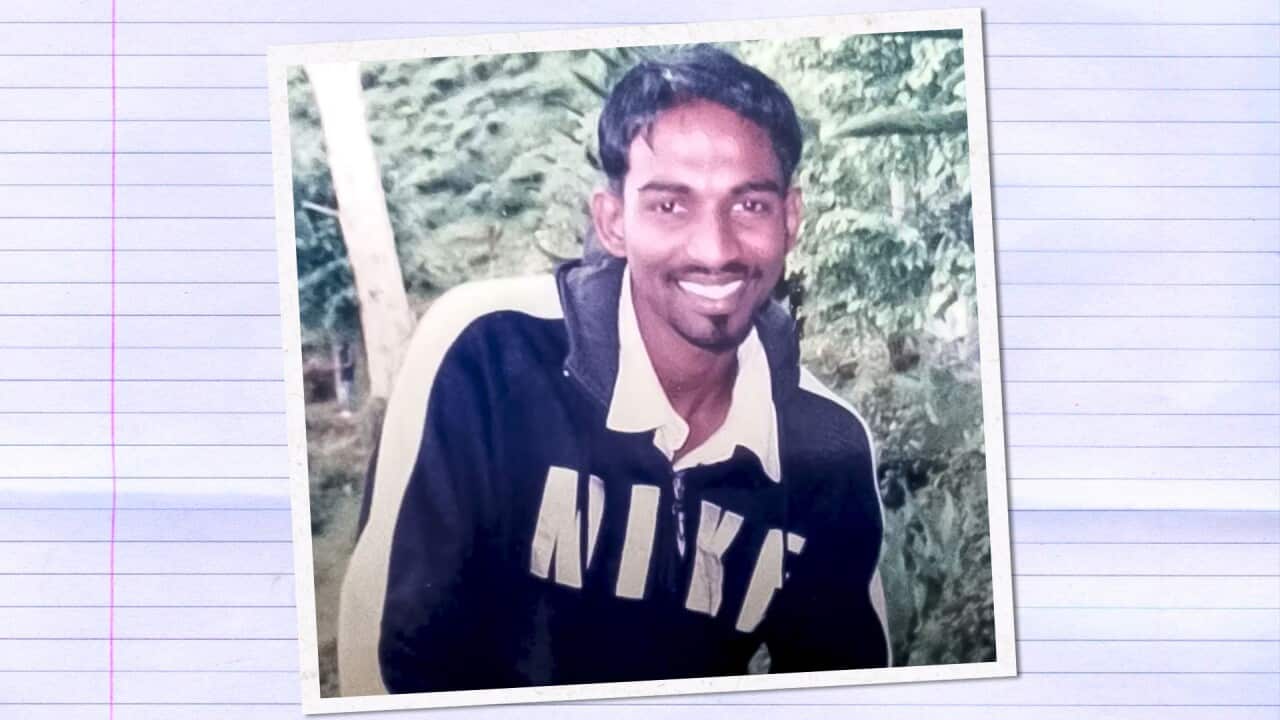
A ‘queue’ for execution: how Singapore’s tough stance on crime resulted in Pannir’s death

A ‘queue’ for execution: how Singapore’s tough stance on crime resulted in Pannir’s death

7 minutes, 2 seconds Read

Singapore’s toughest prison

Death is the courtesy shown to you as a mercy.
This is the first line of a poem called You Die from Within, written last year by then 37-year-old Pannir Selvam Pranthaman while on death row in Singapore.
Pannir was convicted of drug smuggling after 51 grams of pure heroin was found on him at a checkpoint on Singapore’s border with Malaysia. According to Singapore’s Central Narcotics Bureau, three packets containing a “granular/powdery substance” were found on his body and one packet in a compartment on his motorcycle.
It was his first criminal offense, but in May 2017 he was sentenced to death.

For more than eight years, Pannir, his family and activists fought to have his sentence commuted, believing it was disproportionate to his crime. But on October 8 this year, he was hanged by the Singapore government – the twelfth execution this year.

Dateline met Pannir’s sisters Sangkari and Angel in 2024. They regularly traveled six hours from Malaysia to Singapore to see their brother.
“I think Singapore is too strict when it comes to drug-related issues,” Sangkari told Dateline at the time.
“They need to give a second chance to novice committers.”
Both sisters felt that Pannir’s punishment did not fit the crime for which he was convicted.

“Like Singapore [was] If they are really concerned about the people and their safety, they should focus more on the key figures,” Sangkari said.
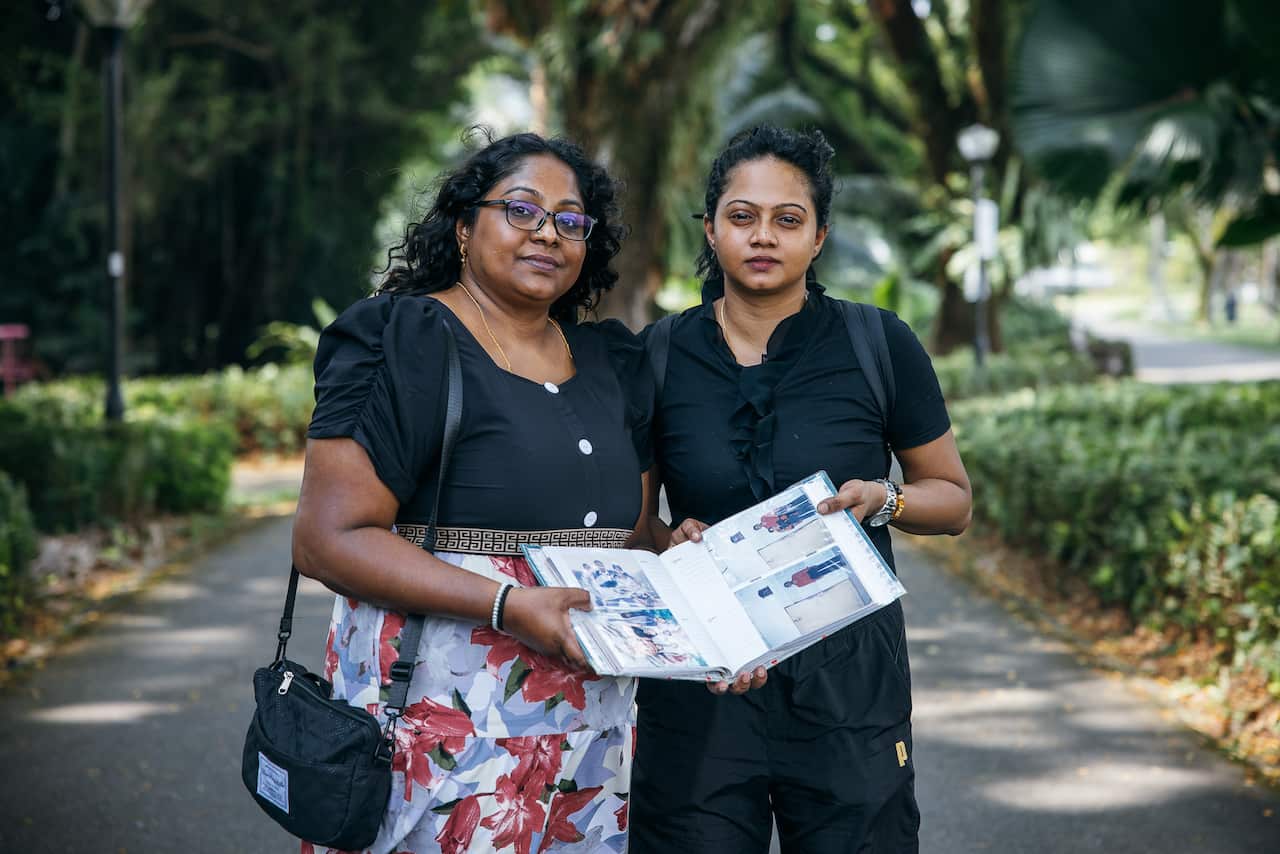
Two women stand on a path in a park and hold open a photo album. They both have a neutral facial expression

Sangkari and Angel fought to change their brother Pannir’s sentence. Credit: SBS dateline

Kirsten Han, a journalist and activist who works with the families of death row inmates, said Pannir’s family worked “incredibly hard” to save his life, including campaigning, lobbying politicians and meeting with media and NGOs.

Since Pannir’s execution, Singapore has hanged two more convicted drug traffickers.
According to Han, one of them was the only woman on death row. A spokesperson for Singapore’s Ministry of Home Affairs told SBS Dateline that it does not publish information about people currently on death row.
In a statement to SBS Dateline, a spokesperson for Singapore’s Central Narcotics Bureau said: “CNB confirms that a man and a woman, both Singaporeans, had their death sentences carried out on October 15, 2025.”

There have been fourteen executions in Singapore this year.

Singapore’s war on drugs

Over the past twenty years, more than four hundred people have been executed in Singapore, mainly for drug offences.
The country’s laws prescribe the death penalty for anyone caught with more than 15 grams of heroin, 500 grams of cannabis, 1,000 grams of cannabis mixture, 200 grams of cannabis resin, 30 grams of cocaine, 30 grams of morphine and 250 grams of methamphetamine.
In certain circumstances, a court may sentence a person to life in prison instead of the death penalty for being found with the above amounts of drugs, under Singapore’s Misuse of Drugs Act. These circumstances may include the public prosecutor declaring that the person has “substantially assisted” the Central Narcotics Bureau in “disrupting drug trafficking activities.”
Amnesty International reported that in seeking leniency, Pannir had argued that he had provided authorities with “substantial information” but that he had not been granted the explanation that could change his conviction.

In 2019, Pannir applied for judicial review of this decision, but this was rejected by Singapore’s Court of Appeal.

In August 2025, convicted drug trafficker Tristan Tan Yi Rui had his death sentence commuted to life imprisonment, although official statements do not indicate this had anything to do with the information he provided.
This is believed to be the first time such a death row inmate has been pardoned in Singapore since 1998.
Both the United Nations Special Rapporteur on extrajudicial, summary or arbitrary executions and Amnesty International had called for a halt to Pannir’s execution. His execution has already been postponed twice, once in 2019 and once in 2025.
“Pannir’s case is emblematic of the many shortcomings in the application of the death penalty in Singapore,” Chiara Sangiorgio, Amnesty International’s death penalty consultant, said in a statement on the organization’s website.

“Under international law and standards, the imposition of the death penalty for drug-related crimes as a mandatory punishment is unlawful.”

According to Amnesty International, only four countries have executed people for drug-related crimes in 2024: Singapore, China, Iran and Saudi Arabia.
Malaysia, Singapore’s neighbor, abolished the mandatory death penalty for a range of crimes in 2023, commuting hundreds of death sentences, although judges there can still impose the death penalty.
Singapore has repeatedly defended its policy of capital punishment for drug offences. The country also prides itself on offering rehabilitation for certain crimes, including for drug users.

But after his death, those who knew Pannir want to make it clear that he was much more than the crime for which he was convicted.

What people think about the death penalty

In a May 2025 response to Australian media reports questioning Singapore’s approach, the country’s High Commissioner to Australia, Anil Nayar, defended the drug laws.
“As a small country with a small population, Singapore is particularly vulnerable to the threat posed by drug trafficking. We are on the threshold of the Golden Triangle – a region the United Nations describes as ‘literally swimming in methamphetamine’,” he said.
The statement also rejected criticism of the use of the death penalty even when relatively small amounts of drugs were smuggled.

“The quantities may be small, but the impact is not,” he argued.

Nayar said research among Singaporeans showed that the majority of people agree that the death penalty is an effective deterrent to drug trafficking.
But activists like Han argue that public support for the death penalty is ultimately the result of a pro-death penalty media and a lack of media freedom.

Reporters without Borders ranks Singapore 123 out of 180 countries in terms of press freedom.

An Asian woman with short hair and glasses stands in an office room, with both hands on a table. She wears a black T-shirt that says 'Not in my name. Abolish the Death Penalty,” printed on it

Anti-death penalty activist Kirsten Han says criticism of the death penalty is not often discussed in the mainstream media. Source: SBS / Adam Liaw

“Critical perspectives on the death penalty don’t make it into the mainstream media… you generally just get government statements that the death penalty works very well,” Han said.

She said the government will then release public opinion polls on whether the death penalty works “and then use that public opinion poll to justify that the majority of Singaporeans want to keep this system in place”.

Pannirs live on death row

When Han first spoke to Dateline in 2024, she said that there is “no murder as good as the death penalty, because the death penalty is murder dressed up as governance.”

After Pannir’s death, she told Dateline that government language used to describe drug traffickers often includes “very dehumanizing rhetoric,” such as calling them “proxy killers.”

In Pannir’s poem You Die from Within, one line describes life on death row as being like “an animal in human form.”
Han believes that dehumanization is essential to supporting the death penalty.
“[The government] The only way we can get away with this is to be very dehumanizing, because otherwise people will see it for what it is, which is that they are killing people,” she said.
She described Pannir as someone who has “worked very hard to make it clear that people are more than the mistakes they have made, and that there is capacity for change, there is capacity for growth, there is a lot of potential”.

While on death row, Pannir began reading and writing, even publishing a book of poetry.
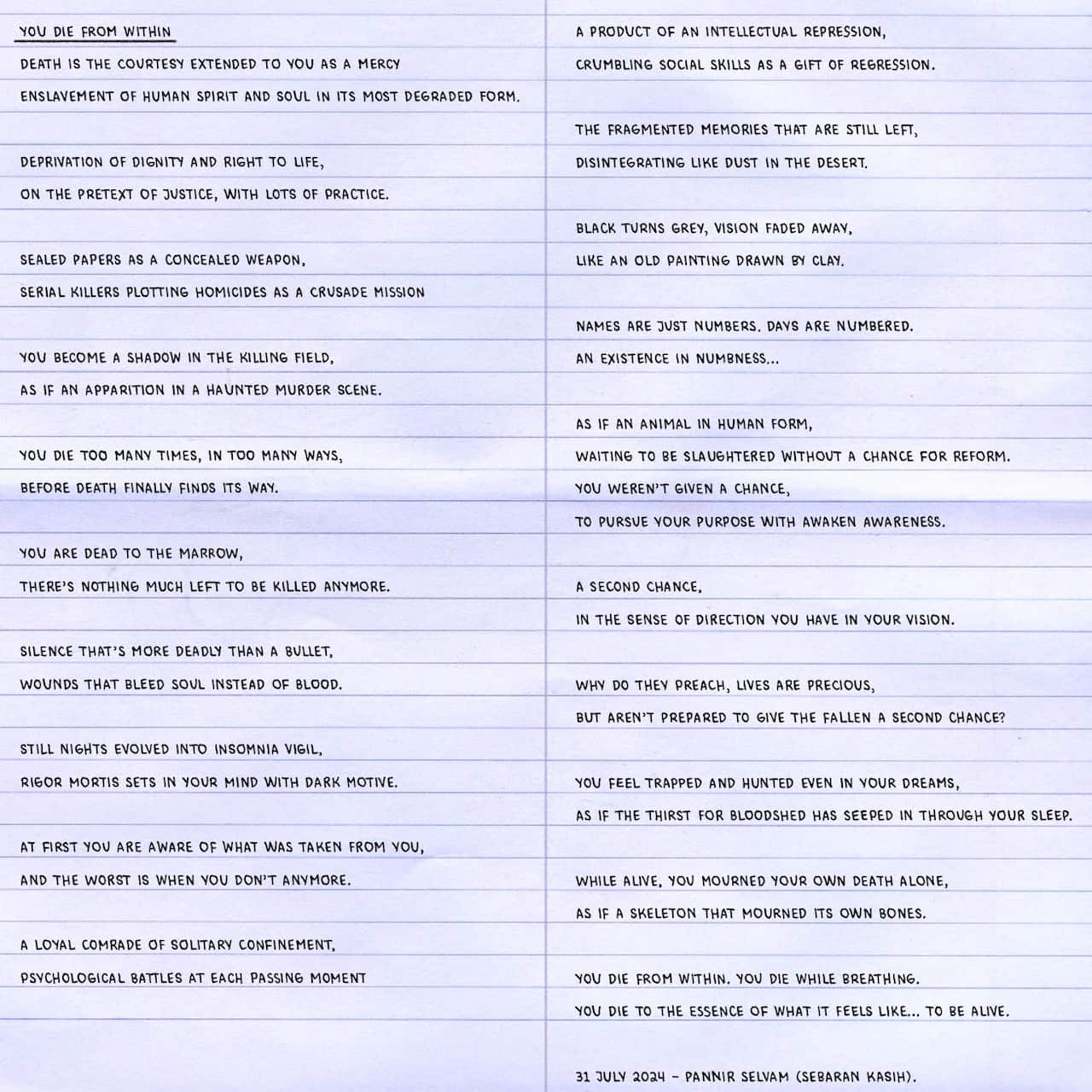
A graphic interpretation of a poem. The full text reads: Death is the courtesy shown to you as a mercy. Slavery of the human mind and soul in its most degraded form. Deprivation of dignity and right to life, under the pretext of justice, with much practice. Sealed papers as a hidden weapon, serial killers plotting murders as a crusade mission. You become a shadow in the killing field, as if you were an apparition in a ghostly murder scene. You die too many times, in too many ways, before death finally finds its way. You're dead to the core. There isn't much left to kill. Silence that is more deadly than a bullet, Wounds that make the soul bleed instead of blood. Still the nights evolved into insomniac wake, Rigor mortis lingers in your mind with dark motives. In the beginning you are aware of what has been taken from you, and the worst part is when you no longer do. A loyal comrade of solitary confinement, psychological battles at every passing moment, a product of intellectual repression, crumbling social skills as a gift of regression. The fragmented memories that remain disintegrate like dust in the desert. Black turns gray, vision blurs, like an old painting drawn with clay. Names are just numbers. Days are numbered. An existence in numbness… As if an animal in human form waits to be slaughtered with no chance of reformation. You have not been given a chance to pursue your purpose with awakened consciousness. A second chance, in the sense of direction you have in your vision. Why do they preach, lives are precious, but are they unwilling to give the fallen a second chance? You feel trapped and hunted, even in your dreams, as if the thirst for bloodshed has seeped into your sleep. While you were alive, you mourned only your own death, as if a skeleton mourned its own bones. You die from within. You die while you breathe. You are dying to the essence of what it feels like… to be alive. July 31, 2024 – Pannir Selvam (Sebaran Kasih).

You Die from Within is a poem that Pannir wrote in July 2024. Credit: SBS Dateline / Caroline Huang / Text provided by Pannir’s family.

When Pannir’s family collected his belongings after his execution, they were given a number of documents, Han said.

“Some of the assets handed over to them was actually his handwritten manuscript for a second book of poetry that he wanted published.”

I look ahead

Han is concerned about the large number of executions that will have taken place by 2025, and the fear that prisoners on death row must feel.
People are executed based on the date of their sentence, meaning prisoners know where they are in the ‘queue’ for execution.
“I’m still a little worried whether we’ll hear more foreclosure announcements in the coming weeks, and that’s possible. And I think if I’m concerned about this, we can only imagine the level of fear on death row.”
Although the media cannot speak to people on death row in Singapore, Pannir’s poetry provides some insight into those feelings.
Why do they preach, lives are precious / But aren’t they willing to give the fallen a second chance?

#queue #execution #Singapores #tough #stance #crime #resulted #Pannirs #death

Similar Posts

Leave a Reply

Your email address will not be published. Required fields are marked *