

In a pre-dawn raid in November 1990, the FBI, armed with arrest warrants, padlocks and chains, seized everything Willie Nelson owned: his golf course, ranches, studio, everything. Only one thing slipped through IRS outline: Willie’s guitar, “Trigger.” Thirty-five years later, Willie still has Trigger. Oh, and he eventually got the ranches, studio and golf course back. Today, Willie Nelson’s nine-hole course, nicknamed Cut ‘N Putt, dances like an old brown shoe through the pine trees in the Austin hills. The parking lot is guarded by what people in the music business call “a silver firecracker”: a big Airstream van that Willie and his friends call Honeysuckle Rose. (Willie has been on the road again, headlining Farm Aid 40 at age 92 and announcing a new, and perhaps final, tour.)
Golf pro Fran Szal, 75 years young, greets all visitors with a wry smile. For pilgrims like my wife and me, who come from far away, he slips in stories as if they were always on his lips.
“They took everything,” Szal recalled during our visit last year, adding with a chuckle. “But not… Trigger. Yeah, we managed to hide that.” We met him near Cut ‘N Putt’s rustic pro shop, which could pass for a set for the 1960s sitcom The Beverly Hillbillies. In a world that needs magic forever, Trigger seems to have powers of his own. Rumor has it that Willie’s daughter helped in the escape. But when pressed, Szal only says, “The family likes to keep some things to themselves.”
The fact remains: on the day the FBI came to take Willie out, Trigger somehow slipped out of bed, made it to the golf course, traveled by mail to Hawaii, and hid until Willie got his house and taxes back in order. (Willie’s daughter Lana may have had something to do with the stamps being properly mailed.) Of all the blessings in the world, the fact that the Federals missed Trigger seems like a story that’s winning the battle with infinity.
Trigger had accompanied Willie’s mellow tone on “Stardust,” the now triple-platinum 1978 album that brought the mainstream to country. Can you look at the endless sky in these hills and not hear Willie’s voice singing Irving Berlin’s “Blue Skies”? Willie wrestled that immortal song into our mortal world, his fingers caressing Trigger, the instrument that spawned so many iconic tunes: “Angel Flying Too Close to the Ground” (1980); “Always on My Mind” (1982); “On the Road Again” (1988).
My wife Monica and I had different reasons for traveling to Pedernales. She’s a fan. But our visit to Willie’s golf course was partly for my research into a book on Indigenous-owned golf courses. (The course is formally called Pedernales, but its nickname is Cut ‘N Putt.)
It’s a little known history that I tried to dig up. The Osage built a track in Pawhuska, Oklahoma, during the oil boom, which no longer exists. The Mescalero Apache course at The Inn of the Mountain Gods in New Mexico, built in 1975, remains a beloved masterpiece. With the advent of gaming in 1988, more than 60 tribes, bands and nations emerged courses built.
Some, including myself, consider Cut ‘N Putt, purchased in 1979, to be yet another early course from Native. After all, Willie Nelson was twice named Outstanding Indian of The Year by the American Indian Exposition. In 2014, he and Neil Young were presented with buffalo robes for their work at Farm Aid and the Oceti Sakowin, Ponca and Omaha Keystone Pipeline protests.
But like others who believe they have native roots in Arkansas and Texas (the states where Willie’s family lived), evidence can be elusive. It is known that Nelson’s mother – Myrle Marie Greenhaw Harvey Nelson – was three-quarters Cherokee. In the story of Texas, the Bullock Texas State History Museum reports this as fact.
In one interview reported in The Encyclopedia of Arkansas, However, Nelson’s mother’s sister, Sybil Greenhaw Young (1923–1999), claimed that it was her mother, Bertha Greenhaw (Willie’s grandmother), who was three-quarters Cherokee. In the same interview, Young also said that her grandmother (Willie’s great-grandmother) was “full-blooded Cherokee” and that Willie’s great-grandfather was “half Cherokee and half Irish.” The encyclopedia separately reports that although Cherokees were known to live in that same area, Willie’s maternal grandparents were listed as white in the US censuses.
None of these ancestors appear in the Dawes Rolls, a historic federal document from 1909 to 1914 that documented the enrollment of members of five tribes, including Cherokees, and neither they nor Willie were ever citizens of the federally recognized Cherokee Nation, which enjoys tribal sovereignty and determines its own membership. Willie himself was born the year before the Indian Reorganization Act of 1934, the New Deal Act.written by John Collier) which led to most tribal constitutions developing criteria for claiming indigenous heritage in the following decades.
Given this history, and given the social milieu from which Willie emerged, it is perhaps not surprising that the Greenhaws and Nelsons have not formally demonstrated descent from a recorded ancestor. Nevertheless, in a 2024 interview with Robert Sheer, Nelson retold the family stories that confirmed his mother’s Cherokee ancestry for him. Given this, the accolades from the tribes themselves, and Willie’s embrace of Native causes, I consider Cut ‘N Putt an early Native-owned golf course worthy of our pilgrimage.

As for Willie’s lineage, it’s clear that he comes from a long line of musicians. And that was the other reason for our visit: my wife’s love for his music. Inside the rustic clubhouse, my bride, Monica, picked up her phone and showed Szal the photo she keeps of her and Willie. They met at the South Shore Music Circus in Cohassett, Massachusetts, in 1992. “When he was younger,” she said.
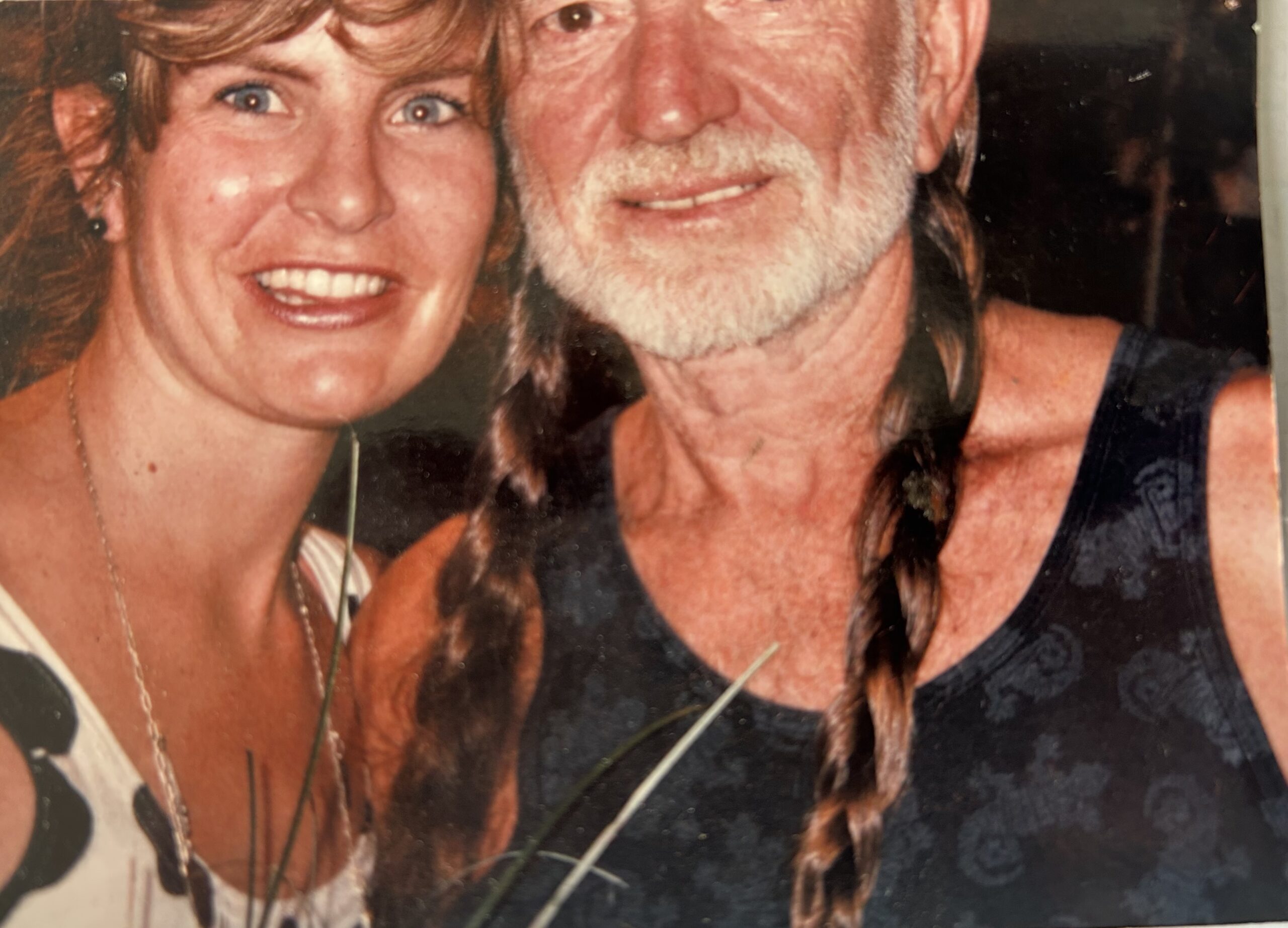
Szal smiled. In the photo, her beautiful face is nestled in Willie’s shoulder. He is wearing a red bandana. Her smile is as wide as Texas. “I asked him who was the first to sign his guitar,” she told Szal. He raised an eyebrow. “Leon Russell,” she said excitedly. Szal then nodded and handed her a golf shirt. The emblem? Trigger of course.
Willie has said that Trigger’s tone “defies explanation.” After his Baldwin acoustic was damaged – in 1969, under circumstances involving Merle Haggard and drinks – Willie bought the nylon string Martin N-20 from a luthier in Nashville named Shot Jackson. He had Jackson take the electronics from his broken Baldwin and install them in the Martin, and Trigger was born as what musicians call a Frankenstein, an instrument made of several, disparate parts.
Szal waved us out the door into a beautiful winter sun. When asked if Willie is good at the insanely difficult game of golf, he said diplomatically, “Willie plays ‘Feel Golf.'” Then he pointed along an unkempt fairway to where Willie built a studio, the same studio the FBI seized and had to return. Szal explained how Nelson’s method became “cut and putt.” Cut a song and play nine of them while the mixers mix. Cut a number and then putt. Then do it all again. The first work produced in this wave method of making music? Stronger than leatherthe 1983 album with the hit ‘Pancho and Lefty’.
I asked Szal to clarify what he meant by “Feel Golf.” After leading another group of pilgrims to the first tee, Szal directed us to Willie’s Rules, hand-painted on burl wood. Among them:
Par is what you set it to.
No more than 12 in your foursome.
Missing balls are considered stolen. (No fine.)
Bikinis Okay.
Szal, my wife and I stood there laughing in the bright light.
Willie and Trigger slowly won their battle with the tax authorities: he paid off back taxes, including by releasing more songs under the title Who buys my memories? And Willie’s things came back to him: the ranch in Austin. Utah ranch. This studio and golf course, where Trigger would do his best work.
Given the seemingly supernatural powers of that six-string, I asked Szal how many years ago Feel wave would become the standard of the game, when bikinis are okay and all lost balls would be considered stolen?
He didn’t dare guess, but I came away convinced. In the end, we would all be better off if we followed Willie’s rules.
#journey #Willie #Nelsons #golf #unorthodox #rules #uncertain #tribal #identity