

- At home
- Opinions about news
- January 21, 2026 – 4 Undervalued Bluechip Stocks to Add to Your Watchlist
January 21, 2026
Stock markets do not move in straight lines.
Even strong companies go through long phases of stock underperformance. The profits disappoint investors and their attention wanders elsewhere. What seemed like a safe bet started to feel uncertain.
Many blue-chip companies have been in this phase over the past year. Growth slowed, expectations were lowered and valuations cooled after years of being priced to perfection.
But this makes them weak companies. It means they are going through a difficult part of the cycle.
In 2026, some of these companies appear to be back on their feet. Costs are under control and balance sheets remain strong. Demand is not increasing, but also starting to improve. The numbers are not dramatic, but the direction is starting to change.
For investors who value stability and are patient, these companies are worth a look. The excitement may be lacking, but the foundation for a comeback is being laid.
#1 Dr. Reddy’s Laboratories
The first on our list is Dr Reddy’s Laboratories.
Dr. Reddy’s Laboratories is a global pharmaceutical company with a strong presence in generics, biosimilars and proprietary products.
The company focuses on the US, India, Europe and emerging markets. The company operates a diversified business, with its US generics business accounting for a large portion of sales, alongside steadily growing non-US markets.
Dr. Reddy’s reported a mixed quarter, with sales largely in line but margins coming under pressure. The sore point was the US operations, where faster than expected price erosion, especially in gRevlimid, weighed on profitability.
Growing operations in Europe and emerging markets helped keep sales stable, but not enough to offset the margin impact.
In the second quarter of FY26, consolidated revenue grew 10% year-on-year (year-on-year). The EBITDA margin fell sharply to 23.3%. Lower gRevlimid sales in the US, higher SG&A expenses and one-time provisions related to a discontinued product negatively impacted margins.
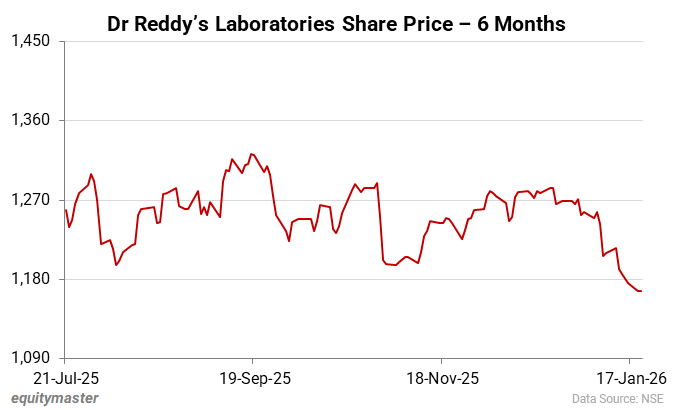
Management expects some pressure in the US in the near term, but expects single-digit sales growth in the US over the next two to three years due to new launches.
Outside the US, performance was stronger. Europe grew sharply and emerging markets grew 14%, supported by new launches and favorable currency movements. Revenues in India rose 13%, better than the industry.
Looking ahead, management aims to soften gRevlimid’s blow. These include launches such as Semaglutide, Abatacept and Denosumab, planned in the period 2026-2027.
While prices, especially for Semaglutide, are expected to be competitive, these products should gradually regain growth momentum. But management expects the impact to be gradual, with earnings growth likely to remain subdued in the near term.
Currently, the stock trades at a price-to-earnings ratio of 17, below the historical median.
If you would like to know more about the company, view the financial fact sheet and the quarterly results.
#2 Infosys
Next on our list is Infosys.
Infosys shares have largely stayed within the range over the past year as the recovery in demand for IT services has been slower than expected.
Enterprise technology spending has been cautious. While transaction activity has improved, investors have not priced in a full recovery.
Operationally, the company has done better than its share price suggests. In the first half of FY26, Infosys achieved consistent foreign exchange revenue growth of 3.3%. The revival was led by a strong increase in major deals, including the NHS contract, along with steady discretionary spending in the BFSI sector.
The industrial sector was stable, but the retail sector remained cautious. Major deal wins reached $6.9 billion, of which over 60% came from new deals, improving visibility beyond FY26.
Margins have remained stable despite higher investments in AI capabilities and subcontracting. This was due to pricing discipline and efficiency gains under Project Maximus.
The operating margin in the first half of 26 was 20.9%.
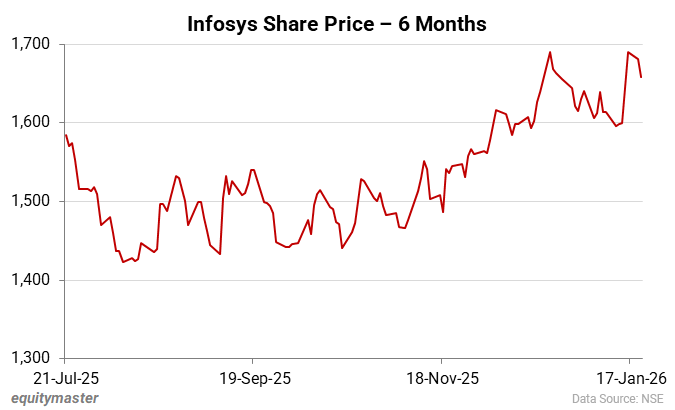
What stood out this quarter was the change in management’s tone. Infosys raised its FY26 revenue growth expectations at constant exchange rates to 3-3.5%. Management also pointed to early signs of demand improvement in BFSI and energy and utilities for FY27.
These are still early signals, but they suggest that AI-led programs are beginning to move from pilots to large-scale deployments.
AI-related work is becoming a bigger part of the conversation. Infosys sees stronger growth in enterprise AI, especially in modernization and cost optimization programs. Several projects are underway, which should help with deal conversion and customer retention.
Infosys’ cash generation was strong. The company announced a buyback of Rs 180 billion along with a higher interim dividend.
Currently, Infosys trades at a price-to-earnings ratio of 24, below the five-year median of 27.
If you would like to know more about the company, view the financial fact sheet and the latest quarterly results.
#3 Energy Finance Company
Third on our list is Power Finance Corporation (PFC).
PFC is India’s largest financier of the energy sector. Over the past year, the stock has fallen 10-12% as investors have become cautious about PSU financials after a strong multi-year rally.
In the first half of FY26, the consolidated loan book grew 10% year-on-year to Rs 11.43 trillion (tn), in line with management’s expectations for the full year. On a standalone basis, loan assets rose 14% year-on-year to Rs 5.61 trillion.
The disbursements stood at Rs 85.994 billion, the highest ever in six months. This was supported by energy distribution, transmission and renewable energy projects.
Margins were stable despite a competitive credit environment. The net interest margin was 3.62%, while the interest rate difference was 2.55%. A marginal decline in the cost of funds supported spreads even as interest rates remained stable.
Consolidated profit after tax grew 17% year-on-year to Rs 16,816 billion.
Asset quality has improved. Net NPA fell to 0.3% on a consolidated level and 0.37% on a standalone basis, the lowest in almost a decade. Gross NPA also came in lower. Now that the stresses of the past have largely been addressed, credit costs remain limited.
PFC’s renewable energy loan portfolio, which stood at Rs 84,679 billion as of September 2025, was further expanded. Renewables now account for around 15% of the standalone loan portfolio. The book has exposure to several sectors, spanning solar, wind and large hydro projects, keeping concentration risk low.
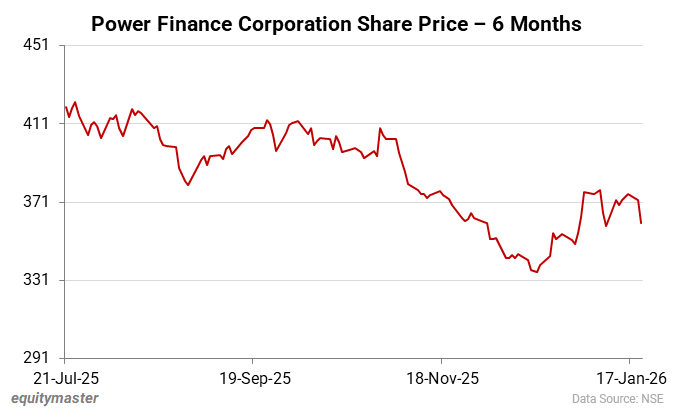
Looking ahead, PFC has reiterated its credit growth expectations of 10-11% for FY26. Payouts are expected to remain stable. This will be driven by energy distribution reforms under the RDSS programme, transmission projects and growing opportunities in renewables and energy storage.
Capital adequacy (21.62% CRAR) remains comfortable. The loans are well diversified and almost 95% of the foreign currency exposure is hedged. This should limit balance sheet risks.
Currently, the price-to-book (PB) price of 0.97 is above the historical median.
For more information about the company, you can consult the financial fact sheet and the latest quarterly results.
#4 Ashok Leyland
Fourth on the list is Ashok Leyland.
Ashok Leyland is one of India’s leading commercial vehicle manufacturers. The company has a strong presence in medium and heavy duty trucks, buses and a growing non-CV portfolio.
After a period of subdued demand, the company’s operating performance improves and signs of a CV upcycle appear.
In the second quarter of FY26, Ashok Leyland’s revenue grew 9.3% year-on-year. This was due to a richer product mix, with aftermarket revenues up 11%, energy solutions revenues up 14% and defense revenues up 25%. The company’s focus on diversification beyond its core CVs is starting to show in the numbers.
The EBITDA margin improved to 12.1%, despite input cost inflation and the transition to AC cabins. This was due to cost-saving initiatives, better price discipline and a higher share of non-CV and export revenues.
Exports grew 45% year-on-year, while volumes grew 38% in the first half of FY26. Management expressed confidence that export volumes will grow at a CAGR of 20% over the next two to three years, driven by demand from the GCC, Africa and SAARC.
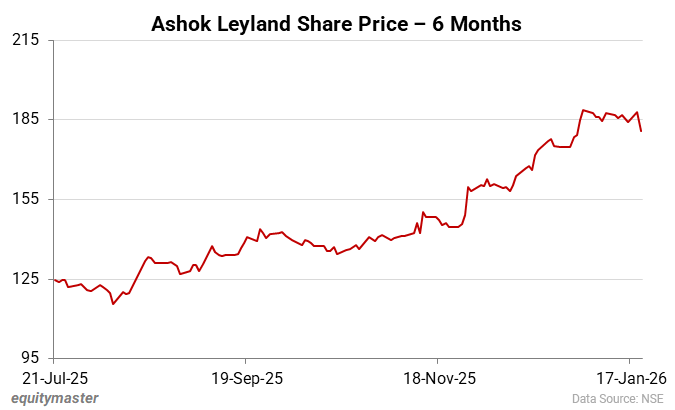
Domestic demand is also becoming favorable. Truck utilization and freight rates have improved. GST rate cuts have reduced vehicle acquisition costs and supported freight demand. Management believes these could be the first signs of a CV upcycle.
Looking ahead, Ashok Leyland is banking on premiumization and new launches to drive growth and margins. The company plans to introduce trucks with higher power and torque in the premium segment to regain market share and improve realisations.
Currently, the stock’s price-to-earnings ratio is 30, slightly above the historical median price-to-earnings ratio.
If you would like to know more about the company, view the financial fact sheet and the latest quarterly results.
Conclusion
Even in markets dominated by short-term trades and rapid sector rotations, blue-chip stocks tend to be the quieter core of most portfolios.
They offer scale, resilience and the ability to absorb shocks when market cycles become uncomfortable.
The real work lies in identifying those stocks where business operations remain intact, earnings are beginning to stabilize and valuations are no longer assuming perfection.
2025 has reminded us that size alone does not protect companies from corrections. But where balance sheets are strong and execution is good, these phases become periods of recovery rather than decline.
For patient investors, this is often the time when the next phase of compounding quietly begins.
Investors should evaluate the company’s fundamentals, corporate governance and stock valuations as key factors when conducting due diligence before making investment decisions.
Have fun investing.
Disclaimer: This article is for informational purposes only. It is not a stock recommendation and should not be treated as such. Read more about our referral services here…
#Undervalued #Bluechip #Stocks #Add #Watchlist