

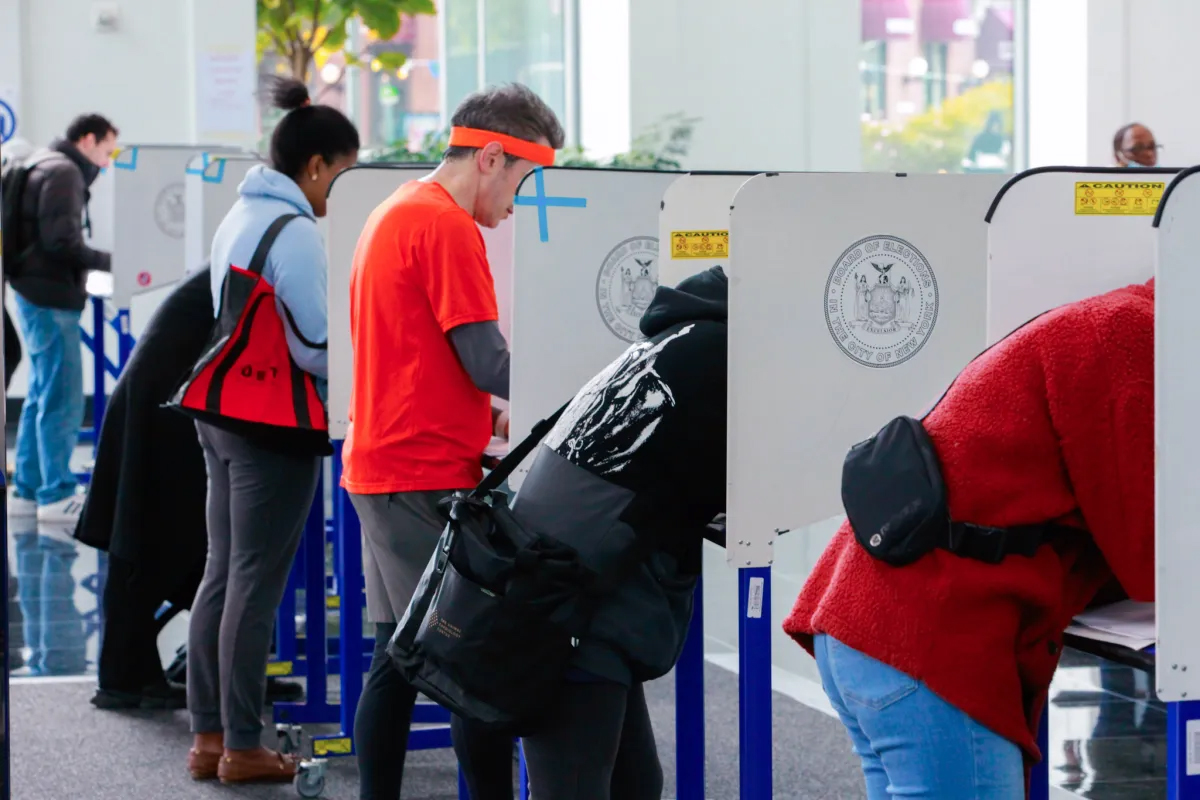
Queens voters cast their ballots in Long Island City for the mayoral election on October 31, 2025. Photo by Alex Krales/THE CITY
This article was originally published on November 2 at 10:59 PM EDT by THE CITY
The numbers are in from the nine-day early voting period that ended Sunday afternoon: More than 732,000 New Yorkers have already cast ballots, accounting for nearly 14 percent of the city’s more than 5.3 million registered voters, according to THE CITY’s analysis of the latest City Council Elections data.
Sixty-five percent as many people have already voted this year as the 1,125,258 total who voted in the 2021 non-competitive general election, where Democrat Eric Adams crushed Republican Curtis Sliwa, who is running for the party again this year.
Early 2025 voting figures suggest total turnout could approach 2 million people — a level the city hasn’t come close to since David Dinkins and Rudy Giuliani faced off in 1989 and again in 1993.
Early voting reached its peak over the final weekend, with 103,597 New Yorkers voting on Saturday, and another 150,053 on Sunday – the two highest turnout days of the early voting period that began the weekend before. Brooklyn accounted for 33 percent of the city’s total early votes, with Windsor Terrace and Park Slope leading the city with the largest share of registered voters who showed up early.
Overall, however, Manhattan showed a greater share of registered voters voting early than any other borough, with the Upper East Side leading the way.
A number of multi-generational households also voted early, including in Jackson Heights, a pan-South Asian enclave and stronghold for Democratic candidate Zohran Mamdani where at least 56 such families cast ballots, behind only the Upper West and East Sides. Washington Heights, a predominantly Dominican neighborhood in northern Manhattan, and Parkchester, the Bronx neighborhood nicknamed “Little Bangladesh,” came fourth and fifth. (THE CITY tallied these figures by counting voters registered in the same apartment unit. A multi-generational household is defined here as households with voters from three or more generations.)
Here are four more takeaways from the early voting data:
1. Boomers led the turnout in the early days, but Millennials closed sharply
Baby boomers, born between 1946 and 1964, maintained their status as early voting leaders through the first six days of the nine-day period – raised doubts among some political scientists about whether Mamdani’s support of younger voters would get him as far as he did in the Democratic primaries.
But Thursday heavy rain showerswhich sharply suppressed early voter turnout for that day, appeared to be a turning point. Millennials, born between 1981 and 1996, cast the most votes of all generations last Friday, Saturday and Sunday. Overall, millennials ended up casting 28 percent of the first votes – just 1 percentage point less than baby boomers, who accounted for 29 percent of those votes.
2. Many early voters are not registered this year
Mamdani aimed at registering voters early in his campaign and attracted thousands who did not vote in previous primaries in June. Many of these new voters showed up again during the early voting period.
People who registered to vote this year made up a larger share of voters — about 8 percent — than those who registered in any other year. Overall, nearly one in five of the 134,066 New Yorkers who put their names on the voter rolls after the June primary cast their ballots during the early voting period.
3. Many working-class voters have not yet turned out
Voters from wealthier neighborhoods were significantly more likely to cast their ballots early. While 17 percent of registered voters went to the polls early in areas where most households earn more than the city median income of about $75,000, only 8 percent of registered voters did so in neighborhoods where most households earn less.
Votes in these working-class neighborhoods were slightly more likely to favor former Gov. Andrew Cuomo during the Democratic primaries than those in higher-income neighborhoods.
4. Voters not registered with a party were the least likely to vote early
The share of registered Democrats and registered Republicans who voted early was about the same: 15 percent. But only 8 percent — or 90,711 of more than 1.1 million — of voters not registered with a party showed up early.
These unaffiliated voters, who cannot vote in the city’s primary elections, in which only party members can vote for their nominees, make up 21 percent of all voters. They are most concentrated in southeastern parts of Brooklyn, where Cuomo prevailed in the primaries, and in northeastern Queens, where Mamdani and Cuomo prevailed. neck and nape.

Related stories
Email tips@brownstoner.com with further comments, questions or tips. Follow Brownstoner further X And Instagramand like us further Facebook.
#takeaways #early #voting #NYC #numbers