

December 12, 2025
Indian space technology is no longer just for scientists or policy experts; it becomes a real business opportunity.
Companies now create radar systems, satellite communications, precision electronics and advanced mapping technology that support every space mission.
Some small companies are creating high-end microwave systems for defense, others are working on homegrown avionics, and a few are building digital maps that future transportation will rely on.
There are also companies focusing on optics and space hardware. These companies may seem small today, but demand is growing quickly… and the future looks promising.
If you are curious about the small companies that play a major role in this sector, read on…
#1 Astra microwave products
First on the list is Astra Microwave Products, a designer and manufacturer of high-performance radio frequency (RF) and microwave supercomponents, modules, subsystems and complete systems, primarily aimed at the defense sector.
The company has a significant and growing presence in the aerospace sector. The company has been involved in the Indian space program for about 25 years.
It supplies critical RF and microwave components and subsystems for satellites and launch vehicles and has contributed to major missions, including ISRO’s recent CMS-03 communications satellite, by providing advanced subsystems such as C-band 15-watt SSPA and Ku-band receiver and converter.
Now the company is strengthening its role in the emerging commercial space market, which is expected to grow significantly.
To this end, it established a wholly owned subsidiary, Astra Space Technologies (ASTPL), in February 2024, which is engaged in the design, development, manufacturing and integration of satellite equipment, including the assembly of small satellites.
The company has set up cleanrooms for satellite assembly at its facility in Bengaluru and is actively exploring options to build and launch small satellites.
It plans to generate revenue from data generation through satellite constellations, and position itself to benefit from global space technology trends that focus on areas such as satellite communications, Earth observation and national security.
Although the defense sector accounts for the majority of its current activities, the space sector is a strategic area for expansion. It adds to the overall order book and reflects the intention to substantially scale up its space-related offering in the future.
In terms of financial performance, the company has achieved revenue growth of 12% compound annual growth rate (CAGR) over three years and a net profit CAGR of 58%. The average return on equity (ROE) over the past three years was 14%.
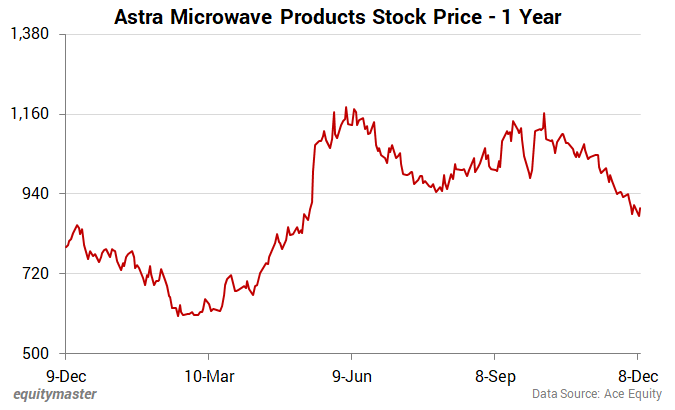
Looking ahead, the company is focused on substantial expansion in the short and long term. The management is confident of achieving revenues between Rs 11.5 billion and 1.2 billion (billion) for the current financial year (FY26).
This target is anchored in an underlying revenue growth expectation of approximately 20% year-on-year.
Management has indicated that it wants to double turnover in the next 3 to 4 years. It is expected that this growth will culminate in Astra Microwave Products becoming a $1 billion company in the long term.
Revenue for FY28 is expected to be around Rs 16.5 billion.
The company aims to book new orders worth around Rs 14 billion in FY26.
Management estimates large opportunities totaling Rs 240-250 billion across all sectors till FY28.
The margin profile is expected to remain stable or improve slightly, mainly due to the favorable shift in the product mix towards higher value domestic activities.
Gross profit margins are expected to remain between 45% and 50%.
Overall, earnings before interest, taxes, depreciation and amortization (EBITDA) are expected to remain above 25% going forward.
The company plans to launch its own revenue-generating satellite, Astra SAT-1, within 24 months.
For more details, please consult the Astra Microwave Products financial fact sheet.
#2 Apollo Microsystems
Second on the list is Apollo Micro Systems, founded in 1985, which operates as a leading provider of electronic, electromechanical and engineering design solutions specializing in high-performance, mission-critical systems for the defense, aerospace and homeland security sectors.
It develops subsystem-level components tailored for space-qualified performance to ensure mission success in orbit, a core competency based on more than four decades of expertise in aerospace and defense work.
Specifically, the company develops and supplies payload settlement systems and ground station acquisition systems for space applications, most notably providing the first indigenous payload settlement system to ISRO, replacing older imported systems.
In terms of financial performance, the company has achieved revenue growth of 32% CAGR over three years and net profit CAGR of 58%. Over the past three years, the ROE has been 8%.
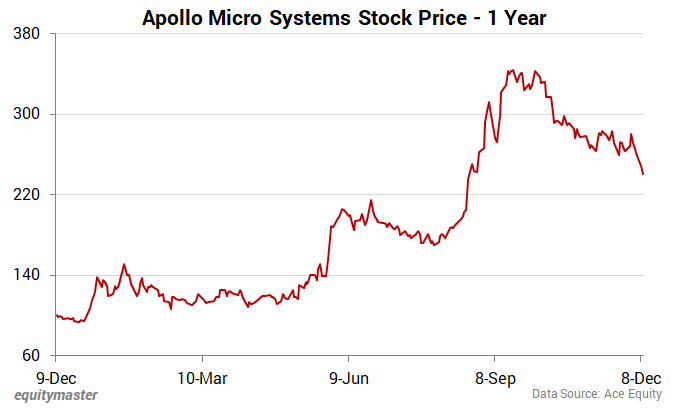
Management expects core revenues alone to grow at a CAGR of 45% to 50% over the next two fiscal years (FY26 and FY27).
Taking into account the recent acquisition, Apollo Micro Systems expects total consolidated revenue to double in FY26.
However, due to ongoing and planned capital expenditure (capex) and facility expansions, management expects margin growth to moderate in the second half of FY26 and into FY27. Nevertheless, the company strives to maintain profitability balance.
An important driver for margin improvement will be the shift to production orders with higher margins. Management expects to convert the mix of 25-30% production currently to 40-45% production projects over the next two years.
Construction of Unit 3 (30,000 square meters Integrated Defense Engineered Systems/IpiDS Plant) is underway, while the Civil Structure of Phase 2 has started.
The total capital expenditure allocated for Unit 3 is Rs 2.5 billion. Unit 3 is expected to become fully operational in the first quarter of 27.
This expansion is expected to increase total production capacity up to eight times current production capacity. Working capital cycle days are expected to decline by around 100-120 days from FY27 onwards.
For more details, please refer to the Apollo Micro Systems financial fact sheet.
#3 Defense and Space Technologies Section
At number three is Paras Defense and Space Technologies, a leading engineering company specialized in both the defense and space sectors.
The company has an all-round capability that includes the design, systems engineering, production, integration and qualification of optical systems tailor-made for space programs.
Notably, Paras is the only private Indian company to have developed and manufactured hyperspectral cameras designed for both defense and aerospace applications, with a hyperspectral camera product designed, developed and manufactured in India and expected to be launched jointly by DRDO and ISRO.
The Optics and Optronic Systems industry’s offerings include ultra-high precision optics for space imaging systems, large space mirrors intended for high-precision imaging in Earth observation satellite systems, and optical reflectors used in rocket and payload assemblies.
Through its wholly owned subsidiary Quantico Technologies, the company is actively developing next-generation technologies in quantum communications and quantum sensing, providing a competitive advantage in space technology.
In terms of financial performance, the company has achieved revenue growth of 26% CAGR over three years and net profit CAGR of 32%. The ROE over the past three years was 10%.
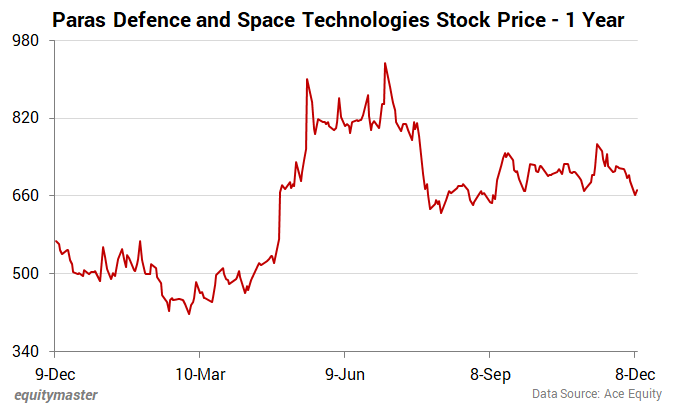
Looking ahead, management aims to tap into a high-quality opportunity funnel over the next one to five years.
The scope of capabilities is significant, broken down by segment: optical systems/drone cameras/periscopes/development projects (20+ billion), advanced electronics (30+ billion), laser systems (30+ billion), and optical telescopes (10+ billion).
For more information, please refer to Paras Defense and Space Technologies’ financial fact sheet.
Conclusion
The companies we just examined are not riding the wave of space technology from the sidelines.
These companies build RF systems, optics, electronics, cleanrooms, satellites and payload technologies that India’s space sector relies on.
These small caps aren’t just space-themed stories. They are engineering-led companies with good order books, increasing capacity and long-term roadmaps.
The benefit is real, but so are the risks. The fundamentals are still important.
It is important to thoroughly research finance and corporate governance before making any investment decisions, and ensure they align with your financial goals and risk tolerance.
Have fun investing.
— Advertisement —
Investing in the securities market is subject to market risks. Please read all related documents carefully before investing
These 3 hand-picked stocks are currently a ‘BUY’
Rich shares with high conviction value
Chosen by Rahul Shah, Tanushree Banerjee and Richa Agarwal
Opportunity ends soon
Full details here
Details of our SEBI Research Analyst registration are listed on our website – www.equitymaster.com
——————————————-
Disclaimer: This article is for educational purposes only. It is not a recommendation and should not be treated as such. Read more about our referral services here…
#Small #Cap #Spacetech #Stocks #Watchlist